[@lexfridman] Iran War Debate: Nuclear Weapons, Trump, Peace, Power & the Middle East | Lex Fridman Podcast #473
![[@lexfridman] Summarizer](https://summaries.pages.dev/img/logo.webp)
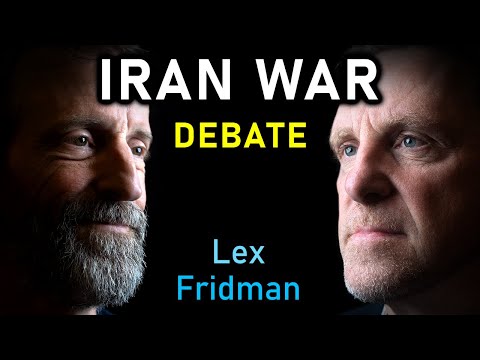
Link: https://youtu.be/gtmJi8LbAts
Short Summary
Executive Summary: This is a lengthy, nuanced debate on the Iran-Israel conflict and Iran's nuclear program between Scott Horton and Mark Dubowitz. They disagree sharply on Iran's intentions, the history of US involvement, and the effectiveness of various strategies, but agree that the situation is dangerous. The main points of contention are whether Iran seeks a nuclear weapon and the impact of US policies on the current crisis, where Horton believes the US makes it worse and Dubowitz that US power can deter.
Number One Action Item/Takeaway: Continue diplomatic efforts with Iran, but acknowledge strong disagreement is key to navigating this complex issue to arrive at a reasonable deal.
Key Quotes
Here are five quotes extracted from the transcript that I found particularly valuable:
-
Scott Horton: "Their [Iran's] position has not been, 'I'm making a nuke so I can wipe Israel off the map.' Their position has been, 'Look, if you guys don't attack us, we could just keep this civilian program the way it is.'" This highlights the argument that Iran's nuclear program is a deterrent, not necessarily an offensive threat, and challenges the more hawkish narrative.
-
Mark Dubowitz: "I think what Kame wants is he wants a nuclear weapon as a backstop for his conventional power... It's very much the Kim Jong-un model of North Korea, right? I'm going to have nuclear weapons with ICBMs to threaten America, but what I'm actually going to do is threaten South Korea with having massive conventional capabilities on the DMZ that I could take South Korea in a week. I could destroy in a week. So, you the United States and South Korea have no military option." This is a concise and powerful explanation of a potential Iranian strategy of using nuclear weapons for regional power projection, rather than direct attack.
-
Scott Horton: "Those sworn loyal to Osama bin Laden and I alsawahhiri ruling Damascus now uh their own ISIS caliphate in our era." This reveals the potential unintended consequences of interventions and alliances in the Middle East.
-
Mark Dubowitz: "It's not about weapons and technology. It's about the people. It's about the men and women who have sacrificed their lives um to serve our country. At the end of the day, if we understand we have adversaries, we're careful about we how we use our military, we understand the importance of foreign deterrence in order to actually confront threats before they become so severe that we ended up plunging ourselves in a war." This shows that despite different political positions about foreign policies and interventions, respecting those serve this country is shared value and core to national security.
-
Dwight D. Eisenhower (from the concluding remarks): "Every gun that is made, every warship launched, every rocket fired signifies in the final sense a theft from those who hunger and are not fed, those who are cold and are not clothed...under the cloud of threatening war that is humanity hanging from a cross of iron." This quote serves as a powerful reminder of the human cost of militarism and the opportunity cost of prioritizing military spending over other social needs.
Detailed Summary
Okay, here's a detailed summary of the YouTube video transcript you provided, broken down into bullet points:
Key Topics & Arguments:
-
Iran's Nuclear Program: The central debate revolves around the nature of Iran's nuclear program – whether it is solely for civilian purposes or aimed at developing nuclear weapons, and the actions that have been taken by Iran, the United States and Israel.
-
Historical Context & JCPOA: Discussion of the historical context of the Iran-Israel conflict, the 2015 nuclear deal (JCPOA), its sunset clauses, Trump's withdrawal, and potential pathways for future negotiations.
-
US Foreign Policy & Military Interventionism: Examination of US foreign policy toward Iran, including the debate on deterrence vs. permanent militarism, the role of the military-industrial complex, and the impact of US interventions in the Middle East.
-
Israel's Role: Disagreement regarding the role of Israel in influencing US foreign policy and the potential impact of Israeli actions on regional stability and the actions taken by Israel on Iran's nuclear progress.
-
Best & Worst Case Scenarios: Exploration of potential best and worst-case scenarios, including peaceful negotiations, military strikes, regional war, and the potential for a regime collapse in Iran.
-
Nuclear Proliferation: Discussion of nuclear proliferation in the Middle East and Asia, in general, if it is more likely to decrease or increase, and its potential implications on international security.
-
Libertarianism & Non-Interventionism: Discussion of Libertarianism. and the non-aggression principle is core philosophical underpinnings.
Detailed Breakdown:
-
Initial Conflict and Ceasefire:
- A debate between Scott Horton and Mark Dubowitz on the topic of Iran and Israel.
- Discussion of a "barely stable ceasefire" between Iran and Israel.
- Brief timeline of events: Trump administration's "maximum pressure" strategy, Iranian negotiations in Oman.
-
Mark Dubowitz's Perspective:
- Trump's policy towards Iran: "maximum pressure," no nuclear weapons.
- Negotiations in Oman: Iran rejected the US offer.
- Israeli strikes against Iran's nuclear program.
- US strike on Fordo: Designed to degrade, not obliterate, the facility.
- Iran has been declared a leading state sponsor of terrorism for multiple administrations.
- The IAEA and the United States went after the detailed archive taken by the Mossad, discovering a program to build five atomic warheads.
- President Trump offered the Iranians, join him in Amman, for another round of negotiations.
-
Scott Horton's Perspective:
- Negotiations were just a pretext for war.
- Trump knew the Ayatollah would not give up enrichment.
- The US bombing of Fordo will incentivize Iran to make nukes.
- A latent nuclear deterrent posture is reasonable for Iran.
- Claim that the Ayatollah is not going to give up all enrichment.
- Heavily implies that there is no credible evidence that Tyrron ordered that Beirut Marine Bombing.
-
The Goal and Red Line:
- Discussion on the acceptable outcome for the US regarding Iran's nuclear program.
- The Iranian regime lied about the number of its nuclear sites.
- Discussions on the JCPOA and whether it achieved its goals.
-
Technical Details of Nuclear Program:
- Explanation of enrichment levels (3.67%, 20%, 60%, 90%) and their significance in weapons development.
- Emphasis on Iran having significant stockpiles of 60% enriched uranium.
- Definition of the "three legs of the nuclear stool": weapons-grade uranium, delivery vehicles (missiles), and warheads.
-
Refutations and Disagreements:
- Horton refuted claims made by Dubowitz, stating they were "completely false."
- Contradictory information about lightwater reactors, plutonium reprocessing, and heavy water reactors.
- Albright's role in supporting initial claim, then debunking warhead dimensions.
- Disagreement on verification of Iranian initial work toward a nuclear warhead.
-
Nuclear Archive:
- Horton claims the archive is a Mossad fabrication based on recycled fake documents.
-
The DNI and Nuclear Weapons:
- Contradictory statements regarding assessment that Iran is or is not working on developing capabilities to deliver a nuclear warhead.
-
JCPoA and Sunset Provisions:
- Long-term sunset provisions for Iran allow the country to retain key capabilities for enriching and reprocessing.
-
The Power of Money:
- Accusations that Trump is influenced by wealthy donors like Sheldon Adelson and that the system is designed for the squeaky wheel to get the grease.
-
Accusations of Lies:
- Claims of misinformation or intentional lies by various governments (US, Israeli, Saudi).
-
Israel's Role:
- That the Mossad (Israeli secret service) has fabricated claims in the archive.
- That the Israelis withheld information from the USA leading to a Beirut truck bombing.
-
Power and Military:
- America uses military force against non-nuclear weapon countries in the NPT and has broken treaties.
-
Al-Qaeda:
- Relationship between Iranias and Al-Qaeda has been long debated.
- America's close relationship with Israel has prompted Al-Qaeda attacks against it.
-
Possibilities for Iran's future:
- Is Kamal going to do a deal, even if the deal means he has to drink the poison chalice.
- What is I don't do a deal and what can I do to squeeze the Americans.
- Was my plan wrong, I was close to having a nuclear weapon in the Ahmadi plan and then there is a chance I could do that again in the future.
-
The Value of Military Deterrence:
- The show made that claim that the United States is so powerful that Iran is afraid to strike for fear of America's power.
- Is America over-learning the lesson after 20 years of mistakes?
- Was the overnight strike on facilities a success for all, with Trump doing what no one else could do.
-
Scenarios for the Future:
- More countries would be incentivized to create their own atomic weapons to guard against their power being attacked.
-
The Power of the IAEA
- Was the IAEA really on top of what was going on at all?
-
Possibilities for Iranian Leadership:
- In the event of the death of the present leaders, they have had the power of it for some time now.
-
Political Considerations for Trump:
-
Who are those who are in his pocket and those whose support he will need?
-
Why hasn't he succeeded in brokering deals to create a better world order?
-
Role of the Power of Nuclear Weapons:
- Those with atomic bombs are not interfered with like those who gave them up.
- What has America done to justify their holding on to the weapons?
-
Closing Questions:
- If the human race blows up in the next 75 years, what needs to be done to prevent that?
- Can the old world, world ways be made to work so we have a better chance of succeeding in the future?
- What in the future is promising and makes you feel like the game is still worth playing?
This summary captures the core arguments and information presented in the transcript. Please let me know if you would like any further details or clarification on any particular aspect.