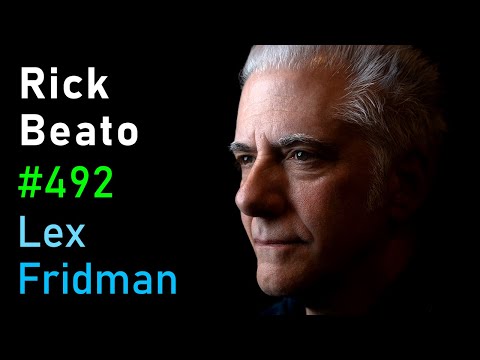
[@lexfridman] Rick Beato: Greatest Guitarists of All Time, History & Future of Music | Lex Fridman Podcast #492
· 4 min read
![[@lexfridman] Summarizer](https://summaries.pages.dev/img/logo.webp)
Link: https://youtu.be/1SJiTwbSI58
Duration: 0 min
Short Summary
Rick Beato's interview highlights his musical journey, beginning with the early influence of Jimi Hendrix and the learning of 'Hey Joe' on the E minor pentatonic scale. He emphasizes the importance of perfect pitch, noting that his son Dylan demonstrated this innate ability through complex ear training tests at age eight. The discussion also explores the 'Gilmour effect,' advocating for a focus on space and melody over technical virtuosity in guitar performance.
Key Quotes
Key Quotes
- "So that is one of the most difficult styles to master, because all these things are a language. Blues playing, they're all just languages, right? It's like, just like you'd learn any type of language." (00:07:28)
- "So, once you're given a reference note, you can use relative pitch to identify the relative nature from one pitch to another." (00:11:33)
- "Thought is the enemy of flow. How do you make sense that Flea, the bassist for the Red Hot Chili Peppers, is influenced by bebop jazz?" (00:42:28)
Detailed Summary
Musical Foundations and Early Influences
- Rick Beato's musical foundation was established early, with his first learned guitar solo being "Hey Joe," which utilized the E minor pentatonic scale over simple E, C, G, D, A chords.
- He and his younger brother John began playing guitar together at ages 14 and 11, respectively, engaging in frequent soloing sessions supported by their mother.
- Beato identifies Charlie Christian, Django Reinhardt, and Andrés Segovia as the three giants of 20th-century guitar influences, with Django known for his unique playing style despite a fire affecting his fingers.
Perfect Pitch and Early Development
- The conversation underscores the concept of perfect pitch, where children are born with the ability to hear all 6,500 language phonemes and identify notes without a reference tone.
- Research by Patricia Kuhl suggests that exposing infants to Mandarin three times a week for 25-minute sessions significantly aids in later language and music recognition.
- Beato's son, Dylan, demonstrated this trait at eight years old by performing a complex ear training test while holding a mouthful of candy, successfully identifying single notes and polychords.
The Gilmour Effect and Technical Artistry
- The "Gilmour effect" describes a preference for David Gilmour's musical approach, characterized by a focus on space, silence, and depth over rapid tempos, mirroring Miles Davis's philosophy.
- Gilmour's technical setup includes a Zoom 9030 rack and collaboration with long-time tech Phil, who has maintained original gear like Binson Echorec and Hiwatt amplifiers for approximately 50 years.
- The discussion highlights "Comfortably Numb" as the top rock guitar solo, featuring a specific early solo that is equally great but often overlooked in broader analyses.
Jazz Evolution and Historical Context
- Miles Davis is recognized as a pivotal innovator who mentored Charlie Parker and led influential quintets in the '50s and '60s, producing seminal fusion and modal records.
- The legacy of high-information music is evident in the exposure to artists like Bach and Keith Jarrett, which fosters social brain connections for language and music acquisition starting at 15 weeks of gestation.
- The historical context of the Moscow concert in 1991 is highlighted as the greatest of its kind, featuring Metallica and AC/DC and attended by up to 1.6 million people.
Practice, Technology, and AI Integration
- A balanced practice schedule of 10 minutes daily over seven days is recommended to maintain motivation and skill development, preventing instruments from remaining untouched for months.
- Modern musicians are encouraged to use AI tools like Suno, Udio, and ElevenLabs for idea generation, with a focus on distinguishing high-quality outputs from AI-generated "slop" through careful curation.
- The integration of high-quality WAV files and specialized audio processing software, such as iZotope RX, supports the creation of authentic sound in the digital age.