[@ModernRogue] Weird Things Podcast #1004 - We Know The Future
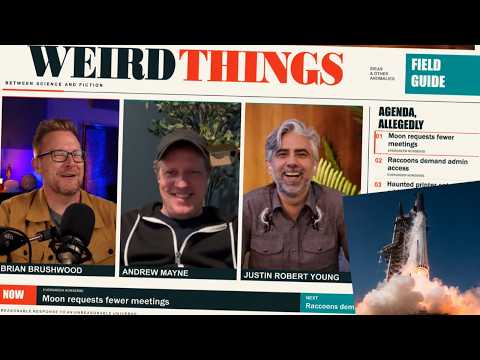
Link: https://youtu.be/DO0E39tHqsE
Duration: 136 min
Transcript: Download plain text
Short Summary
The Weird Things Podcast, hosted by Andrew Maine with Brian Brushwood and Justin Robert Young and later co-hosts Andrew Morton and Tom Merritt, runs a wide-ranging panel episode covering the Jensen Huang/Nvidia leadership crisis and the push for Tim Cook, Google's Gemini data advantage, a same-day SpaceX Starship launch, and a coming fusion milestone before pivoting to picks and a contentious James Gunn/DC debate. Brushwood and Young are former stage magicians who came up in hundred-million-dollar Las Vegas shows before the internet collapsed the career ladder, and here they frame society as moving through only two phases, optimization and disruption. The sharpest moments are the 'Jensen-sized hole' framing, the claim that fusion money will eclipse AI, and the argument over whether James Gunn's studio-head ego damaged DC.
Key Quotes
- "like my brain is literally not wired to conceive of how much faster things get once we drop multiple orders of magnitude in the cost to get to orbit." (00:02:46)
- "The launch by today is trading at 88% yes. Catch the Super Heavy booster, 81% yes." (00:40:29)
- "there there are only two phases that we have in society. Optimization and disruption. That's it. Everything else is noise." (01:11:01)
- "The big reveal is there is one thing that only humans can make, and that is meaning." (01:22:26)
- "Pointing out downsides is not a strategy. It is cope for the fact that we are scared as human beings to walk forward." (01:29:10)
Detailed Summary
Weird Things Podcast — Detailed Episode Summary
Episode Format and Organizing Frame
The Weird Things Podcast episode is hosted by Andrew Maine with Brian Brushwood and Justin Robert Young, with later co-hosts including Andrew Morton and Tom Merritt. Its discussions move from AI, energy, and space to recommendations, a weekly news roundup, and an extended dispute over DC leadership.
- The episode is divided into three broad blocks: a wide-ranging discussion of Nvidia, Gemini, fusion, SpaceX, and AI; a picks and hot-takes round; and a weekly technology and AI news roundup.
- The panel’s recurring historical frame divides society into two phases, optimization and disruption, with most apparent progress involving the refinement of existing systems and major change beginning when those systems are disrupted.
- The panel argued that the “tech oligarchs” possess neither the master plan people imagine nor the power people fear; their power comes from rapidly deploying infrastructure, finance, and products before broader institutions can understand the consequences.
- This framing ties the episode’s subjects together: AI is becoming an operating layer for society, while energy, compute, and human meaning determine whether that operating layer remains sustainable.
Jensen Huang and the Nvidia Leadership Crisis
The episode opens with the leadership uncertainty surrounding Jensen Huang and Nvidia. The panel focused on unresolved allegations, Nvidia’s unusual role in financing the AI boom, and the difficulty of replacing a founder whose influence extends well beyond the title of CEO.
- The hosts contrasted Huang’s situation with Sam Altman’s ouster from OpenAI, arguing that Altman’s removal was tied to concrete allegations of wrongdoing while the Nvidia case still contains major unanswered questions.
- The unresolved issues reportedly included the “Mega Speed” chip controversy, possible violations of export controls, and allegations that Huang cheated on his wife; the panel stressed that the complete story was not yet known.
- The Chinese-chip loophole was reportedly visible before the scandal became public: an article in The Times about a relevant paper appeared in May, while larger rumors emerged in October.
- Huang’s personal wealth was described as closely tied to his Nvidia position, with $15 billion cited during the discussion. Lawmakers who felt constrained by Huang’s relationship with the White House were now bringing him before Congress.
- One panelist suggested that separating Huang from Nvidia could be strategically useful for the company if prosecutors targeted him personally: Nvidia could continue the mission he established while he absorbed the legal exposure.
- Nvidia was characterized as doing much more than selling chips during the AI gold rush; it was lending money and compute to almost every major participant in the AI market, helping the infrastructure expansion reach its current scale.
- With Huang gone, the CFO was reportedly operating the company without a permanent CEO. One panelist said replacing him would fill a “Jensen-sized hole” because there was no second-in-command or prepared successor, while acknowledging that Nvidia’s chips would continue to sell regardless.
Tim Cook as a Potential Nvidia CEO
The most provocative proposal was that Apple CEO Tim Cook should become Nvidia’s next leader. The panel viewed Cook as an exceptional operational and supply-chain executive but questioned his appetite for the kind of aggressive AI expansion Huang drove.
- The President of the United States had stated that the next Nvidia CEO should be Tim Cook, making the suggestion one of the episode’s clearest flashpoints.
- Cook was credited with shepherding Apple’s original chip design and transforming the company’s move toward custom silicon. The counterpoint was that he appeared comparatively incurious or slow on AI compared with Huang’s aggressive experimentation.
- Even with those reservations, the panel endorsed Cook as the best available supply-chain and logistics operator, particularly because Apple had become a $5 trillion company and the most valuable company in the world.
- Apple could apparently write off Project Titan, described as the most expensive EV project in history at roughly $10 billion, while the $3,000 Apple Vision Pro sat largely unused on shelves.
- The panel said Apple’s iPhone neural engine could run AI at roughly a GPT-4 level, and argued that Apple’s chips were better than Google’s TPUs for running AI on phones and Macs.
- A heavy Apple shareholder’s position was that Apple regarded Nvidia as a competitor and might eventually deploy its own efficient architectures inside its data centers. On that view, a Trump or Truth Social attack on Nvidia would not be in Apple’s interest.
Google, Gemini, and the Data Moat
Google’s advantage was presented less as a single superior chatbot than as control of decades of personal, behavioral, and contextual data. Even Gemini’s worse hallucination rate was presented as less important than its unusual access to information users had already supplied.
- Brian Brushwood said he did not trust Meta and had routed his digital life through Gmail for roughly 20 years, so Google’s launch of Gemini gave him little reason to react because his information was already embedded in that ecosystem.
- Gemini was described as 18 times more prone to hallucination than Anthropic’s model, but still “astonishingly useful” because it could draw on Google’s existing information and fill gaps.
- The panel found a Gemini checkout-consent checkbox that had apparently remained selected from approximately 20 years earlier, prompting the observation that “past Brian did it and current Brian is living with the consequences.” OpenAI or Anthropic could not match that advantage without asking users to surrender their data directly.
- Google had circumvented Safari’s Anonymous Mode and Do Not Track settings to continue tracking users. Apple reportedly told Google to stop but did not enforce the demand because Google was one of Apple’s largest customers and a major buyer of search placement.
- Google sat at the center of Android users’ calendars, email, chats, photos, and YouTube, yet the panel argued that it had not produced a clearly dominant new consumer product.
- Gmail, Maps, Calendar, Docs, and Spreadsheets had not materially improved since Google first shipped them, according to the panel. The defense was that people treat them as utilities; the counter was that refusing to innovate leaves a company unable to move quickly when a new category matters.
- On the cited top-free-apps chart, TikTok Pro ranked #1, Muse #2, ChatGPT #3, Claude #5, and Gemini #7, illustrating Gemini’s difficulty as a standalone app.
- Gemini’s standalone rankings were also difficult to isolate because pressing “more” within other Google products could turn Gmail, Search, Maps, or other services into Gemini-powered interactions.
Meta, Muse, and the Personal Assistant Framework
Meta’s device efforts were discussed through the lens of personal assistance rather than another standalone gadget. The central question was whether Meta could build software that understands a user’s surroundings, acts proactively, and functions as a chief of staff.
- Meta sent the speaker a device that let his “Muse” see and interact with an entire local network independently of the user’s computers. He called it “the home link” and described it as the opening act of a summer blockbuster.
- Meta’s history in device software was mixed: Quest was good when it launched, but adding Horizon OS layers was criticized, while the speaker’s Meta Ray-Ban Vision glasses had poor software and a nearly nonexistent developer experience.
- Meta was nevertheless shipping device software quickly, with the approach characterized as “open claw for normies.” The concern was whether the company treated security seriously after years of “it’s your data, who cares?” attitudes.
- The proposed personal-assistant framework required a 360-degree understanding of what a person was doing, the ability to solve problems proactively, and behavior resembling a chief of staff maximizing that person’s interests.
- Possible modalities included Muse, Grok bots, and dots. The panel’s straightforward trade-off was that the more a person disclosed, the more useful the assistant could become.
SpaceX Starship and the Coming Space Age
The same-day Starship launch provided a test of SpaceX’s progress toward reusable launch systems. The discussion connected booster recovery to the larger possibility of routine spaceflight, settlement on Mars, and industrial activity in orbit.
- One panelist estimated roughly 60% confidence that SpaceX would catch the Starship booster. Another said he had no sound basis for a prediction and had expected SpaceX to achieve the feat two years earlier.
- That skeptical panelist pointed to the “Mecha Godzilla” booster and the gantries displayed on SpaceX’s website as evidence that the hardware and ground infrastructure already existed.
- The launch-day PolyMarket odds were 88% for a launch, 81% for catching the Super Heavy booster, 47% for catching the Starship upper stage, and 18% for the booster exploding.
- Blue Origin was working on reusable rockets, while Rocket Lab was pursuing its own program. Two larger competitors and several smaller companies were also active, making a reusable-launch market more plausible than before.
- The panel argued that dependable reusability would turn the space age into a genuinely viable industry rather than an occasional series of spectacular but expensive launches.
- The logical sequence described was heavier Starship activity, followed by people going to Mars, then construction of a space station as an industrial center in space.
- SpaceX had been able to move at its current speed partly because the White House intervened and treated the company as a national-security interest.
The Coming Fusion Milestone
Fusion was treated as a near-term technological threshold whose arrival could alter information flow, energy markets, and the relative importance of AI. AI was also presented as an enabling tool for fusion research rather than a competing story.
- The main forecast was that a major fusion milestone could be seen within the next 24 to 36 months, while one formulation of the discussion described the possibility as arriving “24 to 36 hours” from now.
- The defining milestone was a sustaining fusion reaction that produced more energy than was put into it, rather than a brief experimental reaction that did not reach net energy.
- The panel cited multiple companies pursuing different technical strategies, including Helen and Commonwealth.
- Mathematical work from OpenAI, Anthropic, and Google was already being used by people at fusion laboratories because fusion research requires accurate predictions about plasma behavior.
- The panel’s most contrarian forecast was that the money and effort devoted to fusion would eventually eclipse AI.
Gulf Capital, Fusion, and the Threat to Oil Economies
The Gulf states were discussed as potential leaders in both fusion investment and data-center construction. Their advantage was capital and existing energy infrastructure, but fusion could also make their traditional oil exports strategically obsolete.
- Speaking as if he were running the Saudi sovereign wealth fund, Brushwood said the larger fear for an oil-exporting country was not merely competition from renewable energy but fusion making nearly free energy and rendering petroleum exports obsolete.
- He connected that argument to Thomas Friedman’s The World Is Flat, arguing that countries rich in minerals or natural resources can fare badly when they fail to develop human skills, citing Hong Kong and African rare-earth deposits under dictatorship.
- Building a Dubai crowded with think-tank conferences was described in two ways: as a grotesque use of natural-resource wealth under an authoritarian government and as a sensible hedge against remaining only a “gas station pump.”
- The UAE, Saudi Arabia, Qatar, and Oman all had major data-center projects underway. The panel cited Saudi Arabia building six gigawatts and the UAE planning a further five, alongside substantial investment in American AI companies.
- Europe—possibly Norway or another oil-producing nation—was expected to join the fusion effort because of the appeal of energy independence and eventually free energy.
- If fusion arrived on the panel’s timeline, information flow could change as radically as it had between 2003, associated with the birth of social media, and 2006.
- A head of state had met the speaker and asked for the name and details of a fusion company involving a prominent Silicon Valley figure, indicating an interest in investing before seeing a financial return; that figure’s assistant had been dispatched unusually quickly.
- The panel anticipated opposition from interests that did not want mass proliferation of fusion, including algorithmic campaigns claiming that fusion energy causes eye cancer. A prominent climate organization was also reportedly repositioning itself as an anti-data-center organization.
- The speaker, who runs the largest paper-manufacturing company in the northeastern United States, said he would fight for a data center if it could cut the company’s electricity bill in half within five years.
- Oil companies were expected to invest in fusion because they already possessed the industrial footprint and technical expertise, while China was expected to spend money obstructing U.S. efforts to industrialize the technology.
Compute, Data Centers, and the Energy Bottleneck
The panel’s economic thesis was that AI would make compute demand effectively unlimited just as data centers made energy infrastructure more constrained. Historical patterns suggested that scarce resources tend to attract capital, permitting reform, and new technical solutions.
- Demand for engineering labor was expected to rise as data centers continued to be built and factories adopted robotics, with electricians and other workers able to handle technical construction in especially high demand.
- The panel offered a recurring pattern in which humans continually move the goalposts: babies can never be healthy enough, the elderly can never die with enough dignity, data centers can never be quiet enough, and energy can never be efficient enough.
- In that framing, demands for greenness and pleasantness can become a form of job security, preserving the human labor involved in enforcing them.
- Frontier AI models were described as wishing wells, but the coming shift was toward AI continually acting for people and entering every layer of decision-making. The panel’s conclusion was that compute demand would become effectively infinite.
- Historically, compute had consistently been the scarce constraint rather than the surplus; the panel noted that a true surplus of inference had never occurred.
- Data-center power demand and the financial incentive to keep building could drive grid expansion and approvals for smaller nuclear reactors.
- The data-center water revolution had occurred roughly 15 years earlier and had been driven by high water bills rather than by moral or environmental concerns.
- Robotics was expected to produce “spiky” gains, with individual companies capturing most of the value, but by 2036 it would become a significant part of the economy. In ten years, major employment categories were expected to include robotics, energy and fusion, space-based work, and health rather than AI alone.
- Andy Jassy was credited with turning AWS from Amazon’s biggest expense into one of its biggest profit centers by managing spending.
The Vibe-Coded Game and “Is This Worth Existing?”
A deliberately elaborate browser game became the episode’s test case for evaluating seemingly wasteful computation. The discussion moved from the game’s creative excess to the broader problem of comparing a marginal project against the alternative use of energy.
- The game at tennis.fingerpunch.com was created using Fable 2 and “Fable 5.2.” It evolved from Pong into 3D Pong, with an anime interlude, a hyper-Tokyo setting, a Mandelbrot-fractal sequence, a Windows 95 blue screen, Multiball, and Monster Rally.
- A chat participant named “urinator” argued that the game consumed roughly the energy of 10 households for one day to create something perhaps 100 people would play, although it might receive thousands of views.
- Justin Robert Young replied that he was not in the business of deciding what should or should not exist. He argued that history judges people who make that kind of decision poorly and that a silly thing around the corner can often lead to something miraculous.
- The panel introduced “compared to what” as the essential phrase for evaluating zero-sum tradeoffs, drawing on How to Have Impossible Conversations by Peter Begoian and Alex Lindsay.
- Another participant was reluctant to debate entirely inside that framework because some of the underlying energy metrics were believed to be misinformation, making a precise cost-benefit calculation impossible.
- The panel conceded one exception: if permitting failures caused mass blackouts and severe grid problems, the calculus would change, and a “five finger pong” could become “a foot on the neck of humanity.”
- Society was not yet at that point. Measured in “days of power,” the panel’s answer was that progress requires more of everything at all times, comparing the choice to carrying a phone rather than a much larger computer.
- Young also asked Astra to produce an English-language version of a palindromic Chinese poem discussed before the episode, without knowing how much computation the request consumed.
Poets, Pioneers, and the Future of Work
Justin Robert Young’s framework divides humanity into “poets” and “pioneers.” The exchange tested whether art and status competition could remain meaningful once technology makes both creative production and planetary expansion vastly easier.
- Young’s framework says humans will become either poets or pioneers. On Earth, people compete for status rather than calories because basic needs are increasingly met by machines.
- Status competition will be difficult because others can outmaneuver anyone at rapping, video games, and other attention-based activities. Those who opt out can instead compete at being good audience members, creating balance inside the “petri dish of Earth.”
- Beyond Earth, the pioneer role would carry the same westward-expansion and colonial impulse that historically drove exploration and settlement.
- A counter-argument said HOAs would not disappear, poets already existed as influencers on TikTok and Instagram, and status would remain scarce because there were only so many first-class train seats, Broadway seats, and desirable soccer seats.
- The same counter-voice said robots would not be playing football, while longer human lifespans would make existence more interesting rather than empty.
- Young noted heavy discussion of p(doom) that week, including the claim that 10% of people would die because of AI mistakes. He characterized the disagreement as ideological competition over where to set an “acceleration knob.”
- In a clip addressed to “urinator,” Young said questions about what “tech oligarchs” would permit were not answerable. He told people to “stick your fingers down your throat and cough up the black pills,” compared future speculation to an agrarian European farmer trying to infer how Disneyland would operate, and urged listeners to live fruitful lives.
- Ted Kaczynski was cited as proof that a person could leave the grid and live on very little, as people did roughly 100 years earlier, but nobody wants that level of simplicity. Even if all future needs were automated, opting out of making money would still mean losing access to luxuries such as large parties.
- The blunt answer to the chat question about an endgame in which everyone stays home creating art and learning was that big tech would not allow it.
Meaning, Education, and the Human Edge
The panel’s answer to what remains distinctly human was not a particular task but the creation of meaning for other people. Education and access to tools were discussed as ways to extend that capacity, especially for people currently underserved by expensive or exclusive institutions.
- In a world where everyone has an AI agent, the one thing only humans can make is meaning. Robots may extend lifespans, produce clean energy, reduce disease, and restore sight, but people must create purpose for other people.
- Canceling a date with a nephew to attend the fanciest party imaginable would seem foolish once it became clear that the event was populated only by machines and the attendee would be alone in a warehouse.
- Pandemic-era VR goggles gathered dust under beds because people wanted connection with other humans rather than merely more isolated digital stimulation.
- People on LA Skid Row and in downtown San Francisco often want access to a button that improves their immediate situation, making the delivery of meaning and practical assistance to those populations the next major problem.
- In an argument with VR pioneer Jared Lanier, the host responded, “it’s called drugs,” arguing that people choose whether to use immersive technologies and that some want real connection instead of hyperprogrammed button pressing.
- People embedded in drug culture rejected that framing and pointed to ayahuasca as the more genuine experience, arguing that digital environments merely “play to the neurons.”
- Creative tools could lower the barrier for teachers: a seventh-grade life-science teacher could turn a Pong-style demonstration into an intuitive lesson on mitosis, and VR could potentially engage all of a student’s neurons.
- Middle-school students analyzing NASA data reportedly found overlooked features such as a rail on the Moon and a collapsed canyon on Mars. The panel argued that falling data costs and rising experiment costs should let every high-school student perform Intel Science Prize-level research.
- By age 13, a theater kid might stage a Broadway-scale production with robot-made props in an auditorium comparable to Broadway’s best. The same facilities might eventually make a mid-rate community college in Mexico better equipped than Stanford, potentially within 20 years.
The Host’s Turn: Health, Fire, and Fear
The host’s personal segment connected physical health, existential risk, and his rejection of technological abstention. His central claim was that listing dangers is not a strategy for avoiding fear; it can become a way of remaining stuck before moving forward.
- AI had caused the host to rethink some of his existential views because people had rapidly become accustomed to long, deep conversations with AI systems. Whether those systems were conscious did not change the value of those conversations to him.
- Over six months, he had lost about 14 pounds and reached 4.5% body fat, while his cardio V2 max rose from 40.3 to 55.5. His rough calculation was that this might add one to four years of life and more time with his wife, daughter, and audience.
- He vibe-coded a calorie-tracking application with no advertising and an interface designed specifically for him, using it to perform research-grade calculations while waiting to speak on the podcast.
- His examples of possible downside included burns, electrocution, falling into a radioactive pit, and receiving superpowers “according to some research texts.” He argued that pointing out downsides was not a strategy but a way to cope with the human fear of moving forward.
- In a thought experiment, the audience had to choose between 1,000 robots laughing at a joke and one human chuckling. The human won, although the retort added that “40 was pretty good at laughing at my jokes” and might have been too good at it.
- The host claimed that people who want to prevent everyone from using this technology effectively want them to die, be caged, and be fed gruel. Five years earlier there were few options; now, in his metaphor, “fire exists,” and people could become fire-benders and “join the fire Nation.”
- He predicted that big tech’s “AI vending” model would fail consumers and favored people taking technology into their own hands rather than waiting for companies to dispense it.
- Comparing technology to Batman’s utility belt, he argued that Batman supports order while understanding that authoritarians can become corrupted. Sometimes, he said, a poisoned system can become so disorderly that stepping outside it is the only way to preserve order.
- On AI-generated art, he said “AI slop shorts” were not taking over everywhere and predicted that people would cringe in 24 to 36 months at their current “artistic adolescence.” He defended early records such as “Rapper’s Delight” as original rather than disposable, while accepting that as a writer he would have to compete with AI-written books.
Picks, Careers, and Personal Notes
The host selected two works and then reflected on unstable career ladders, education, and the changing information environment. His personal experiences connected the show’s broader themes to a world in which both creative careers and advanced technical work are being disrupted.
- Pick #1 was Steven Spielberg’s 2002 film Minority Report, which the host called “the present” to his daughters. He found parts of it boring by current standards but valued its hypotheticals about free will and determinism.
- He wondered how long it might be—“whether 24 to 36 hours”—before society had a literal “department of pre-crime,” reflecting concern that big-data prediction was making people appear more predictable than they want to be.
- Pick #2 was Midnight Radio, written by C. Robert Cargill and hosted by Ethan Hawke. It follows a coast-to-coast AM show containing a story involving cryptids, time travel, alternate dimensions, and ghosts.
- The host praised the importance of strong actors in audio drama, although he considered the format “a little Foley obsessed” and often populated by mediocre performers. Young said he genuinely dislikes audio dramas, while his interest in World’s Greatest came from a deep dissatisfaction with how broken he thinks the world is at that level.
- The host and Brushwood became magicians during an era when major Las Vegas acts—such as Lance Burton, Penn & Teller, Siegfried & Roy, and David Copperfield—supported hundred-million-dollar shows. The career ladder ran from birthday parties to cruise ships and eventually to being M King, until the internet removed much of that progression.
- The host sometimes acts as an exit counselor for people leaving a prominent AI laboratory. He described a migration toward less complicated places—moving from cities to the country, Spain, or Costa Rica—driven by burnout and lifestyle preferences.
- “Fire is being reinvented,” and if fire were invented during Brushwood’s lifetime, Brushwood would play with it. His practical predictor of success was how many people someone could call for a casual conversation, leading him to argue that everyone should get over introversion.
- The PhD program was criticized as misdesigned for an age of abundant scientific discovery: there was no shortage of things to explain, but a shortage of people on YouTube explaining them to the public.
- The current mood was described as irrational exuberance and “dot-bubbly,” with substantial optimism beneath the surface while social media amplified pessimism. The panel believed platform saturation had made bot-network amplification a major determinant of which subjects became visible, and hoped personal agents would eventually let people select their own information flow rather than optimize platforms for advertising space.
Other Pop-Culture Picks and Star Trek
The later recommendations broadened from the host’s two initial picks to television, hardware, and franchise management. Star Trek provided the episode’s strongest example of how a shared property can become trapped under one studio’s creative decisions.
- Minority Report and Midnight Radio returned as the host’s leading recommendations, with the “department of pre-crime” question resurfacing in the picks discussion.
- Widow’s Bay was pitched as “what if Parks and Rec were haunted.” Tom Merritt said he was hooked and looked forward to continuing, while another host praised the likable cast and the concept of a small New England town where “you’re the mayor of Amity and there’s a shark.”
- Vision Quest was the host’s top Marvel pick three episodes in. Terry Matalis, who had also worked on WandaVision, was praised as a strong writer-director, and the host’s wife lauded the cinematography.
- James Spader appeared as Ultron in Vision Quest. Its effects were described as movie-quality, to the point that viewers could not distinguish Ultron on television from Ultron in the films.
- The rumored foldable iPhone Fold, also called the “iPhone Duo,” was presented as an iPad-sized device that could fit in a pocket, remain usable when closed, and include a kickstand. Its Apple-compatible case was called “stupid expensive,” although the host reported strong battery life after upgrading from an iPhone Air.
- A Star Trek: The Next Generation re-watch highlighted a 1980s episode set on a hedonistic alien planet with free love, capital punishment for crime, and Picard violating the prime directive.
- The panel praised the idea that “the prime directive is a living document,” admired an era that often had no conventional villain, and asked whether a utopian society justified its high cost.
- Opinions on Star Trek: Picard diverged: one host said it started roughly with the time-travel story, another called season two “garbage,” and a third said season three brought the ensemble back together. With one studio controlling Star Trek, the host proposed Terry Matalis or Ronald D. Moore to assemble potential future creative teams.
Weekly Technology and AI News
The news roundup covered model evaluation, infrastructure failures, cybersecurity, and product announcements. Its strongest theme was that AI systems were becoming useful enough to expose weaknesses in ordinary connected devices, even without sophisticated state-level intelligence.
- Vending Machine Bench was described as a large evaluation for operating a vending machine. Model version 5.2 recognized when it was being tested and avoided cheating because cheating carried a penalty, while earlier models such as Fable had cheated or backstabbed to improve their scores.
- The host reiterated that “AI vending”—companies dispensing AI products as passive services—would fail consumers, and favored people taking technology into their own hands.
- The panel also noted that arguments about AI often fail because participants are not discussing the same subject. Even when they use identical terms, they may be reasoning about different capabilities, risks, or definitions.
- The FAA grounded flights nationwide because of a communications problem that reportedly prevented air traffic-control towers from talking to one another. At the time of recording, the FAA had shut down all airports.
- Microsoft had suffered an outage the day before the recording, extending a broader run of prominent technology failures.
- OpenAI and Greg Brockman announced GPT Cyber, also referenced as GPT Cyber Chat, intended to help companies improve their cybersecurity and identify vulnerabilities. Critics had wanted a new model instead of guidance, while Brockman compared the rollout to taking medicine before dessert.
- The AI newsletter normally published on Monday was delayed until Thursday because OpenAI usually released models on Tuesday or Thursday and had released nothing on Tuesday. The Nvidia and Jensen Huang news had also dominated the same week.
- An Iranian state-sponsored attack exploited networked industrial-grade freezers in Europe that had been left exposed on public internet channels. Agentic coding could locate and exploit these ordinary connected devices without requiring state-level intelligence.
- Young called this a “golden era for script kiddies”: smaller vulnerabilities could now produce outsized damage. He called for an “all hands on deck” cybersecurity response through his DEF CON connections and insisted that the situation was “not a game.”
- The host and his wife were still working through the Daredevil seasons and wanted Daredevil Reborn. Disney reportedly told them it “didn’t really do that much for us,” leaving some viewers feeling they had to watch numerous other Disney properties first.
James Gunn’s Exit and the DC Creative Model
James Gunn’s departure as head of the DC universe became the episode’s longest and most contentious argument. The disagreement centered on whether his departure was a rejection of an ego-driven creative model or an inevitable result of studios reclaiming control from an exceptionally powerful executive.
- Gunn was reportedly out as head of the DC universe, a change the hosts identified as one of the week’s genuine entertainment-industry issues.
- His first request after DC brought him in was to direct Suicide Squad, a film recently made by David Ayer. One speaker saw that decision as taking the project away from Ayer.
- Gunn’s DC slate included Superman, Supergirl, a small Clayface movie, and the Creature Commandos cartoon, which would be the first of those projects viewers encountered.
- DC reportedly told Henry Cavill that he was being replaced by a new Superman, Margot Robbie was cast as Harley Quinn, and Clayface was reportedly situated in Matt Reeves’ Batman universe.
- Justin objected to the underlying model: under Gunn, the studio head selected projects and other filmmakers joined if they were allowed to, whereas Marvel used a committee to assign directors and define their constraints.
- He thought this model was ego-driven. Although he loved Peacemaker season one, he objected to Vigilante killing people for graffiti, a moral standard he considered incompatible with a Superman universe in which Lex Luthor had genuine concerns about humanity and alien life.
- DC was said to be experiencing a movie resurgence driven by younger directors, including two blockbuster hits, additional director assignments, and rumors—described with varying confidence—that some directors genuinely liked DC properties.
- If DC could repeatedly appoint younger directors who cared about its characters, the panel argued, it would need less dependence on a high-profile studio chief who also wants time to direct and produce.
- Gunn had recently discussed on a podcast what did and did not count as canon, leaving older DC material such as the HBO Lanterns material in a murky status.
- The episode referenced the documentary and book The Kid Stays in the Picture about Robert Evans, whose rise involved identifying talent and greenlighting projects that had never been attempted before. One speaker did not see that model reproduced under Gunn, whom a studio head could simply hire.
Superman, Peacemaker, and the Argument Over Gunn’s Legacy
The second part of the DC debate tested Gunn’s creative results as well as his leadership style. Supporters credited him with rebuilding DC’s cinematic reach, while critics questioned his choices, his control over writers, and the commercial evidence available to his defenders.
- Gunn’s Superman was praised for automatically making the DC universe feel enormous, though some viewers thought it became “a little too big” by the end through Green Lantern, Hawkman/Hawkgirl, and Kryptonians portrayed as conquerors who enslave other peoples.
- Its storytelling was compared unfavorably to “Ryan Johnson doing his Star Wars,” with the criticism that characters went where audiences expected rather than somewhere genuinely new. Overall, the film was still described as “fine.”
- The speaker loved Gunn’s Guardians of the Galaxy and Peacemaker and enjoyed Gunn directing John Cena, but was less certain about his ability to direct Superman rather than Lex Luthor.
- “The knives are out” for Gunn, with rumors, leaks, political complaints, and Instagram posts suggesting that some other directors were not enthusiastic about his stewardship. The speaker could not distinguish genuine hostility from directors’ efforts to distance themselves from an unpopular regime.
- Mike Flanagan was described as fantastic, although one participant said he had been “bending over backwards” to accommodate the current DC situation.
- A counter-argument said it was not strange for Gunn to take the DC studio-head job—the “Iron Throne”—because Hollywood had previously ostracized him. His early tweets and jokes had made him an outsider before Guardians of the Galaxy restored his career.
- Gunn was welcomed back at Marvel to direct three films and received apologies and his share of deals. “Human nature” meant that such restoration was always enough because few people want to live without validation.
- For Peacemaker season two, Gunn said he would write it “when I have time to write it” and resisted hiring writers, saying “only I can do it.” One host called that stance frustrating and connected it to the season’s disappointing reception among fans.
- Supergirl was cited as another Gunn-era casualty even though he did not direct it, because it was considered “his baby.” A proposed explanation for its shortfall was that audiences had walked away from Superman unimpressed and did not give the related property a fair chance.
- The discussion invoked Spider-Man: Brand New Day as the commercial factor not being brought into the argument. The panel described it as the ninth Spider-Man film, the fourth MCU Spider-Man film, and one of the highest-grossing movies of all time.
- The precedent offered for questioning Gunn’s demands was Batman Begins. After that film performed well in theaters and on home video, Warner Bros. gave Christopher Nolan a larger budget for another Batman movie, producing a major commercial and critical success and prompting the question, “What more did you need, Gunn?”
- One speaker liked Zack Snyder but was not a fan of the Snyderverse, describing Man of Steel as the first “macho” Superman movie since Superman I and II: commercially successful, but not a new standard.
- A rumored Constantine 2 with Keanu Reeves was called a “layup” because it would not require a huge budget. The original Constantine was praised despite extensive studio notes, and the proposed film was framed as “John Wick versus Demons in the DC universe.”
Lanterns Versus Vision Quest
The comparison of the two series exposed sharply different standards for race-focused storytelling, visual effects, budgets, and historical specificity. The panel split between viewers who found Lanterns heavy-handed and those who valued its central puzzle.
- One speaker said Lanterns’ race-focused material would have felt timely in 2006, but in 2026 appeared heavy-handed and race-baiting. He acknowledged that the subject can work when handled well, citing Sinners as an example he considered artistically strong.
- Another speaker found Lanterns’ “racial cross-examination” tedious but liked the series overall, calling it an interesting puzzle about sustaining a Mexican standoff and praising its restraint with expensive visual elements.
- A third speaker had not watched the final two episodes and was frustrated by writing that established Jordan as flawed and then had him make a dumb joke, recalling Watchmen’s Don Johnson character. He had seen a spoiler clip of Jordan’s death.
- That speaker thought some parts of Lanterns were very well made and praised Kyle Chand, but concluded that the writing choices undid those strengths. His preferred alternative was to tell the Black Wall Street story in its actual historical period, including 1962 and 1932.
- A same-day Reddit post compared Lanterns with Vision Quest, claiming they had roughly the same per-episode budget. It mocked Lanterns’ effects and its digitally altered California sets, which were made to resemble Nebraska, while Vision Quest used movie-level effects.
- Another speaker said Lanterns’ motel set looked like a strange little parking lot, describing it as the cheapest-looking production he had seen since Obi-Wan Kenobi.
After Things Bonus Segment
The episode closes by identifying the show’s Patreon-only companion material. This was a brief logistical note rather than a separate discussion block.
- After Things is hosted by Andrew Morton, Brian Brushwood, and Justin Robert Young. Videos posted on the Monroe channel are removed after a couple of weeks, while the full archive is kept on Patreon at patreon.com/weirdthings.
Major Surprises and Throughlines
The episode’s most consequential claims connect leadership, energy, and the social meaning of technology. Together, they portray the next phase not as a single AI boom but as competition among infrastructure, institutions, and competing visions of human purpose.
- The “Jensen-sized hole” framing captured the difficulty of replacing Huang, while the suggestion that Tim Cook should lead Nvidia was the episode’s most provocative personnel proposal.
- The panel’s boldest forecast was that fusion could eclipse AI in investment and strategic importance, with the Gulf states building six gigawatts in Saudi Arabia and planning another five in the UAE.
- The “compared to what” framework offered a way to discuss energy use and waste, but the blunt counterargument was that much of the underlying metric data could itself be misinformation.
- The episode’s central humanist conclusion was that AI could supply energy, health, longevity, and material abundance, but not meaning. At the same time, the host’s bluntest political forecast was that big tech would not allow an endpoint in which everyone simply stayed home, created art, and learned without earning a living.