[@Area52Investigations] Researcher Discusses Top UFO Cases of All Time - Vinnie Adams | ep. 107
Link: https://youtu.be/dhayjLhr0eA
Duration: 123 min
Transcript: Download plain text
Short Summary
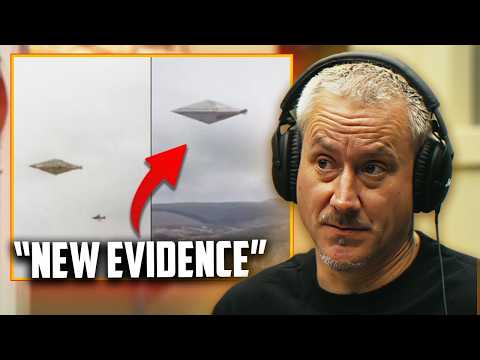
Host Chris interviews Vinnie Adams, host of the Disclosure Team podcast and a self-described "average Joe" who turned a decade of solo research into unedited, unglossed conversations with figures like Jacques Vallée, Lou Elizondo, James Fox and Richard Dolan. Adams weighs David Grush's expanding claims as credible but not yet settled, argues the Calvine photograph was likely an American craft handled by JARICK, and recounts filming a 90-minute show of 20-to-30-foot plasma orbs over a Colombian mountain valley. The pair also debate whether the phenomenon is one system or many species, whether disclosure should be a slow ontological drip rather than a dramatic reveal, and how burnout, community polarization and conspiracy explain-alls are reshaping the field.
Key Quotes
- "always supported him and I I will continue to. Um, I just hold everything in this little area of unknown." (00:02:39)
- "And we can't say that it's not that can't be a possibility just because we don't want it to be." (00:03:50)
- "it's a global phenomenon. It really is a global phenomenon. I'm sorry. It really is." (01:21:04)
- "And I think the only thing they'd want to keep more secret than aliens is technology derived from aliens." (01:31:39)
- "there's no way that any of us have unlocked it, unlocked its full potential because it would be over already. I do believe that." (02:01:32)
Detailed Summary
Disclosure Team’s Vinnie Adams on Grush, Disclosure, Classic UFO Cases, and the Meaning of the Phenomenon
A Childhood Encounter with a Golden Orb
The episode opens with a firsthand account of an unexplained event during childhood. The speaker describes the experience as more uncanny than a conventional UFO sighting, but it provides a striking introduction to the kinds of personal encounters that shape Adams’s interest in the subject.
- The speaker was about 10 years old and in Louisiana on a “frog gigging” outing with his mother, her friend, and another child.
- The ground began vibrating, followed by a mass emergence of worms and snakes around the group.
- A dim golden orb rose behind a clearing of trees and moved toward the people, prompting them to flee to their truck and drive quickly down a dirt road.
- The orb followed for some distance before finally taking off; when the group returned the following night, nothing else happened.
Vinnie Adams’s Path from Private Research to Podcasting
Adams describes the Disclosure Team as a one-person production supported by an informal community rather than a conventional research organization. His path into the subject was gradual and largely independent, with the podcast emerging from a decade of private investigation during the pandemic.
- Adams calls himself an “average Joe on the street” who would likely be part of the audience if somebody else were producing the show; the “team” is therefore everyone who watches, interacts with, or supports his work.
- His entry point was an online lecture by Richard Dolan at a UK exopolitics conference, where Dolan emphasized that declassified government documents are publicly accessible.
- Adams spent roughly 10 years researching from a triple-monitor gaming PC, keeping documents open across separate screens and showing his brother what he found each week.
- He was initially unaware of the broader UFO community and said he had spent his 20s and 30s absorbing books, documentaries, and fringe subjects one at a time.
- When COVID arrived, he began posting research fragments on Instagram as a personal record; the account grew much larger than he anticipated.
- Although he did not want to appear on camera, Adams eventually started the Disclosure Team and settled on unedited, unglossed conversations without a fixed format.
- Guests have included Jacques Vallée on multiple occasions, Dina Pulka, and Lou Elizondo, who Adams believes was his fifth or sixth guest in 2021.
- Elizondo’s specific answers gave Adams “food for thought” and the sense that the subject was real; he later brought Gunter Hofer back specifically to discuss Cynthia Hine’s African cases.
- Born near the end of the 1970s, Adams credits Close Encounters, Star Wars, The Goonies, and Flight of the Navigator with drawing him toward the subject rather than following a conventional 9-to-5 path.
- Chris says he learned Adams’s graceful, humble interviewing style by watching the podcast, while Adams continues to struggle with imposter syndrome.
David Grush: Highly Credible, but with Expanding Claims
Adams regards Grush as a serious and credible witness while resisting the temptation to treat every new allegation as settled fact. The concern is not only the extraordinary content of Grush’s statements, but also the way those statements continue to expand.
- Adams says colleagues who watched Grush’s live interview described the beings as resembling the pop-culture reptilian type rather than the “Greek-god-looking” entities Chris had expected.
- Every time Grush speaks, Adams says, he adds something beyond his previous statements; Adams remains supportive but cannot place the claims on the “top shelf” as established fact.
- Chris and Adams discuss whether Grush was simply permitted to say more or was actively encouraged to do so, and why the additional details continue to appear.
- Adams agrees that manipulation cannot be ruled out because no one knows who has spoken to Grush privately or where his information originated.
- Chris notes that Jason Sans was largely ostracized for making similar—and in some respects more restrained—claims; both speakers nevertheless continue speaking directly with people such as Sans despite online attacks.
- Grush attended the congressional hearing and was subsequently hired by Representative Burles as an adviser; Adams characterizes this as unprecedented by comparing it with the government’s treatment of Julian Assange.
- Adams says Grush was sensible enough not to incriminate both himself and national security, even while discussing claims that would be difficult to conceal.
- Chris summarizes references to biologics, crash retrievals, bipedal entities, and “sentient plasmoids” as science-fiction material that seems to require calling the Ghostbusters.
- Both speakers reject dismissing Grush merely because his account does not fit an expected narrative; if he is telling the truth, rejecting it on stylistic or conceptual grounds throws away potentially important evidence.
- They describe disclosure as inherently likely to produce “curve balls coming from all directions,” rather than a neat revelation that fits existing categories.
Government Disclosure: Tranches, Internal Conflict, and Unseen Resistance
The speakers regard the official release process as real but incomplete and difficult to interpret. Their expectations range from cautious optimism to agnosticism, and they describe extensive friction among government entities, contractors, and potential whistleblowers.
- The first disclosure tranche contained many items already in the public domain, along with previously unreleased NASA material and some new images; the speakers judged it disappointing but worth continuing.
- Chris suspects the early tranches are “primer fluff” before larger releases, while Grush and others have suggested that substantial information will come through the process.
- They expect a future tranche to contain bodies and predict that crash-retrieval photographs will quickly surface online once archives are opened.
- Chris calls himself an “eternal optimist” who needs optimism to remain enthusiastic, whereas Adams describes himself as agnostic about how disclosure will unfold.
- Adams recalls building his core knowledge while stigma was intense and government officials said almost nothing; the subject accelerated from 2017 onward as hearings and official participation expanded.
- He reports “a lot of internal fighting” involving the Department of Defense, intelligence community, and contractors, noting that sincere people in all three areas may want disclosure.
- The speakers say one brave person can be neutralized through scandal or other means, while most behind-the-scenes activity remains invisible.
- They cite Matthew Sullivan, who was reportedly preparing to come forward before his “mysterious” death, as evidence that something significant may be being kept quiet.
- Credible, high-confidence contacts have advised participants to “hold the line,” but Adams says this strategy leaves him uncomfortable because it postpones clarity without revealing what comes next.
Key Influences: Elizondo, Nolan, Hofer, and James Fox
Adams describes several researchers as formative influences, emphasizing direct relationships over alignment with online factions. Their work has shaped both his interview approach and his understanding of how difficult the subject is to communicate.
- Lou Elizondo was approximately Adams’s fifth or sixth guest in 2021, a period when Adams was still discovering what podcasting could permit him to ask.
- Adams says the early 2021 podcasting environment made highly specific questions possible and gave Elizondo’s answers a role as a springboard for later interviews.
- Adams built each interview relationship himself rather than trying to align the podcast with the expectations of online commentators.
- Elizondo was, in Adams’s account, gracious both on and off camera without using private conversations to reveal secret information.
- Adams credits Gary Nolan with extensive materials research, work involving material Jacques Vallée passed to him, and participation in the Skywatcher project.
- Chris and Adams speculate that Nolan may have withheld information because of clearance or nondisclosure obligations; Adams says Nolan’s ideas “rub off” on him.
- Gunter Hofer, now a good friend of Adams, worked the Ariel case and served as an assistant to South African researcher Cynthia Hine, who arrived roughly the following day.
- Hofer built homemade devices to measure what Adams believes was electromagnetic radiation; interviewing witnesses and the children connected with Ariel left a particularly strong impression.
- Adams says discussions with James Fox about his work and a case called “Venia” always produced a “whoa” moment because of the number of data points involved.
- Chris calls Fox one of the hardest-working researchers in the field and says he is eager to share new findings, sometimes to the point of a fault.
- A new Fox interview released during the discussion featured a police chief describing a witness who saw “them throwing the net on the being,” an old account that Chris said continues to yield striking angles.
The Calvine Photograph: The Original Sighting
The Calvine case is one of Adams’s principal pieces of firsthand research, conducted alongside investigative journalist Dr. David Clarke and others. The central photograph was taken in the Scottish Highlands in 1990 by two hotel kitchen workers after an unexplained craft appeared in a remote valley.
- The two workers went into the Highlands after a shift, although accounts differ over whether they were hunting deer or gathering magic mushrooms.
- They saw a diamond-shaped object hovering silently in a valley and used a disposable camera to take six photographs.
- Two aircraft passed the object and returned while the pictures were being made.
- After hovering for roughly 10 minutes, the object departed vertically and straight up without making a sound.
- The workers sent the negatives to the Scottish Daily Record, which printed one image and sent it by train to the RAF press officer in Scotland.
- The RAF press officer faxed the photograph to London, but the story never broke; Adams attributes this to discussion of a D-notice and the media’s general reluctance to publish national-security material.
- Clarke, whom Adams describes as a data-driven skeptic rather than a debunker, had been actively searching for the image for about 20 years.
- Clarke identified the RAF press officer as Craig Lindsay and secured the original image after a process lasting roughly a year and a half.
- Adams and Clarke drove six to seven hours to Scotland and collected the image at the building that used to house Lindsay’s press office, now converted into apartments.
- The recovered image was donated to Sheffield Hallam University’s archives, where Clarke had already placed other UFO photographs and documents.
- The Calvine image appeared in one of James Fox’s documentaries, while Nick Pope was described as unusually guarded about whether additional photographs survive.
Why Adams Thinks Calvine Was Probably American
Adams rejects the simplest extraterrestrial interpretation of Calvine and argues that the evidence points toward a British-managed American craft. His reasoning combines the craft’s appearance, the timing of the event, and the response of British authorities.
- An on-record man, then 78 years old, who had worked on the Calvine case and was connected with DI55 said officials knew the object was neither a UFO nor a non-human craft.
- Adams characterizes DI55 as the Ministry of Defence’s top-level defence-intelligence group and its proper UFO unit.
- His conclusion is that the object was American and was handled by JARICK, a UK organization of analysts who understood that it was a legitimate object.
- Even if the photograph was enhanced with Photoshop, Adams says it displays rivets, panels, and a small tail fin; he reads the craft as an early-generation alien or reverse-engineered human ship.
- The craft’s vertical departure was, in his assessment, clearly beyond prosaic human capability.
- Documents connected to the case mention “Aurora,” which Adams interprets as a mythological secret-aircraft program that may have involved more than one craft but produced no public follow-up.
- On a rainy night, a car with no plates and dark tinted windows collected the two chefs; they returned “white as a sheet” and were unwilling to discuss what happened.
- Researchers believe they have identified both chefs, believe one has died, and may have traced the other, who does not want to talk.
- Copies of the original negatives are said to remain in the Scottish Daily Record archives, with MOD personnel describing “a very clever way of making them disappear.”
- The sighting occurred either two days before or two days after the start of the Gulf War, and RAF Machrihanish—where American aircraft including the SR-71 operated during its European era—provides a possible American-testing context.
- Adams argues that a government would hide technology derived from aliens more severely than the aliens themselves, and that an American marking on the craft would signal adversaries to Britain’s closest ally.
- That combination of secrecy and alliance management makes him regard the object as more likely American than extraterrestrial.
Cash Landram, Roswell, and the Standard for Official Confirmation
The discussion broadens to several American cases with physical effects or multiple witnesses. Adams explains that his conviction varies by case and that official confirmation would carry greater weight than any single anecdotal account.
- Before 2017, the United States already had many cases involving multiple data points and witnesses rather than isolated stories.
- In the Cash Landram case, two women and a young boy driving along a street saw a huge diamond-shaped object hovering above the highway with helicopters around it.
- As the witnesses approached, the object burned paint off their car and left physical traces on their bodies.
- Roswell is the American crash case Adams has investigated most extensively, beginning about 15 or 16 years ago and returning to it as other researchers spoke with him.
- He wants Phil Corso’s Roswell testimony to be true and regards it as highly believable, while noting that Corso is controversial in some aspects of his record.
- Adams says convincing evidence would ideally be an official announcement by a president or head of state that specific cases were real, preferably accompanied by evidence.
- He notes that many skeptics cannot identify what evidence would change their minds once they are pressed to do so.
- Adams says he is close to 100% certain that something non-human occurred in a small number of Virginia cases involving witnesses ranging from children and a pilot to surgeons, pathologists, a police chief, a mayor, and military personnel.
- Even being shown direct evidence might not convince him that one of those cases was a hoax or scam, illustrating how deeply his conclusions are tied to the assembled pattern rather than a single object.
Shag Harbor and the Chupacabra
Shag Harbor and the Chupacabra illustrate two different ways investigators interpret ambiguous physical evidence. Adams treats the first as intriguing but not his most compelling case, while the second stands out because of its alleged danger to living beings.
- In the 1967 Shag Harbor incident off Halifax, approximately four lights descended into the water and were witnessed by many people.
- Fishermen searching for debris found only unusual orange foam, and Navy dive teams later failed to recover anything.
- Other witnesses reported orbs and balls of light that night, suggesting that more than one object may have been involved rather than a single craft.
- Adams calls Shag Harbor less compelling than some other cases but says it interested him from his early years.
- The Chupacabra was among the first cases Adams discovered, and he remembers its basic outline as frightening enough to discourage casual research.
- He describes it as one of the few cases in which UFOs appeared to be genuinely harmful, with attacks on people, civilian and military witnesses, and lasting physical markings.
Falcon Lake: Contact, Burns, and a Preserved Archive
The 1967 Falcon Lake case in Canada is one of Adams’s most striking physical-contact stories. It also has surviving artifacts, making it a focus of the David Marlor archive discussed later in the episode.
- A prospector searching for rare minerals such as silver saw a craft land on a rocky outcrop in Falcon Lake.
- The witness’s name appears as Steven Micholac or Mitchellac; he spent about half an hour drawing the craft from a distance before curiosity drew him closer.
- Chris says the account describes two craft, one above the forest and another that hovered for five to 10 minutes before departing; Adams says he cannot confirm that detail but has read the version several times.
- The witness wore welder’s gloves and a welder’s mask when he approached the craft.
- Contact caused his hat and shirt to catch fire, while perforations matching a perforated plate were imprinted on his skin and burned clothing.
- He heard hissing noises and voices through an open door; the voices were described as having a Scandinavian accent, which Adams considers consistent with the craft’s Nordic appearance.
- A famous hospital-bed photograph shows the witness’s injuries, which reportedly flare up roughly once a year.
- David Marlor possesses the original burned shirt and glove in his personal archive, which he funded and developed through his own time and money.
- Marlor’s archive is being presented to the All-domain Anomaly Research Resolution Office, described as the government’s official “new blue book” investigative body, with the two parties currently in negotiations.
- Because maintaining the archive is expensive, Marlor may need to grant ARRO access if donations do not cover its costs.
- One speaker suggested that someone inside ARRO must be keeping researchers away from the “smoking gun”; the other countered that not everyone there is nefarious and that some staff are trying to learn the subject’s history to perform their jobs properly.
- Their suggested compromise is a reciprocal exchange: “you show me yours, I’ll show you mine.”
The Colombia Field Investigation
Adams rarely conducts field research, but he describes the Colombian project as one of the proudest accomplishments of the Disclosure Team. The investigation combined local testimony, indigenous history, mountain access, and nighttime filming in an effort to determine whether the regional lights had an ordinary explanation.
- About a year into making the podcast, Adams was contacted on Instagram by “UAP Colombia,” an account that initially went live with nothing but a camera pointed toward a mountain.
- The Colombian contact described mysterious balls of light or plasma balls witnessed in the valley for hundreds of years.
- The rural valley lies about two hours outside Bogotá, and local town archives were said to contain documents dating to the 1600s about the lights.
- Indigenous oral tradition refers to the lights as “ancestor lights,” while the Moa people associate them with ancestral spirits.
- Adams assembled an eclectic team to interview local residents and Indigenous people, with Chris invited along as the “UAP guy”; within months, Adams was on a plane.
- The team rented a large country house for approximately two weeks as headquarters, bringing together participants of different ages from several countries.
- The planned documentary series was intended to document how participants’ views changed during those two weeks.
- For the Indigenous communities, UFOs were part of ordinary life rather than a stigmatized subject; police escorted the team up the mountain and referred to the phenomena simply as UFOs.
- The route was narrow and treacherous, and the investigators found no environmental or human feature that explained the lights as misidentification.
- A ledge called the Miridor was said to be where hundreds of Moa people died by jumping as conquistadors took their lands, providing a cultural explanation for the lights as souls.
- On the penultimate night, Adams and the Colombian organizer watched from a balcony approximately a mile away as the lights appeared.
- The objects grew larger, moved, developed visible ripples, and produced a show lasting about 90 minutes; Adams estimated each light at roughly 20 to 30 feet across.
- A crew member returning from the bathroom was the first to notice them, and the display was captured by tripod-mounted cameras.
- The team returned a year later and saw what they described as “super high looming torches.”
- They attempted to recreate the lights using thermal drones and other methods designed to test whether hikers carrying torches could account for them, but could not come close.
- The conclusion remains open-ended; proposed next steps include filming cases in surrounding towns and cities, examining the cultural dimension more closely, and reviewing original documents in local archives.
Colombian Lore, Marian Imagery, and a Tic-Tac Witness
The Colombian material also links modern sightings to the valley’s religious imagery and to a witness with direct aviation experience. The speakers treat these connections as evidence that the phenomenon has deep regional roots rather than beginning with modern technology.
- A retired Brazilian female fighter pilot—identified as belonging to either the Brazilian Navy or Air Force—lives in the same valley and recounted a white Tic-Tac literally looping through it in local press coverage.
- Adams connects the shape to the Tic-Tac seen by Fra and Dietrich during the Nimitz encounter.
- He argues that UFO reports are not confined by national borders and that evidence of the phenomenon in this region extends across many generations.
- The regional tradition is discussed alongside Marian apparitions, including a reported encounter in which a woman left her home and saw a Tic-Tac loop through the valley.
- The Lady of Fatima is cited as another disc-related apparition: after promising to return at a set hour, she was witnessed by roughly 60,000 people as a disc sped around.
- Church murals in the valley town depict a church on a hill with a large disc emerging from the clouds, showing how local religious imagery and the lights are linked.
- The speakers suggest that the constant presence of the phenomenon fits a much older history better than the idea that it began with modern observation, while Adams finds lessons in the local culture’s easygoing acceptance.
One Phenomenon or a Million Things?
Adams and Chris reject both rigid labels and premature simplification when describing the range of alleged visitors. The question remains unresolved between a single underlying system and multiple beings or craft.
- Adams calls fixed labels dangerous, including formulations such as “the grays are drones,” “the reptiles are evil,” and “the Nordics are benevolent.”
- He connects that practice to a historical pattern in which visitors arrived on many shores, pointed at whichever population was present, and called the locals “savages.”
- Asking how modern visitors might regard Americans as primitives unable to understand nuclear weapons, he argues that humanity has not learned the lesson and still harms itself through categorical assumptions.
- Chris describes moving from belief in one generic “gray” species to a proliferating taxonomy that includes human-looking types, reptiles, mantids, tall grays, and short grays.
- He now sees the choice as “a million things” or one thing, but is unwilling to combine every report because the phenomenon does not behave uniformly.
- Common features, including the messages given and experiments performed on contact or abductees, may indicate a single systemic operation, while other phenomena fit nowhere within that framework.
- Adams struggles to classify the visitors as a biological group and expects the explanation to combine cryptoextraterrestrial, interdimensional, and extratemporal ideas with something entirely different.
- He suggests the visitors may choose to be biological and may be able to “dip out of our reality,” while emphasizing that there is no current basis for preferring one theory.
- Adams says there is enough evidence to justify investigation and believes a non-human intelligence has interacted with humanity for some time, perhaps longer than humans have existed, but treats that as a broad and revisable position.
- Grant Cameron is cited as saying the phenomenon is only meant to inspire people; Adams says he does not accept that interpretation.
- Both speakers entertain the possibility that visitors deliberately provide too few “puzzle pieces,” preventing the full picture from resolving and leaving investigators with missing or jagged edges.
Reverse Engineering or Crude Retrofits?
The conversation distinguishes between genuine reverse engineering and the limited, improvised use of technology whose operators do not understand it. Adams’s analogy turns the familiar claim of recovered anti-gravity craft into a question of capability, maintenance, and long-term usability.
- Chris notes a reverse-engineering paradox: researchers claim anti-gravity was cracked in the 1950s, yet people such as Jim Latsky barely got inside a craft.
- Adams agrees that humanity has not progressed very far and is inclined to believe there was more than one type of craft.
- Chris notes that triangular and disc-shaped craft were filmed at Area 51 during the 1980s and 1990s and says some may not have been intended for spaceflight.
- Michael Herrera described panels on craft being used by soldiers, while Dr. Steven Greer has said the craft were reverse engineered and that their capabilities are now available.
- Adams instead argues that the craft were retrofitted rather than fully reverse engineered.
- He compares the situation to a Tesla parked in the 1100s whose battery eventually runs out, leaving its occupants unable to recharge it or understand the underlying technology.
- In his account, windows were turned into weapons, doors became shelters, and seat belts were repurposed for carrying sticks.
- Adams notes that Bob Lazar has consistently said humanity will never fully figure out the craft because the occupants do not understand themselves.
- The resulting focus on consciousness, including the study of the beings’ brains and children, follows from the idea that humans do not know the craft’s complete capabilities.
What Disclosure Should Actually Mean
Adams’s conception of disclosure has shifted from expecting immediate material benefits to valuing official acknowledgment of a non-human reality. The conversation nevertheless remains cautious about forcing an unprepared public to absorb the information all at once.
- Adams once expected disclosure to deliver free energy, an end to poverty, and a utopian future; he now sees its primary function as official acknowledgment that something exists.
- He notes that even free-energy technology would take a very long time to implement, making the practical benefits less immediate than he once assumed.
- Citing worldwide polls, Adams says support for disclosure is above 50%, so he accepts the majority’s decision to learn the truth.
- Both speakers say their side has warmed to the idea that people could handle disclosure; if it occurred, their research would not stop but would evolve into a next phase.
- Adams invokes Plato’s cave and struggles with whether people who did not ask to be brought into the light should be pulled out anyway.
- He has never raised the subject with family, friends, or people at the school playground while picking up his child, although people now approach him regularly.
- Adams recalls unloading everything he had learned on his brother and other unwilling listeners, watching their expressions change as they recognized the reality of the subject and then feeling bad about what he had done.
- His position is that people should make their own choices; those who prefer to remain in the cave should not be forced out.
- He defends the government’s “slow dripping” release as acceptable while acknowledging how frightening it is to disclose something this poorly understood.
- If the government produced a body, Adams says he would be happy and all his current reasoning would be “out the window”: “deal with it, we have aliens, everybody deal with it.”
- He prefers disclosure through stories, testimony, evidence, research, and archives over years or decades, allowing conviction to grow bit by bit rather than arriving as a single shock.
- Adams places faith in humanity as a resilient species, citing his retired mother, who continues gardening and baking while dealing with the psychological impact.
- The speakers also hold researchers responsible for their behavior toward other people; Horo Nakawa, who works on New Mexico material, is praised as an unusually conscientious and informative researcher.
High Strangeness, Wales, and Skinwalker Ranch
The speakers distinguish conventional crash and sighting cases from the more ambiguous “high strangeness” material associated with entities, spirits, mutilations, and unusual locations. Skinwalker Ranch becomes the central example because of its combination of physical investigation, television production, and claims of government involvement.
- Asked for a lesser-known high-strangeness location, Adams recommended a site in Wales surrounded by reports of hitchhikers and cattle mutilations.
- He noted that the United Kingdom has remote rural locations associated with orbs, hitchhikers, spirits, Bigfoot, and other phenomena, although he explicitly declined to claim that all of these are connected.
- Both speakers said they would spend a night at Skinwalker Ranch; one was initially skeptical but became more open after encountering Ben Woodruff’s biological work there.
- Adams wants places with this history treated with reverence and described as sacred rather than merely as entertainment locations.
- Jason Turner, part of the UAPX team and present at the Princeton encounter during the Nimitz event, texted from the ranch that he had “been affected by it.”
- Turner sent real-time photographs showing bloodshot eyes and was taken to the hospital.
- Adams calls Skinwalker Ranch a “Disney World for ufology,” noting that seven seasons have increasingly resembled a show of firing rockets into the sky.
- Brandon Fugal suggested on the Bigelow podcast that the ranch should be approached from the consciousness side, and Adams hopes season 8 will adopt that direction.
- Woodruff says the dig is 100% monitored by the government; Adams worries that official involvement, including Travis Taylor’s mysterious role, prevents the project from finding anything of truly national-security significance.
- The speakers reason that anything important enough to compromise national security would be suppressed before cameras could document it.
- They disagree over the ranch’s current condition: one calls it a farce resembling the Oak Island treasure search, while the other emphasizes that Fugal is deadly serious.
- Asked what they would exchange for a genuinely new angle, they say they would trade the television show for finding the Ark of the Covenant: “Let’s dig it up.”
Phil Schneider and the “Dark Version” of Ufology
An audience question from Amy prompts a critical reassessment of Phil Schneider and the darker tradition he represents. The speakers acknowledge the emotional power of his stories while explaining why Adams ultimately became skeptical.
- Schneider was one of the channel’s most popular commenters and was named as the deep dive that most strongly disturbed the speakers’ “cognitive dissonance tree.”
- He presented claims about deep underground military bases and participated in drilling with large diamond machines that allegedly broke into an alien base already beneath the ground.
- Schneider also claimed that he was shot in the chest during a shootout, that a laser was used to reopen the wound, and that he lost a finger.
- Adams says he was initially “all in” on Schneider before reversing course after learning about Schneider’s past self-mutilation and mental-health problems and after other researchers’ work “completely flipped” his beliefs.
- At the height of his earlier conviction, Adams believed Schneider’s suicide had been staged by the government.
- The speakers group Schneider with Bill Cooper and John Lear as figures who presented a “dark version” of events through the “run like hell” speech, Dulce-base material, and claims of torture at level four.
- One speaker says Zeitgeist drew him into the subject and pushed him to tell his family that the government deceives people, money does not exist, and banks control everything, which he now regards as a dark period in ufology.
- The other first encountered Dulce-base material through Coast to Coast radio and archived broadcasts, when YouTube barely existed and the base was discussed as a matter of fact.
Visitation and Psychic-Overlay Stories
Adams maintains a small collection of visitation and psychic-overlay accounts, assigning them more weight because of their source quality than because they fit familiar abduction categories. The stories are strange, but their witnesses include researchers whose judgment he respects.
- Adams has collected roughly a dozen visitation or psychic-overlay stories from people including Jacques Vallée.
- He finds the visitation cases more credible despite their strangeness because the people reporting them tend to be strong sources.
- One account describes a woman meeting a beautiful girl in a supermarket and instantly recognizing that something about the encounter was unusual.
- Another describes a person seeing himself from a cashier’s perspective while paying; the cashier subsequently avoided eye contact.
- Adams says he has personally received fewer reports of beings permanently living among humanity, but would not be surprised if they were present.
- Charles Hall mentioned beings encountered going out on particular nights in Las Vegas and dressing themselves up; Adams regards this as far-fetched but does not rule it out.
- He has lower conviction in David Jacobs’s “hubbids” scenario, in which beings assimilate into human society, because the alleged visitors would also have been trained by other humans aboard the craft.
Books, Films, and the Historical Record
The speakers recommend a mixture of investigative books, firsthand case collections, and science-fiction films for people trying to understand the subject. They emphasize that meaningful data long predates the modern disclosure era.
- Adams’s favorite books include Leslie Kaine’s UFOs, Generals and Pilots Go on the Record, Paul Dero’s Earth Lights, Revelations, Jacques Vallée’s books including Passports Meonia, and a Ross Coular book he calls “something special.”
- Adams praises South African researcher Cynthia Hine’s African cases as exceptional but poorly circulated, and says he brought Gunter Hofer back solely to discuss them.
- For newcomers, Adams recommends Richard Dolan’s After Disclosure and his security-state books, along with UFOs and Nukes.
- Chris argues that UFOs and Nukes includes testimony from 116 people who worked at nuclear sites and held clearances, forcing skeptics to reject the witnesses rather than the researcher.
- Chris also recommends Preston Dennitt’s books, which compile cases from his own research, including contact experiences involving healing and schoolyard sightings.
- Dennitt once posted flyers asking people who had seen something to call a number, generating interviews with many experiencers who otherwise might never have been heard.
- Suggested films include Starman, K-PAX, They Walk Among Us, Fly Me to the Moon, and Flight of the Navigator.
- Adams emphasizes that there was never a shortage of UFO data before 2017; what changed was the willingness of more people to come forward through official channels after the 2017 influx and congressional hearings.
- Chris recalls a mid-1990s talk-show appearance by Ray Santilli discussing the alien autopsy, where the complaint was that the public had received only fuzzy images and no concrete government disclosure.
- They note that the same barriers appeared in the 1950s, 1960s, and 1970s, leading Chris to conclude that the issue has sometimes felt as though “we haven’t moved an inch.”
- Interest moves in peaks and valleys, with the 2017 hearings and viral videos by figures such as Jesse Michaels producing new waves of enthusiasm.
- Their advice to newcomers is to use quieter periods to study history and old material, building a core knowledge base that allows later discoveries to connect instead of becoming isolated surprises.
Burnout, Polarization, and Emotional Strain
The speakers treat the subject as psychologically demanding rather than merely a weekly-media project. Online conflict, unsolicited messages, conspiracy explanations, and persistent uncertainty can create burnout even for people committed to careful research.
- Adams says he has never belonged to group Signal chats or plotting groups and prefers one-to-one relationships.
- He also says he has never had to ask whether he was being used, and his willingness to discuss many unrelated subjects keeps him from being tied to a single narrative.
- Both acknowledge that their platforms allow people to share reasoning, opinions, agendas, and personal narratives; Adams advises listeners to take his statements with “a giant grain of salt.”
- They describe backroom discussions and “passage” material as an inevitable byproduct of the subject, which they describe as difficult and not reducible to a simple podcast.
- One speaker reports mental heaviness from the constant conversations and messages generated by the topic, noting that the pressure sometimes appears without warning.
- The other discloses struggles with mental health, including bouts of seasonal depression.
- One speaker counters seasonal decline with routines such as staying busy, going to the gym, and reading books as winter approaches.
- One also argues that people in the UFO community are supposedly targeted by entities, human or non-human, while acknowledging that the community’s contentious bipolarization can draw people in.
- One avoids posting opinions online because the resulting counterattacks, ad hominem attacks, and unnecessary engagement are not worth the exchange.
- The other says people quickly resort to “scop” or bot explanations, using conspiracy theories to dismiss everything regardless of the evidence.
Ideal Interviewees and the Limits of Public Testimony
When asked whom they would interview for three hours, both prefer people with operational knowledge over the biggest public names. The ideal subject would possess direct information about programs, craft, or crash retrievals rather than merely offer commentary about the phenomenon.
- Chris says he would not necessarily select a famous researcher but would favor someone in the background of government programs, such as a person involved in reverse engineering or crash retrievals.
- He would also like to speak with someone who has not come forward, possibly from a military branch or the intelligence community, who possesses a different outlook and genuine insider knowledge.
- The speakers name deceased figures they wish they could interview: Leonard Stringfield, John Ke, Jay Allen Heinik, Stan Friedman, Eisenhower, Vannevar Bush, and Remy Forestall.
- For Adams, Jacques Vallée remains the ideal interview subject because he is a philosopher whose statements and books show him continually connecting ideas.
- Adams has interviewed Vallée twice, with each conversation limited to about an hour because of Vallée’s schedule.
- Chris says Vallée answers through a long narrative arc before reaching the question, which can make the interview difficult, while Adams treats the pacing as part of the depth of the responses.
- In the first Vallée interview, they discussed a Brazilian case involving UFOs hovering above the jungle; Chris described the account as extremely vivid and difficult to forget.