[@lexfridman] Visiting Taiwan w/ Jensen Huang | Lex Fridman
![[@lexfridman] Summarizer](https://summaries.pages.dev/img/logo.webp)
Link: https://youtu.be/FGCP2F_7rQk
Duration: 90 min
Transcript: Download plain text
Short Summary
Lex Fridman interviews NVIDIA CEO Jensen Huang — who grew up in Taiwan — across Computex in Taipei and several street-food stops, weaving together NVIDIA's Grace Blackwell and Vera hardware, the multi-trillion-dollar AI build-out, U.S.–Taiwan reindustrialization, and export-control philosophy. The conversation also traces the Taiwan semiconductor origin story from K.T. Li and Morris Chang through TSMC's early days as a ~$300 million foundry that NVIDIA cold-called via the Yellow Pages, and closes with Huang's "rough justice" partnership philosophy with TSMC.
Key Quotes
- "Eating and being hungry are completely unrelated things." (00:59:09)
- "Nothing gives me more pleasure than last year when my entire supply chain's stock price went up 300%, mine stayed flat." (00:55:20)
- "goodwill is not a zero-sum game. It's not limited by physics." (00:44:22)
- "It's really inspiring to see an engineer be treated like a rock star, 'cause engineers build the world, and they don't often get the love... I think they deserve." (00:13:32)
Detailed Summary
Lex Fridman Interviews Jensen Huang: NVIDIA, Taiwan, and the Trillion-Dollar AI Build-Out
Setting and the Two Hosts
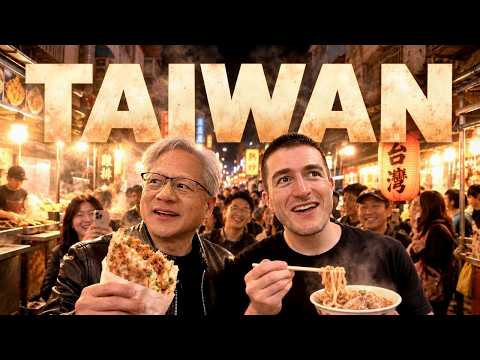
Lex Fridman's first visit to Taiwan coincided with Computex in Taipei and several days with Jensen Huang, the CEO and founder of NVIDIA, who grew up in Taiwan and returns to his childhood memories on camera (including a night-market cook's-knife injury at age 5). The interview weaves together an NVIDIA employee gathering and multiple Taiwanese breakfast and night-market street-food stops, with Jensen serving as the de facto "foodie guide." Across the trip, Lex says the food coverage outpaced the storytelling — it took about 14 dishes over ~20 minutes of conversation to advance roughly a year of NVIDIA's origin story.
NVIDIA's Hardware Roadmap: Grace Blackwell and Vera
- The Grace Blackwell generation is 100% liquid cooled, up from 80% in the prior generation, which cut assembly time from 2 hours to just 5 minutes.
- The new Vera CPU delivers 1.8x the performance of x86 architectures.
- Jensen argues x86 hyperscale CPUs were optimized as rentable resources sold by the dollar per core, whereas AI is sold in tokens, so token-generation throughput is the priority metric.
- Jensen frames the AI stack as a five-layer cake of technologies that must advance in tandem.
- SK Hynix is highlighted as a trillion-dollar high-bandwidth memory company that brought LPDDR into data centers at 2x bandwidth and 0.5x the power.
Taiwan as the World's Semiconductor Hub
- Taiwan produces more than 90% of the world's most advanced semiconductors despite being an island that is two-thirds mountains.
- NVIDIA currently has about 1,000 team members in Taiwan spanning supply chain, systems engineering, ops engineering, fab, packaging, and test.
- NVIDIA plans a replica-style building in Taiwan for 4,000 people, requiring roughly 3,000 new hires once land is secured.
- NVIDIA globally has 43,000 employees, one of whom has been with the company for 17 years.
- Jensen sums up Taiwan in a quip: "This island makes semiconductors and fruit."
The Multi-Trillion-Dollar AI Build-Out
- Jensen says NVIDIA and Taiwan must "build and sell a few trillion dollars of computing over the next several years," with every ecosystem participant investing hundreds of billions of dollars in the same window.
- He admits he was super nervous before the Computex keynote but gives every public speech without a teleprompter and barely rehearses, saying it "comes together at the last moment."
- The AI boom, in his telling, is the United States' best chance to reindustrialize — urging investment in the grid, sustainable energy, robotics, and U.S. manufacturing now that demand makes it affordable.
Reindustrialization, China, and Trade
- Jensen describes Taiwan as a strategic U.S. partner that ships engineers and capital to help stand up American fabs because there is "not enough talent" in the U.S.
- On a memorable trip, Jensen was swarmed in downtown Beijing, grabbing food from "every restaurant" and becoming each one's "poster child" within about half an hour.
- He also visited Shanghai for AI companies and Hangzhou for Unitree robotics.
- Chinese AI firms are "compute starved," which Jensen credits with forcing incredibly efficient architectures — "constraints are the mother of invention."
Export Controls, Flywheels, and Geopolitics
- Jensen argues export controls are not how America should win, since technology, knowledge, and IP are force multipliers and the safest countries in history have been the richest.
- He draws a sharp line: hoarding refined rare earth, bullets, and bombs can be legitimate, but broadly depriving the world of U.S. technology damages the U.S. flywheel.
- The U.S. holds a global English-language flywheel advantage: the vast majority of the world responds to English, letting American-built stacks deploy worldwide.
- Decoupling between competing nations could destroy everyone's flywheel; interdependence, Jensen argues, makes conflict harder.
- Platform flywheels can build quietly for one to three decades before a tipping point where they appear to take off overnight, and they can also slow down just as fast.
History of Taiwan's Semiconductor Ecosystem
- K.T. Li, in Taiwan's Science and Industries Ministry, set a vision in the 1950s to bring science and technology manufacturing to the island, a vision that "compelled Morris [Chang] to come back."
- Philips ("the GE of Europe") spun off both the fab that became TSMC and the equipment maker ASML.
- IBM opening the specs of its IBM-compatible chipsets let Taiwanese engineers at UMC and TSMC design and manufacture chipsets (VGA/graphics, cache, memory, interrupts), fueling the PC revolution alongside Compaq, IBM, and Michael Dell (Austin, Texas).
- CoWoS (chip-on-wafer-on-substrate packaging) is so culturally embedded that Jensen jokes "a girl learned to spell CoWoS before she could spell Gucci."
NVIDIA's Origin and the TSMC Partnership
- When Jensen returned to Taiwan in 1996, Windows 95 had just launched, and the PC revolution was driving foundry demand from NEC, Toshiba, Fujitsu, and Hewlett-Packard.
- The fabless industry was born around 1996 with Cirrus Logic ("the giant"), S3, Weitek ("the small one"), and Western Digital (which used to make graphics chips); SGS-Thomson was already a foundry but turned NVIDIA away.
- TSMC and UMC were tiny Taiwanese competitors across one street from each other inside a single campus; TSMC was roughly a $300 million company when NVIDIA approached (Jensen quipped "$300 billion").
- Jensen cold-called TSMC via the Yellow Pages, left voicemails as a graphics-chip startup, and got no callbacks.
- He eventually wrote a long letter to Morris Chang, who called back around 6:00–6:30 PM while employees played the first PlayStation outside his office.
- Jensen chose TSMC over UMC because Morris had clear core values — corporate governance, integrity, partnership, long-term thinking — and Jensen promised: "if we were to work together, I promise you we would jump through hoops for you," a promise kept for 30 years.
Jensen's Partnership Philosophy: "Rough Justice"
- Jensen's philosophy with TSMC is "rough justice": agreements kept loose, sometimes he wins and sometimes the partner wins, because chip-building has unknowns no contract can specify.
- Last year, NVIDIA's supply chain's stock went up 300% while NVIDIA's own stock stayed flat — Jensen cites this as evidence that he deliberately leaves value on the table for partners.
- He says he has no binding agreements with his employees, framing the relationship as a mutual decision to work together rather than a contract.
- Jensen warns that mistreating partners in Taiwan is remembered forever on the island — advice grounded in his own three-decade relationship with TSMC.
- NVIDIA is, in his telling, built on top of the TSMC platform and the Taiwan platform, making those partnerships strategically essential rather than transactional.
People, Culture, and Taiwanese Street Food
- Jensen calls engineers the people "building the world" and says being treated like a rock star is inspiring to "thousands, millions of young kids."
- A signature gift — a FIRST Robotics 2026 shirt — prompted the quip that those young engineers' robots are "probably running on NVIDIA brain."
- Dishes sampled include cold, sweet, and salty soy milk (most Asians are lactose intolerant), rice paper with cilantro, taro balls, sesame balls (defined by the texture "QQ" — bouncy, chewy, elastic), onion pancakes (~90% oil, 10% egg), pork floss egg-sticky rice ("the cha mu"), turnip cake, sesame-coated steamed buns, tofu with broth, grass jelly (squeezed from a plant, not manufactured), fried donuts, plums, and xiao long bao (soup dumplings).
- Other cultural notes: durian (grotesque smell, surprisingly good taste), shaved ice (Lex's first was watermelon), egg-in-everything across Southeast Asia, and a Taiwanese-style "corn dog" (egg crepe with sausage) at 80 NT$.
- Night-market vendors make only about a dime of profit per item but share generously — Jensen compares them to the chef in Jiro Dreams of Sushi: "a bunch of Jiros over there."
- Dining etiquette differs sharply by culture: leaving food can be rude in some places (insulting the host's generosity), whereas in France one must eat everything — which is why French dinners last about three hours.
- Jensen joked he gained 10 pounds on the trip.
Tools, Personal Notes, and Key Takeaways
- Jensen said he uses Perplexity Computer when learning about new companies and technologies.
- He believes the future of computing interfaces is mostly going to be voice control, though he personally finds it harder to think while talking and values pausing.
- Lex name-drops prior gaming interviews with Dan Houser, Jeffrey Kaplan, Todd Howard, and Carmack, and noted his anticipation of Grand Theft Auto VI releasing on November 19.
- Jensen's core worldview: maximize the U.S./global technology flywheel, let partners prosper, treat interdependence as a strategic asset, and don't confuse physical-asset hoarding with technology leadership.
- The co-host closes by calling the week one of the most incredible of his life, having talked to hundreds of engineers and eaten his way across Taiwan's night markets.