[@PeterAttiaMD] 360 ‒ How to change your habits: why they form and how to build or break them
![[@PeterAttiaMD] Summarizer](https://summaries.pages.dev/img/logo.webp)
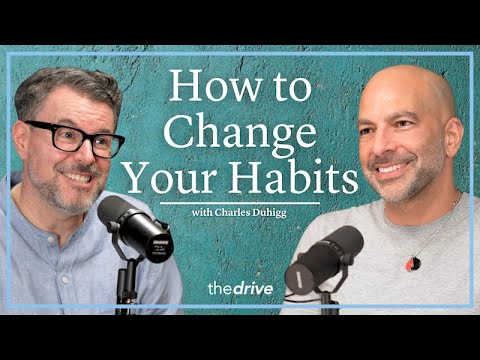
Link: https://youtu.be/yhLHfPZEKgU
Short Summary
Okay, here is the number one action item and executive summary based on the YouTube transcript you provided:
Number One Action Item/Takeaway:
Actively leverage positive reinforcement rather than negative reinforcement, as positive reinforcement is vastly more effective (about 120 times) in shaping desired behaviors and creating lasting habits. Pair positive reinforcement with careful cue selection to create effective habit loops.
Executive Summary:
The discussion centers on the science of habit formation and change, emphasizing the disproportionate effectiveness of positive reinforcement over negative reinforcement. Understanding the cue-routine-reward loop is crucial for both creating new habits and altering existing ones. By focusing on positive rewards and managing environmental cues, individuals can significantly improve their success in achieving their desired behavioral outcomes.
Key Quotes
Here are 5 direct quotes from the transcript that I found particularly valuable:
-
"The problem is negative reinforcement is about 120th as effective as positive reinforcement."
-
"Making the right choice is so much more powerful than executing really well on the wrong choice."
-
"Humans are habit machines, right? We we literally have evolved a brain that is fantastic at making habits. And so we can take almost anyone assuming a baseline physical readiness and and mental capacity. We can take anyone and we can teach them to be a good soldier."
-
"Teaching children a sense of agency when you bring home an A on your report card instead of saying, "Oh, you're so smart," which is something you don't have control over to say, "Oh, you must have worked really, really hard." Because that's something you do have control over."
-
"Regardless of how long it takes to build that habit or change a habit, every day you do it, it will get a little bit easier."
Detailed Summary
Here's a detailed summary of the YouTube video transcript, organized by key topics:
I. Introduction & Background
- Charles Duhigg, author of "The Power of Habit" and "Super Communicators", is interviewed by Peter Attia about habit formation.
- Duhigg's interest in habits stemmed from experiences in Iraq where he observed the military's ability to instill automatic behaviors in soldiers, and his own struggles with personal habits.
- Early work involved reporting on the science of handwashing in developing nations and how incentives (rewards) were crucial for habit formation, particularly immediate rewards tied to positive identity (being a good parent).
II. Positive vs. Negative Reinforcement
- Habits are composed of a cue, routine, and reward.
- Negative rewards are less effective than positive rewards in forming habits.
- Negative reinforcement is about 1/20th as effective as positive reinforcement.
- Negative rewards work best when the pain/punishment is established before the behavior, and the tension/threat is removed after the behavior occurs.
- To maximize effectiveness, pair negative rewards with positive rewards.
III. Parenting & Habits
- Positive reinforcement is more effective than punishment (negative reinforcement) in encouraging permanent behavior change in children.
- Teach children agency by emphasizing effort ("you worked hard") rather than innate qualities ("you're so smart") after achieving a goal.
- Model good habits and explicitly explain the cues and rewards involved in your own behavior.
IV. Military & Habit Formation
- The military excels at training automatic behaviors by focusing on cues and rewards.
- Soldiers are trained to react to specific cues (e.g., dust from an IED) rather than general stimuli (e.g., the sound of an explosion).
- The military uses social rewards and positive reinforcement (e.g., "Good job!" from fellow soldiers) to build automatic responses.
- Camaraderie and protecting fellow soldiers serve as powerful motivators.
- Humans are fundamentally habit machines; the military believes it can instill necessary habits in almost anyone.
V. Adding & Subtracting Habits
- The interviewer, Peter, discusses his basic framework on habits, additive and subtractive habits.
- For subtractive habits (e.g., eating less junk food), the primary strategy is environmental manipulation (reducing access to the trigger).
- For additive habits (e.g., increasing exercise), the approach is to start small, defining success as simply showing up, not by performance.
- Link new exercise habits with an audio book (for example), so that the exercise turns in to a reward.
- Initially, it's hard to appreciate the positive feeling/runner's high from exercise until it's experienced.
VI. Willpower & Habit Formation
- Willpower is like a muscle: it strengthens with use but can be fatigued in the short term.
- Habit formation bypasses the need for constant willpower exertion.
- People who are athletes, or have been athletes, seem to be more comfortable with willpower.
VII. The Science of Failure and Learning
- Smokers typically need to attempt quitting seven times before success.
- Each "failure" (relapse) should be viewed as a scientific experiment to identify triggers and create a plan to address them in the future.
- Avoid self-blame, and instead focus on learning.
- Accountability partners and social support can accelerate habit change.
VIII. Childhood & Habit Formation
- Teaching kids how willpower works and how to build willpower is important.
- Parents should demonstrate and model the cues and rewards in their own lives in order to help their children become aware of how they change their own habits.
IX. Habit Duration & Breaking Habits
- Neural pathways for habits become thicker with repetition but rarely disappear entirely.
- Returning to an old habit after a break will be easier than building it the first time.
- Different people have different thresholds, and habits have different timelines.
- Every day you do it, it gets a little bit easier.
- Longer, more consistent behaviors are more strongly reinforced in the brain.
- Instead of breaking bad habits, think about changing them. Identify the cue, reward, and insert a new behavior to achieve a similar reward.
X. Creating New Habits
- To build a new habit: choose a cue and a reward, linking them to a desired behavior.
- Cues fall into five categories: time of day, place, emotion, other people, or preceding behavior.
- The magnitude of the reward matters less than its immediacy.
XI. Long-Term Habits & Rewards
- Long-term behaviors need short-term rewards.
- Financial spreadsheet and reviewing those numbers gives immediate rewards.
- Manufacturing a short-term reward, such as social reinforcement, can help to implement long-term habits.
- "Gamifying" the process, such as setting up goals, helps in tracking progress.
- The best short-term reward has to make sense. The better short-term reward also moves toward the long-term reward.
XII. The Power of Social Influence
- Personalized rewards and AI are huge for people
- AI can also be used to help change habits in people.
- The importance of having someone telling you what to do
XIII. Mental Habits & Innovation
- Mental habits involve deliberate choice of cues and rewards.
- Successful innovators often have contemplative routines to spur innovation (e.g., reflection on good ideas or walking before brainstorming).
- Deep thought is crucial for productivity.
- Routine unlocks habits of safe flying and that helped his plane to land safely.
- People must train themselves to focus based on building mental models and challenging it in order to avoid tunnel focus.
XIV. Contemplative Routines
- People may see things differently when building Al systems, so ask why.
- Those with power will want to create a need, whether or not there are resources
- Building habits can recognize pro-deep productivity (deep work)
- Balance rigor and freedom
- Deep thought is a key part of productivity
XV. Decision Fatigue
- The more decisions that have to be made in a day, the more fatigue sets in.
- Creating a decision structure allows a focus on most important decisions while ignoring others.
XVI. How Has the Science of Habit Changed?
- The fundamental principles remain the same (cue, routine, reward).
- Greater understanding of how to influence cues and rewards by influencing the environment.
- Environments with limited resources can produce better outcomes
- AI is interesting but we are early in the process to have conventional wisdom or takeaways.
- Important question is why do some develop these generative AI systems and how will it change thinking?
- Social components are understood today more than it was then.
XVII. Purpose
- Purpose is needed for our species. We are storytelling species
- Schizophrenia is someone who is more difficult to tell consistent story from day to day
- Purpose provides stories and motivation.
XVIII. AI & The Future of Habits
- A world in which people don't need any professional reasons might be substituted with a personal "why"
- AI does not necessarily need a purpose
- "if there is an AI agent that can be the most powerful tool for behavior change as powerful as having you stand next to a person 24/7 as their behavior coach then you really change lives"
- Motivation is more important than previously believed
This summary captures the core information, arguments, and structure of the video transcript, excluding extraneous material like greetings, filler words, and transitions.