[@ChrisWillx] AI Safety, The China Problem, LLMs & Job Displacement - Dwarkesh Patel
![[@ChrisWillx] Summarizer](https://summaries.pages.dev/img/logo.webp)
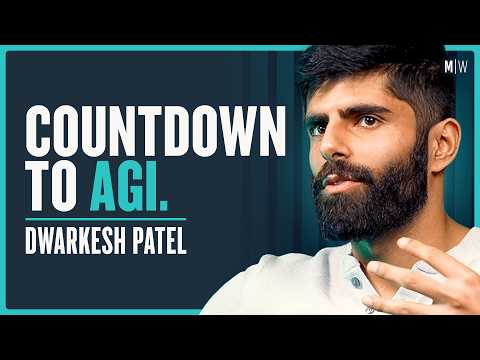
Link: https://youtu.be/RXcYIae6TH8
Short Summary
Here's a summary and the top takeaway from the transcript:
Number One Takeaway: The potential of AI is underestimated, particularly when it comes to its ability to learn on the job and coordinate complex tasks across multiple instances, which could lead to rapid advancements and significant economic transformation.
Executive Summary: The discussion explores the limitations and potential of AI, highlighting its surprising strength in reasoning but its struggles with practical, embodied tasks. The speakers contemplate AI's impact on human creativity, the alignment problem, and the future of society, suggesting that AI's real transformative power will come from its ability to learn continually and coordinate across diverse domains, not just from its raw intellectual capabilities.
Key Quotes
Here are 5 impactful quotes extracted from the YouTube video transcript:
-
"Evolution has spent 4 billion years teaching us how to move around the world how to um pursue your goals in a long-term basis. So not just do this task over the next hour but spend the next month planning how to kill this gazelle." (This quote highlights the stark contrast between AI capabilities and fundamental human skills, emphasizing the vast evolutionary head start humans have in physical interaction and long-term planning.)
-
"Yeah, either human literature is real or AI literature is real. There's no in between." (This provocative statement challenges the perceived distinction between human and AI creativity, forcing a reevaluation of what constitutes originality and genuine expression.)
-
"The closer you look, the more you realize it's either randomness or they were just doing the next obvious thing in the sequence. Uh, it's always incremental." (This quote offers a grounded perspective on scientific and technological advancement, demystifying breakthroughs by emphasizing the role of small, iterative changes rather than sudden genius.)
-
"There is this interesting conundrum where they have no human has seen even a fraction of a fraction of a fraction of the amount of information these models have seen... So far we don't have any evidence of an LLM doing this there. It does suggest these models are like shockingly less creative than humans." (This quote encapsulates the "Dwarash's AI Creativity Problem." While LLMs have access to immense datasets, they lack the capacity for creative connection-making that humans readily exhibit.)
-
"The car, self-driving car model is not like listening to that and then like, okay, I'll I'll I'll be careful next time, right? Um some human has to go in uh and label this. We got to take this, you know, driving thing out of the data set needs to be contextualized more. Yeah." (This quote underscores the limitations of current AI learning systems. They cannot organically learn from nuanced feedback and context in the same way as humans, necessitating human intervention and labeling.)
Detailed Summary
Okay, here is a detailed summary of the provided YouTube video transcript, focusing on key topics, arguments, and information:
Key Topics & Arguments:
-
Moravec's Paradox and AI Development:
- AI excels in reasoning (traditionally considered a human strength) but struggles with basic physical tasks (robotics).
- Moravec's Paradox explains this: evolution spent billions of years optimizing humans for movement and long-term planning, while only recently optimizing for abstract reasoning.
- This is why coding automation is happening before manual labor automation.
-
Applying LLM Principles to Robotics:
- The challenges in robotics relate to a lack of data, especially data about the "feel" of human movement.
- Video data is also harder to process than text data, leading to latency issues.
- Simulation offers a potential solution, but the complexity of the real world is hard to replicate.
-
AI's Impact on Consciousness and Learning:
- LLMs, with their ephemeral session memories, present a unique philosophical concept – an introspection never considered by human philosophers.
- Either LLM-generated literature is genuine, or human literature is equally just "saying [__]."
- The conversation then moves into how AI makes people thing about learning and consciousness of themselves and others.
-
Originality vs. Plagiarism in AI and Humans:
- "Originality is just undetected plagiarism" challenges the concept of true originality.
- Collective cumulative culture always constrains creative expression, and truly new creations are only tiny incremental shifts.
- AI may be engaging in "predictive plagiarism", calling into question the nature of creativity.
-
The Incremental Nature of AI Progress:
- Closer examination reveals that AI progress is driven by small, incremental architectural changes and vastly increased computing power (4x compute per year).
- It is not mainly driven by a single person's groundbreaking idea.
- Incremental change as applied to AI development and it not necessarily a huge "revolution" but a smaller scale one.
-
AI and Creativity Conundrum:
- LLMs can memorize vast amounts of information, but haven't demonstrated the "creative" ability humans would have with the same knowledge.
- This suggests LLMs are less creative than humans, a key problem with AI.
- If AIs become as creative as humans, their other advantages would make them incredibly powerful.
- They also discuss the "move 37" in Alpha Go as an example of Ai being creative.
-
Training AI to Complete Tasks:
- Move from pre-training on human text tokens to training AI to do tasks like coding, knowledge work, and computer operation (like booking flights).
- The reward for completing the task can lead AI to get creative (e.g., cheating on tests).
-
A Timelines to General AI (AGI):
- The speaker believes that AGI is more impactful then people believe but not that it is as close as San Francisco insiders are expecting.
- Human value as workers comes from context-building and organic learning, which LLMs currently lack.
- Difficult to get human-like labor out of AI models. Even if AI development stopped today the existing systems are hard to make economically transformative.
-
Focus on Coding vs Real World Challenges:
- Progress in coding is because of the amount of GitHub data. This doesn't exist for other fields.
- Lack of continual learning and on-the-job training is holding back current AI development.
-
Bootstrapping AGI:
- LLMs may not be the only AI architecture that can be created.
- The ability to train AIs relies on the data, or tokens. It is not just the architecture.
- Training AI to complete projects could be the bootloader for AGI and is currently a real-world challenge that the current state of AI cannot solve.
-
The Potential Effects of AGI:
- Economic growth rates could be dramatically higher.
- AI has several advantages including that AI workers can learn and then copy it across all AI systems and they can be copied/coordinated.
- Discusses how AI can allow someone like Elon Musk to monitor and direct an entire firm.
-
The Future of Population Growth:
- Discusses how population collapse has been a topic and point of worry as well as what the impacts will be.
- Discusses how the drop that it would cause might be offset by productivity gains from AGI.
- This makes them question all of the things people have been working on with concerns of Climate Change, renewable energy, war, and population collapse. How relevant are these topics?
-
The Issue with Memorization:
- People feel they don't need to memorize anything with AGI.
- Learning how to use space repetition is the key in order to learn and retain information. Memorization is an important aspect of learning.
- The use of technology may be causing this and AI is just going to further cause this.
-
The Best Way to Effectively Use AI:
- Treat the AGI like a real person.
- Use Socratic tutoring in order to learn. By asking motivating questions that leads one to arrive at the answer,
- Use the "teach this to me like a Socratic tutor," style.
-
Use Cases for AI Today:
- Coding.
- Summary, which may be done way better then another version.
-
Dismissal of AI Risk:
- The alignment problem isn't addressed or focused on as much.
- People can interact with AGI so the risks don't seem so apparent.
- Most models have been trained on human tokens and this most of the training will not be based on human data so it becomes distinct from human minds.
- The market pressures are stronger then the desires of safety.
-
Boston Grammar's take on AI Risks:
- Doesn't foresee that the first instantiation of AI would be so usable.
- That it would be more user friendly then specifically for Deep Math and Algorith optimization.
-
AI Risks and Concerns:
- Will allow an indulgent therapist for people.
- Companies need to instill a level of backbone or "tough love" in their AI.
-
Hopeful Vision of Bespoke AI:
- Al will make content that is high level aspiration.
- It will be a talented dedicated environment, easily accessed, which gives meaningful experiences.
-
Leaders in the AI Industry:
- There is no clear leader at this point.
- There are more competitive companies then 2 years ago.
-
Current constraints for AI Progress:
- Not compute, it is relevant data
- Also includes hardware, software, and savant guy that fixes the hardware.
-
China:
- Deep Seek is open source and is ahead of American labs.
- China has willingness to accelerate technology, even at the risk of free speech.
- They may be obsessed with technology and industrial policy.
- In order for them to be economically dynamic, they must have engagement with the world and thus need for freedom to a certain degree.
-
Differences between the American and Chinese political systems:
- Different types of people. American is lawyers whereas China is heavy industry and engineers.
- China is more decentralized.
- Merit is more rewarded.
-
How China's Financial System Works:
-
Financial repression to give out loans to companies that the State prefers to make them dominant.
-
The Future and Complexity:
- Discusses the amount of change that there has been and the complexity.
- Technology has impacted our minds.
-
Key Questions to ask an Interviewee:
- Start with picking the right guest and doing prep work.
-
Key Take Aways:
- It's about being respected to someone you respect, even if you don't think it's all that special.
- To get to that point requires putting forth the effort and having a mind for good and bad work.
- And finally to create a positive environment where it is not about shallow flexes.