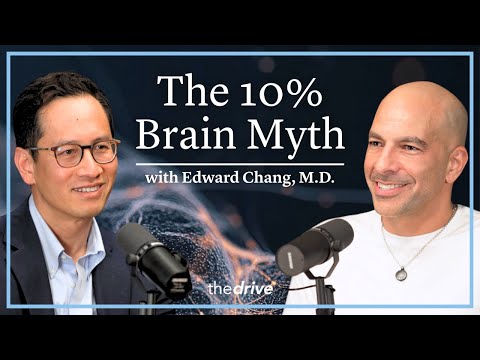
[@PeterAttiaMD] Do We Really Use Only 10% of Our Brain? | Edward Chang, M.D.
![[@PeterAttiaMD] Summarizer](https://summaries.pages.dev/img/logo.webp)
Link: https://youtu.be/e6wWw2B3Dz0
Short Summary
Here's a breakdown of the provided transcript:
-
Most Important Action Item/Takeaway: Understand that the brain has redundancy and plasticity, allowing for functional reorganization after damage or removal of certain areas. This is crucial in neurosurgical planning.
-
Executive Summary: This discussion highlights the brain's remarkable ability to adapt and compensate for injury or surgical removal. Functional redundancy, especially in areas like the frontal lobe, and synaptic plasticity allow for the brain to reorganize itself over time, shifting functions from one area to another, often facilitated by the corpus callosum which is the information highway that connects the left part of our brain from the right side. This understanding informs neurosurgical decisions and helps manage patient expectations.
Key Quotes
Here are four quotes extracted from the transcript that represent valuable insights:
-
"There is maybe about 10 or 15% that um is very critical for our basic functions, our ability to move, to talk, you know, to see etc. It's actually a lot more than that. But um it's also referring to this point that there are parts of our brain actually that are extremely redundant with other parts of the brain." (This clarifies the misconception of only needing 10% of the brain, highlighting the importance of a larger portion for basic functions while acknowledging redundancy.)
-
"If someone's been having something that's slower growing there and there's been time for the brain to reorganize, what we call plasticity, a lot of those functions will essentially no longer be in that right frontal lobe and they've moved to the left side." (This illustrates the remarkable ability of the brain to adapt and reorganize function in response to slow-growing lesions.)
-
"Well, part of it is that both parts of the frontal lobe for people, most people are are both doing the function most of the time. So, it's not like it's just transferring the information. It's that both sides were originally, you know, involved in those functions and then one side gets weaker and the other one has to pick up that slack." (This gives insight into how the brain is able to take over functions in one part of the brain from another.)
-
"Every time we learn a new word, those are new synapses that have formed that were never there, new connections." (This illustrates the dynamic nature of the brain and how learning physically changes our neural connections.)
Detailed Summary
Here's a detailed summary of the YouTube video transcript, focusing on the core topics and excluding advertisements:
-
Neurosurgery & Functional Considerations:
- The initial question revolves around how neurosurgeons determine what to remove during surgery, particularly concerning functional areas of the brain.
- The discussion explores the "tradeoff" between removing a tumor (e.g., meningioma) and preserving brain function.
- The location of the tumor matters significantly. Tumors in areas with critical functions might necessitate awake surgery to guide resection.
-
Brain Real Estate & Redundancy:
- The analogy of "expensive" vs. "cheap" brain real estate is used, though it's emphasized that all brain tissue has value.
- The myth that we only use 10% of our brain is addressed and debunked. While a smaller percentage is critical for basic survival, there's significant redundancy in other areas.
- The frontal lobes are used as an example of redundancy. Surgeons can often remove parts of the frontal lobe with limited noticeable impact.
-
Frontal Lobe Function & Plasticity:
- While the frontal lobe is important for executive function, decision-making, and impulse control, other parts of the brain can compensate if a portion is damaged or removed.
- If a lesion grows slowly, the brain can reorganize, a process called "plasticity," allowing functions to shift from the affected area to other regions (e.g., the opposite frontal lobe).
- Significant differences in the outcome may arise based on if the procedure is performed on the left or right side of the brain.
-
Mechanism of Brain Reorganization (Plasticity):
- The brain's ability to reorganize takes time (weeks, years) and involves gradual compensation by other neurons.
- Synaptic plasticity is key: the "weights" or strengths of connections between neurons change. Learning involves forming new synapses or adjusting existing ones.
- Both parts of the frontal lobe are generally involved in performing the same function. The side less compromised will take over.
- The corpus callosum, a structure connecting the left and right hemispheres, is crucial for communication and information transfer during reorganization.
-
Corpus Callosotomy (Splitting the Brain):
- Roger Sperry's Nobel Prize-winning work on patients with severed corpus callosum is mentioned, leading to the description of split-brain patients essentially having two independent functioning brains.
- The primary reason for corpus callosotomy is to treat severe epilepsy.
-
Consequences of Severing the Corpus Callosum:
- The discussion ends by teeing up the question of how patients behave after undergoing a corpus callosotomy, however, the video ends at this point.