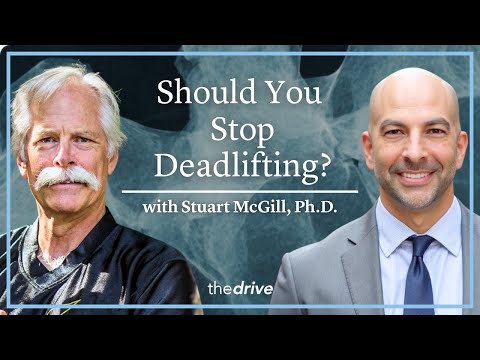
[@PeterAttiaMD] Should You Stop Deadlifting at a Certain Age? | Stuart McGill, Ph.D.
![[@PeterAttiaMD] Summarizer](https://summaries.pages.dev/img/logo.webp)
Link: https://youtu.be/LQm_qB6qy1Q
Short Summary
Here's the breakdown of the YouTube video transcript:
-
Number One Takeaway: Re-evaluate fitness goals to prioritize longevity and sustainable athleticism over chasing personal bests in exercises like deadlifts. Focus on "sufficient" strength, mobility, and endurance to maintain functionality and play with grandchildren at 80 instead of potentially facing injuries from maximal effort training.
-
Executive Summary: The speakers discuss the risks versus rewards of exercises like deadlifts, particularly as one ages. They advocate for shifting focus from maximal performance to sustainable fitness that prioritizes longevity and functional strength through diverse movements and sufficient rather than maximal exertion. This approach aims to preserve joint health and ensure continued physical capabilities into older age.
Key Quotes
Here are four quotes extracted from the YouTube transcript that represent valuable insights or strong opinions:
-
"Most people experience micro fracturing just underneath the end plate of the tbecular bone. Um, if you look at the great strength athletes, they train deadlift...If you deadlift in another 3 or 4 days, the way some trainers, they might deadlift a client three times a week, that allows those micro fractures to accumulate until finally you've got a full-blown end plate fracture or whatnot." This highlights the potential risks of overly frequent heavy deadlifting, especially for those pursuing personal bests.
-
"Would you rather, as your goal, have the ability to play with your grandchildren on the floor when you're 80 and get off the floor and pick them up?" This offers a powerful reframe of fitness goals, prioritizing long-term functional ability over sheer strength.
-
"Now they're thinking of the word sufficient strength, sufficient mobility, sufficient endurance." This encapsulates a key shift in mindset, moving away from maximal effort towards a more sustainable and well-rounded approach to fitness.
-
"It sounds crazy, by the way, that your V2 max and your grip strength are better predictors of how long you're going to live than whether or not you smoke, drink, uh what your family history is for cancer. Like, those things all matter, but it's amazing how dwarfed they are by those two." This presents a surprising and compelling case for the importance of V2 max and grip strength as longevity biomarkers.
Detailed Summary
Here's a detailed summary of the YouTube video transcript in bullet points, excluding advertisements:
Key Topics & Arguments:
-
The Deadlift Dilemma: The discussion revolves around the risk-reward ratio of deadlifts, particularly for middle-aged individuals or those concerned with longevity.
-
Conflicting Perspectives: The speaker expresses internal conflict between enjoying deadlifts as an "audit" for stability and recognizing the potential for injury, particularly with axial loading.
-
Alternative Exercises: The argument is made that single-leg exercises can provide similar muscle activation to deadlifts with significantly less axial loading and risk.
-
Goal Reassessment: The importance of aligning fitness goals with long-term well-being (e.g., playing with grandchildren at 80) is emphasized over chasing personal bests in deadlifts.
-
Microfractures and Bone Callus: It is mentioned that setting personal bests in deadlifts can cause microfractures, and the bone callus takes a week to strengthen. Deadlifting multiple times a week can lead to an end-plate fracture.
-
Sustainable Athleticism: The conversation promotes a shift towards "sufficient strength, sufficient mobility, sufficient endurance" rather than maximal effort lifts.
-
The Importance of Grip Strength and VO2 Max: Grip strength and VO2 max are stated as predictors of longevity. Grip strength is seen as the result of consistent work.
Detailed Information & Points Made:
- The speaker acknowledges past "brute force stupidity" when deadlifting and now understands the importance of proper form (tension in arms, intra-abdominal pressure, foot pressure).
- Deadlifting is described as having a "narrow operating window" where injury is possible.
- Some people are told to walk backward up hills to work their glutes instead of doing deadlifts.
- Powerlifters will typically train heavy deadlifts and squats once a week
- The story of Ed Conn is mentioned in the context of the demands placed on the body when setting a personal best.
- Monster walks and neurological grip techniques (engaging glutes) are presented as alternatives to traditional weightlifting for building strength and stability.
- The podcast believes that hip replacements happen to middle-aged women who did yoga for 30 years and middle-aged men who've done deadlifts all their life. Hip replacements don't tend to happen to "the middle of the road moderates."
- The speaker does not deadlift anymore but splits wood with logs.