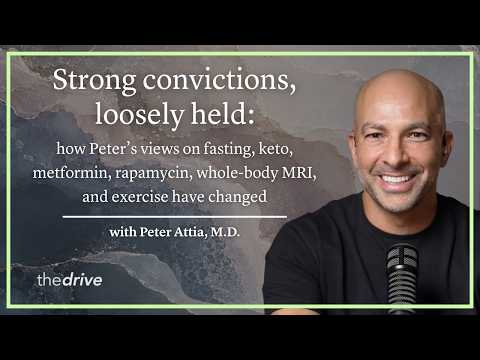
[@PeterAttiaMD] Strong convictions, loosely held: how Peter’s views on fasting, keto, exercise, & more have changed
· 5 min read
![[@PeterAttiaMD] Summarizer](https://summaries.pages.dev/img/logo.webp)
Link: https://youtu.be/6DR8E5QJoCY
Duration: 17 min
Transcript: Download plain text
Short Summary
Peter Attia, host of The Drive podcast, marks its 400th episode (~8 years) by revisiting prior strong convictions, including his views on the ketogenic diet and extended fasting. He now argues metabolic dysfunction stems from energy imbalance rather than hyperinsulinemia, and estimates ~3 days of fasting is needed to meaningfully elevate autophagy.
Key Quotes
- "if you were to write out live 10 years from now, do you think it would be the same book that you wrote you know, 3 years ago and I would say no. I in fact that would be concerning if it were the same book in 10 years as it was at the time it was written cuz it would either suggest I'm too rigid in my thinking or science has made no progress and I think both of those would be would be challenging." (00:01:36)
- "I know I get sort of uh labeled as someone who's anti-keto diets and stuff like that um by by various people out there and and I I just find that to be the most comical uh critique of me because not only was I on a ketogenic diet for 3 years, it was probably the best I ever felt." (00:05:59)
- "I used to believe that the diet worked through insulin suppression. Um but today I I don't think that's the case. Today, I think the diet works um for the same reason many restrictive diets work, which is it makes it easier to control energy intake." (00:08:00)
- "the metabolic dysfunction, the visceral fat accumulation, the ectopic fat accumulation, the insulin sensitivity deteriorating, all of these things are the result of the energy imbalance, and hyperinsulinemia is along for the ride, but if you magically address the hyperinsulinemia without addressing the energy imbalance, you're not going to fix these problems." (00:09:09)
- "somewhere around 3 days seem to be where where you could really sort of juice autophagy levels beyond what you would get from exercise or other things like that." (00:13:53)
Detailed Summary
400th Episode: Revisiting Strong Convictions Loosely Held
Episode Context
- This is the 400th episode of The Drive podcast, marking approximately 8 years since the show began.
- Peter Attia uses the framework "strong convictions loosely held," a phrase he first heard from a hedge-fund friend applying it to investment theses.
- He says a book written today versus 3 years ago would differ, and a 10-year-old unchanged book would imply either rigidity or stagnant science.
Triggers for Changing His Mind
- New literature, expert conversations on the podcast, and direct patient/clinic experience are the three main drivers of view updates.
- Changes range from subtle nuance to full course corrections.
Ketogenic Diet: Updated View
- Attia was an early adopter of the ketogenic diet from a longevity perspective and considers metabolic disease the foundational chronic disease risk.
- He followed a ketogenic diet for 3 years and described that period as when he felt his best; he stopped due to restrictiveness, not efficacy doubts.
- His logged data shows average morning fasting beta-hydroxybutyrate of 1.8–2 millimoles across the 3-year period, indicating deep ketosis.
- Shift in mechanism: Previously he believed keto worked via insulin suppression; he now believes it works because restrictive diets make it easier to control energy intake, combined with satiety and endogenous fatty acid oxidation during weight loss.
- Current metabolic thesis: Metabolic dysfunction, visceral and ectopic fat accumulation, and declining insulin sensitivity are results of energy imbalance; hyperinsulinemia is secondary. Fixing insulin without fixing energy balance will not resolve these issues.
- A ketogenic eater in persistent energy imbalance may fail to lose weight or even gain weight.
- He is "sometimes labeled anti-keto," which he calls the most comical critique given his 3-year history on the diet.
- He recommends a minimum of 1.4 g of protein per kilogram of body weight and is largely indifferent to whether patients hit that target via ketogenic, low-fat, or mostly pescetarian diets.
Extended Fasting and Autophagy: Updated View
- For about 3 years, Attia practiced quarterly 7- to 10-day fasts, with 3-day fasts in the other two months of each quarter, motivated by promoting autophagy rather than weight loss.
- Autophagy is the cellular process of breaking down and recycling old intracellular proteins and structures, preferentially targeting damaged or senescent cells.
- Unlike ketosis (an approximate threshold of 0.5–1 mmol fasting beta-hydroxybutyrate), autophagy is analog rather than digital.
- Based on preclinical data and expert opinion, he estimates roughly 3 days of fasting is needed to substantially elevate autophagy beyond what exercise or other interventions produce.
- He stopped extended fasting due to a combination of evolving evidence and personal cost, although extended fasting clearly promotes autophagy in preclinical models.
Premium Membership & Resources
- Outro promotes Peter Attia MD premium membership at peterattiamd.com/subscribe.
- Benefits include: comprehensive show notes, monthly topic-focused AMA episodes, a premium newsletter produced by a dedicated research analyst team (deeper than the free weekly newsletter), a private podcast feed including AMAs without the promotional outro, and Qualys (a members-only highlight reel of best excerpts).
- Peter Attia is on YouTube, Instagram, and Twitter as @PeterAttiaMD; disclosures/investments/advisory roles are listed at PeterAttiaMD.com/about.
- The podcast is explicitly for general informational purposes only and does not constitute medical advice or a doctor-patient relationship.