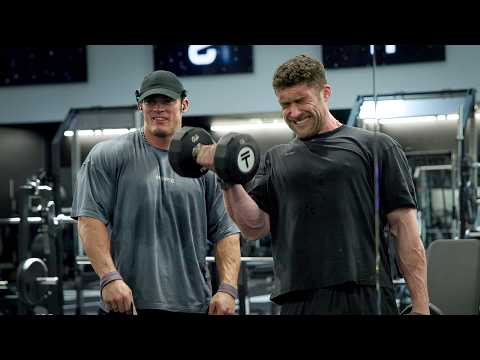
[@ChrisWillx] A heavy arms day with Sam Sulek.
![[@ChrisWillx] Summarizer](https://summaries.pages.dev/img/logo.webp)
Link: https://youtu.be/r9-VBStgKOM
Duration: 42 min
Transcript: Download plain text
Short Summary
In this episode of "Arms building Brawn and Brain" with Chris Williamson, a guest bodybuilder discusses training philosophy, exercise selection, and injury stories. Sam explains why he skips shoulder pressing because his shoulders already look big, argues that bulky arms with small shoulders look worse than small arms with broad shoulders, and shares his tricep rope pushdown progression from 2-second holds to no holds.
Key Quotes
- "Well, it's it's not for the point of enduring the discomfort. It's knowing that you gave 100." (00:33:04)
- "It's every kid that was forced to be Christian growing up that's now like super cool atheist bro like a religion sucks man." (00:12:32)
- "It's more grippy. It's like I want to I want to put enough like neural signals into my biceps and you got to hold the dumbbell, but I don't want to be send in my head. I feel like you've got a certain amount of bandwidth that you can send to really fire. So, if I'm wasting 30% of my bandwidth on forearms, what's happening with my biceps? Are they not getting as much? Which might just be overthinking, but it's just how I think about it." (00:14:36)
- "It's the Tom Flats in you. Yeah." (00:33:36)
- "but the mental angle of my enjoyment of that is worth curling something that most people press is never not going to be satisfying." (00:15:38)
Detailed Summary
Episode Overview
This is an installment of the "Arms building Brawn and Brain" segment with Chris Williamson, featuring an extended conversation with a guest bodybuilder (often labeled "Sam" in the evidence) who shares training philosophy, exercise technique, injury anecdotes, and reflections on competition, geography, and gym environments. The discussion ranges across exercise selection, programming tactics, gym culture, and the personal philosophy behind competition prep.
Training Philosophy and Body-Composition Priorities
Sam frames physique priorities around proportion rather than chasing maximum muscle mass everywhere. He pushes back on the default assumption that everyone should treat arms as a top training priority.
- Sam argues most men should prioritize shoulders before arms, claiming that big arms on small shoulders make a physique look like a "fat guy," while small arms on broad shoulders look like a "football player."
- He has not performed a real shoulder press in roughly 3–4 years because he believes his shoulders are already large enough relative to his arms.
- On a 3-day split he would pair chest with back, then do shoulders and arms together—effectively skipping dedicated shoulder work for the same reason.
- For ab work, he prefers weighted crunches down the midline (aesthetic) over weighted side bends around 100 lb that thicken the waist.
Exercise Technique Details
Sam walks through several movements he considers staples, focusing on grip, position, and small cues that change which muscle does the work.
- Tricep rope pushdown: He holds 2 seconds at the top and bottom, shortens to 1 second, then drops holds entirely because the rope is hardest where the hands are furthest from the elbows.
- Tricep setup preference: He favors bottom-mounted rope tricep extensions ("up and over") for stretching the long head, and uses an easy bar at shoulder height pinned against the machine.
- Curls: Gripping the dumbbell at the bottom of the handle gives more bicep work than holding the top (which he labels "ego lifting").
- Straps on curls: Used to redirect neural bandwidth—estimated at 30%—away from forearm grip and toward the biceps.
- Dumbbell curl weight: Curling weight heavy enough that most people would press it is "mentally satisfying" even at the cusp of being unproductive.
Programming and Failure Tactics
Sam's programming mindset treats the first set of a workout as disproportionately important and embraces advanced failure techniques when they serve a purpose.
- Sam treats the first set of a workout as "setting the tone" (compared to January 1st setting the tone for the year) and once racked a hamstring curl set abruptly, realizing he "could have done five more reps" and that the set was effectively just a warm-up.
- He endorses "Maya reps", a rest-pause set where final reps are repeated with about 3-second rest gaps, allowing up to roughly 10 reps beyond failure.
- Assisted reps beyond failure have value, especially when travel reduces total training volume, though he prefers going to failure in the correct rep range normally.
Form, Safety, and Dorian Yates Commentary
Form standards are discussed as a safety issue rather than a vanity issue, with a notable disagreement from Dorian Yates on RIR training.
- Dorian Yates currently opposes "reps in reserve" training, arguing that strict form standards cause RIR to creep upward.
- Partials on a heavy incline barbell press without a spotter are flagged as especially dangerous when fatigued.
- There is a limit to ugly form: "you can do a nasty set of curls but not a nasty squat," and Sam criticizes lifters who prioritize looking the part on social media over training hard.
Injury Anecdotes and Medical References
Several injury stories illustrate the consequences of ego lifting, fatigue, and bad positioning, with reference numbers attached.
- Sam recalls a CrossFit Regionals competition a few years ago with roughly 10 pectoral injuries caused by dips.
- He reports fully rupturing an Achilles tendon 6 years ago and strongly recommends avoiding one.
- At around 170 lb in high school, he threw a 100-lb dumbbell overhead from a flat bench, fell backward onto his head, and never repeated the stunt.
- At age 19 in a university gym, he kicked 25 kg (~55 lb) dumbbells 3/4 of the way up on an incline press, lost his right hand, and bailed the dumbbell off his face where it had rested on his nose.
Gym Environment, Heat, and Conditioning
The physical training environment—including heat, layout, and atmosphere—shapes training quality and selection of gyms.
- His gym has no air conditioning, forcing 78–80°F sessions in long pants and no mid-workout water—easier this summer because he is dieting rather than bulking.
- There is no one rule for a good gym: he has trained everywhere from windowless basements to multi-million-dollar pro facilities, and highlights a Michigan gym in a former bank where a vault contains a squat rack and bench.
Competition and Motivation
Sam is not currently chasing a show date and is internally driven, using competition as a checkpoint rather than a validation source.
- No show is currently on the horizon; he wants the next one to be worth doing and would prefer to slowly gain weight for 4–6 months while staying lean first.
- His validation does not come from shows; his first two wins were just "proof of work," and he would be similarly proud without competing.
- Sam is internally motivated by getting bigger and stronger rather than external validation, though social validation acts as a performance booster.
Hard Sets and Mental Toughness
The hardest sets are described in almost physiological terms, with reframes meant to keep suffering productive rather than performative.
- Sam experiences seeing stars, ringing ears, and tunnel vision only after leg sets, never upper-body, and fantasizes about a set hard enough to pass out onto safeties without injury as mental fuel.
- Suffering in hard sets is reframed: "it isn't about masochism, it's about knowing you gave 100% effort."
Lifestyle and Geography
Location preferences are filtered through climate tolerance, lifestyle pacing, and what he eventually wants in a permanent base.
- He currently lives in Ohio and would not consider New York because of the "hustle and bustle."
- Texas heat was too hot and may have crossed it off his list for future moves.
- He loves Bozeman/Montana but considers it "uninhabitable for 8 months of the year" and frames a ranch purchase as a "late game" decision.
- Vegas is "not too hot" for him; he notes "Death Valley is in Vegas" to illustrate U.S. climate variety.
- He ultimately wants somewhere warmer, not hot, with gyms everywhere—preferably building his own.
Athlete Reference Points
Sam uses observations of elite athletes in weightlifting and MMA to illustrate how selection criteria and training specialization create extreme physiques.
- Chinese Olympic weightlifters are described as being selected for long torsos and short legs; they perform ~100 kg behind-the-neck weighted GHD sit-ups and squat ~300 kg with very upright torsos owing to ankle flexibility.
- UFC Dagestani wrestlers are described as visually dominated by back erector muscles (covering roughly 95% of their physiques) that they use to smother opponents from top position.
- Dagestan-adjacent lifters also squat ~300 kg completely upright with no forward torso bend.
Introducing Kids to Lifting
The conversation pivots to whether and how to get kids interested in strength training, with both practical examples and a softer philosophy about pressure.
- One speaker started a kid with a 30 lb dumbbell set in his bedroom, doing about 20 curls between Fortnite games.
- A joking Christmas gift idea floated: a pair of 25 lb dumbbells for a 14-year-old without instructions.
- Kids cannot be forced into the gym—pressure tends to turn them off, similar to how forced religion is often rejected later.
Sign-Off
The segment closes as "Arms building Brawn and Brain with Chris Williamson."