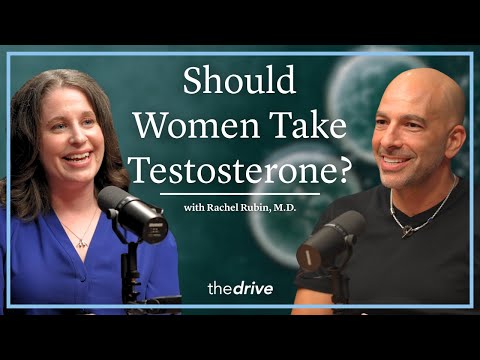
[@PeterAttiaMD] Testosterone for Women: Myths, Truths, and Real Benefits | Rachel Rubin, M.D.
![[@PeterAttiaMD] Summarizer](https://summaries.pages.dev/img/logo.webp)
Link: https://youtu.be/czA7AHaujKU
Short Summary
Number One Takeaway:
Testosterone plays a crucial, often overlooked role in women's health, impacting libido, urinary health, and potentially mood, and its natural decline starting in the 30s can significantly impact women's well-being.
Executive Summary:
The speaker emphasizes the importance of testosterone in women's health, noting its age-related decline and impact on various bodily functions, from libido to urinary health. Testosterone replacement therapy can be beneficial, particularly when combined with estrogen and progesterone, and often helps women regain a sense of their former selves. Despite societal misconceptions and limited FDA-approved options, the speaker believes providing testosterone therapy as an option should be more widely considered.
Key Quotes
Here are four direct quotes from the transcript that represent valuable insights or strong opinions:
- "When you normalize those to the same level, women are shocked to learn that they have 10 times the amount of testosterone in their body that they do estradile at peak estradi. We way more, right? And I love sharing that. Right? When you put everything in the same units, we are testosterone driven beings. Both of us, right? Are testosterone driven beings."
- "We love to gaslight women and say, well, if you have your period, your hormones are normal. It drives me insane."
- "Birth control is high dose. I would argue, you know, sort of the hormone therapy we're talking about in the WHI that is more synthetic, that has side effects that have issues like that. So, birth control turns off your ovaries and it adds back ethinal estradiol and a synthetic progesterine. It doesn't add back testosterone. So, we are botching testosterone for women sort of for along the life cycle to be honest."
- "When we add that testosterone piece, I it's wild. All the the patients come back and they say to me, "Wow, I feel like me again." It's wild, right? That's the piece. Wow, I didn't realize how badly I felt. Wow, that was the missing piece. I hear it over and over and over again. I can't not want that for all women, right? can't not want to give them that as an option on the menu."
Detailed Summary
Here's a detailed summary of the YouTube video transcript, focusing on the key topics, arguments, and information discussed, excluding sponsor announcements and advertisements:
-
Testosterone in Women: An Overlooked Hormone
- Testosterone is often overlooked in discussions about women's hormonal health, despite its importance.
- The speaker emphasizes that women have significantly more testosterone than estradiol when measured in the same units.
- Testosterone plays a vital role in women's overall health, not just sexual health.
-
Age-Related Decline and Effects
- Testosterone levels in women start to decline in their 30s.
- This decline isn't necessarily tied to menopause; it's more age-related.
- Decreased testosterone can lead to various symptoms, including:
- Reduced libido
- Increased risk of UTIs
- Painful intercourse or pelvic pain
- Potential depression and anxiety.
-
Birth Control Pills and Testosterone
- Birth control pills suppress ovarian function and introduce synthetic hormones (ethinyl estradiol and synthetic progestins) but don't replace testosterone.
- Long-term use of birth control can negatively impact testosterone levels throughout a woman's life.
-
Global Consensus on Testosterone Therapy
- Global consensus exists regarding the effectiveness of testosterone therapy for low libido in postmenopausal women.
- Data also supports its use in perimenopausal women, although studies are smaller.
-
Misconceptions and Fear of Side Effects
- Many women and doctors are hesitant to consider testosterone therapy due to fears of masculinizing side effects.
- The speaker highlights celebrity examples (Halle Berry, Kate Winslet) who use testosterone therapy without androgenizing side effects.
- Fear of side effects often prevents women from starting testosterone therapy more than actually experiencing the side effects and stopping.
-
Managing Side Effects
- The most common side effect of testosterone therapy in women is acne.
- Increased hair growth is another potential side effect.
- The speaker uses low doses of FDA-approved testosterone for men, applied topically.
- Pellet implants are not recommended due to supraphysiological levels and difficulty in reversing effects.
-
Benefits of Testosterone Therapy
- Adding testosterone to estrogen and progesterone replacement therapy often has a significant positive impact.
- Patients report feeling "like themselves again" and realize how poorly they had been feeling before.
- Testosterone is often the "missing piece" in hormone replacement for women.
-
Clinical Approach
- Low doses of FDA approved testosterone is administered.
- Use topical application to a location such as the leg so that the person can wax, shave, or laser if they experience increased hair growth.