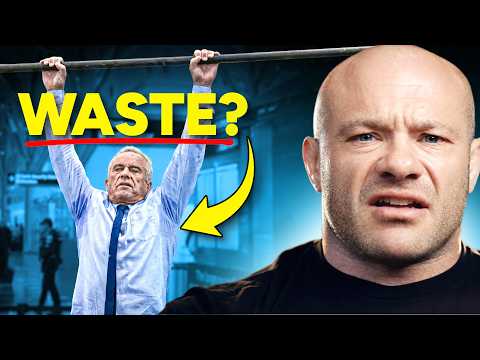
[@RenaissancePeriodization] RFK Is Spending $1B to Make Airports Healthy (Waste of Money?)
![[@RenaissancePeriodization] Summarizer](https://summaries.pages.dev/img/logo.webp)
Link: https://youtu.be/NYKYtmqD00M
Duration: 13 min
Short Summary
President Donald Trump is launching a $1 billion initiative to enhance health access at America's airport infrastructure through federal grants structured as incentives. The program encourages airports to develop facilities such as kids' play areas, nursing rooms, and sensory zones without imposing strict mandates. Experts highlight that while supply and demand drive the limited presence of health-focused businesses, the investment's impact on public health metrics like obesity remains a key consideration for voters.
Key Quotes
Key Quotes
- "A billion dollars doesn't just grow on trees and like is spending it on healthier airports of all places a good idea." (00:00:00)
- "I can't figure out like lifting at the airport and getting sweaty and then like sitting down for a connection. Huh? Did someone think that through?" (00:00:07)
- "Many airports would have already built them with no need for the government to offer incentives. Remember, the people who run the airport have absolutely no conspiracy to sell you fast food. They don't care." (00:00:15)
- "The administration is putting $1 billion in federal grant money toward making airports more familyfriendly and health oriented." (00:00:54)
Detailed Summary
Executive Summary
Dr. Mike and the Speaker discuss the strategic value of a $1 billion federal investment aimed at improving health access within America's airport infrastructure through incentives rather than mandates.
Key Highlights
- Investment Strategy: The administration's approach focuses on encouraging airports to voluntarily build specialized facilities like kids play areas, nursing rooms, and sensory rooms instead of forcing strict compliance.
- Facility Impact: Dedicated kids play areas are emphasized for reducing stress by allowing children to burn energy before flights, benefiting both young travelers and adults.
- Health Food Quality: While Whole Foods offers high-calorie options like meatloaf and General So items, the speaker notes that merely providing healthy food may not be sufficient to drive widespread dietary changes.
- Product Limitations: Specific health-conscious offerings such as Diet Coke are excluded from stores because aspartame is considered a less ideal chemical for health, limiting beverage choices.
- Preparation Methods: General So menu items are highlighted for being fried in organic olive oil and prepared in gigant portions to support healthy eating habits.
- Operational Metrics: Airport operators prioritize per square foot revenue and overall ambiance, often evaluating spaces without necessarily favoring specific business types like health food stores or gyms.
- Adoption Variability: Experts predict uneven adoption where some airports may fully embrace these health improvements while others adopt only bare-minimum measures.
- Market Dynamics: Supply and demand dynamics are identified as the primary drivers for the limited presence of health food and gyms in airports, rather than government incentives alone.
- Health Outcomes: Despite potential benefits, the initiative may not cause a detectable shift in broader public health metrics such as obesity rates and metabolic disorder frequencies.
- Alternative Allocations: Stakeholders debate whether the $1 billion could be more effectively directed toward other sectors such as tax reduction, crime reduction, or military equipment.
- Public Engagement: The value of the billion-dollar spending is framed as a decision for voters, emphasizing the need for broad public support to realize long-term health benefits.
- Resource Alignment: The speaker recommends the RP Diet Coach and RP Hypertrophy apps, linked to Mike Israel's channel, to further support health-conscious behaviors among travelers.