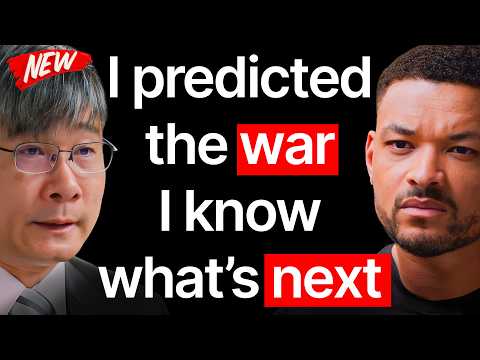
[@TheDiaryOfACEO] WW3 Expert: Israel’s Plan To Conquer The Middle East
![[@TheDiaryofaCEO] Summarizer](https://summaries.pages.dev/img/logo.webp)
Link: https://youtu.be/BTJGr78-zyw
Duration: 131 min
Transcript: Download plain text
Short Summary
This episode features a geopolitics YouTuber who built approximately 2.5 million subscribers in roughly one year after hitting rock bottom following Yale, exploring how global systems—from military empires to financial institutions to media—are artificial constructs maintained through shared belief using Plato's Allegory of the Cave as a philosophical framework. The discussion covers sweeping geopolitical analysis including US petrodollar dominance as a Ponzi scheme, phase one of the Iran war strategy, regional power dynamics involving Russia, China, and Israel, and an 80-90% probability prediction that the Iran conflict escalates to World War III.
Key Quotes
- "If it were not to invade Iran, it would lose its empire. Its empire is based purely on the US dollar, the petro dollar, which is a Ponzi scheme." (00:01:03)
- "Iran is a fortress." (00:05:13)
- "The Western Hemisphere belongs to the United States." (00:10:00)
- "Losing the war means that America would send ground troops. Iran would survive this invasion and this would be so politically damaging that chaos breaks out the United States and the US guard invasion is forced to retreat and the United States is forced to retreat from the Middle East." (00:13:37)
- "Trump getting a third term is not illegal. So, let me explain the loophole." (00:31:03)
Detailed Summary
Detailed Summary: Geopolitics, Power Structures, and the Coming World Order
Introduction: A Geopolitics Educator's Rise
This episode features an interview with a geopolitics YouTuber who achieved extraordinary growth—approximately 2.5 million subscribers in roughly one year—after experiencing profound personal failure following Yale. The discussion explores how global power structures operate as artificial constructs maintained through collective belief, using philosophical frameworks to demystify geopolitics and history for everyday audiences. The guest's stated mission centers on sharing truth with others while remaining open-minded and brave for his family rather than pursuing fame or wealth.
Philosophical Foundation: Plato's Cave as a Theory of Power
The guest reimagines Plato's Allegory of the Cave as a diagnostic tool for understanding modern power structures. He argues that reality itself is constructed through human imagination—shadows on the wall that societies collectively agree to treat as truth. This framework establishes the central thesis that global systems are maintained not by inherent necessity but by shared belief and mutual reinforcement.
Five Interconnected Layers Maintaining Global Power:
- Layer 1 comprises the military-industrial complex and empire forces that physically constrain populations through force projection
- Layer 2 consists of the financial elite, including the Bank for International Settlements in Basel, the SWIFT network, Wall Street, the City of London, and the Federal Reserve, which control currency exchange rates and money supply
- Layers 3-4 involve multilateral organizations such as the World Bank, United Nations, and World Trade Organization that present themselves as impartial global controllers
- Layer 5 encompasses media, Hollywood, and the education system that convince populations that established power structures are legitimate and natural
The guest emphasizes that this system is inherently fragile—anyone refusing to cooperate could theoretically collapse it—but everyone remains incentivized to maintain the edifice for personal survival.
Enforcement Mechanisms and the War for Reality
As younger generations increasingly reject traditional narratives, the system requires more authoritarian enforcement mechanisms to maintain control. The guest identifies censorship, deplatforming, Diversity, Equity, and Inclusion (DEI) initiatives, and woke politics as tools deployed to control public perception and prevent questioning of official narratives.
Tech-Media Power Struggles:
- Google and Facebook captured 70-80% of global advertising revenue, creating direct conflict between traditional mainstream media and tech platforms
- The guest frames current global conflicts as a "war for the fundamental nature of reality" between traditional Wall Street bankers and tech-aligned figures including Larry Ellison, Peter Thiel, and Sam Altman
- "Operation Stargate" is referenced as an initiative associated with AI development under tech leadership
- The system requires young people to accept narratives they instinctively reject, necessitating increasingly visible coercion
Cyclical Empire Theory and Decline Predictions
Drawing on Ray Dalio's cycle theory and Oswald Spengler's organic empire model, the guest predicts a "very strong possibility" that the American empire will collapse within 5-10 years. He identifies three consistent factors that historically precede imperial collapse: excessive debt, corruption, and inequality. Historical analysis suggests empires typically last approximately 200 years before experiencing rise and fall cycles.
Philosophical Frameworks Informing Analysis:
- Hermetic philosophy from ancient Egypt proposes that "reality is energy" and consciousness is what is truly real
- The hermetic principle "as above, so below" suggests humans are fractals of divine consciousness whose individual choices directly impact the world
- Kabbalah's "tree of life" framework is presented as governing human affairs through thesis, antithesis, and synthesis
- Multiple physicists are referenced as describing consciousness as fragmented into many pieces to experience physical reality
US Empire and Petrodollar Analysis
Professor Dian characterizes the US empire as based purely on the US dollar and the petrodollar system, which he describes as fundamentally a Ponzi scheme. The American response to the Russia-Ukraine war involved sanctioning Russia, removing it from the SWIFT financial messaging system, and freezing over $200 billion in Russian sovereign assets. The professor argues this violated the political neutrality required for the dollar's reserve currency status, undermining the foundational credibility that sustains global dollar dominance.
Structural Vulnerabilities:
- The petrodollar system requires continuous expansion to maintain obligations, characteristic of Ponzi dynamics
- Freezing Russian assets demonstrated that dollar-denominated holdings can be confiscated, encouraging diversification away from dollar reserves
- Removing Russia from SWIFT accelerated development of alternative financial messaging systems among BRICS nations
Venezuela Operation and the Donro Doctrine
On January 3rd, Delta Force conducted an operation in Venezuela where Maduro was reportedly kidnapped and completely surrendered. Trump subsequently took control of Venezuela, which possesses the world's largest proven oil reserves. The administration is characterized as threatening Canada, Greenland, Mexico, and Colombia to enforce what is termed the "Donro Doctrine"—Trump's corollary to the Monroe Doctrine asserting complete US hegemony over the Western Hemisphere.
Western Hemisphere Control Strategy:
- The National Defense Strategy is presented as a Department of War document outlining America's four-point program to maintain global dominance
- The US has deployed approximately one-third of its naval assets to the Caribbean to enforce the Donro Doctrine
- NATO requirements include member nations paying for their own defense and fighting Russia in Ukraine while America provides weapons and financing
- America's strategic posture involves controlling strategic maritime chokepoints including the Strait of Hormuz, Strait of Malacca, Panama Canal, Greenland, and Gibraltar
Phase One Iran War Strategy
Phase one of the Iran war began on February 28th and lasted approximately six weeks, with the explicit intention of regime decapitation through strikes on Iranian military installations. Iran responded by attacking US bases throughout the Gulf Cooperation Council (GCC) nations, closing the Strait of Hormuz—which is only approximately 33 kilometers across at its narrowest point—and rallying domestic political support rather than surrendering.
Three-Pronged US Strangulation Strategy:
- Establishing forward operating bases to incite ethnic violence among Baloch and Kurdish insurgent groups inside Iran
- Blocking the Strait of Hormuz to cut off Iranian financing and energy revenues
- Strangling Tehran economically to force civilian populations to demand political settlement from their government
The US is characterized as lacking the political will, manufacturing capacity, and risk tolerance to fight an effective ground war in Iran given its mountainous terrain and 92 million population.
Iran's Military Structure and Resistance Capacity
Iran operates a dual political system where theocratic clerics control morality and foreign affairs while a parallel secular state apparatus manages day-to-day governance. The country maintains two parallel military structures: the regular Iranian military and the Islamic Revolutionary Guard Corps (IRGC), which is loyal only to religious mullas and views its mission as a global religious crusade against the "great Satan" (the American Empire).
IRGC Mosiaak Strategy:
- Each of Iran's 31 provinces operates with localized command and control structures functioning as 31 independent armies with separate leadership
- This decentralized structure resists centralized US targeting because destroying one provincial command does not degrade the others
- Iran's proxy network includes Hezbollah in Lebanon, Houthis in Yemen, and Hamas in Palestine, forming what Tehran calls an "axis of resistance"
- Ceasefire negotiations are described as "for show" because the IRGC controls the battlefield and would not accept peace terms that undermine its religious mission
Russia's Third Rome Strategy and Shadow Fleet
Russia's grand strategy is termed the "Third Rome" doctrine, based on the belief that Russia is the true spiritual and political successor to the fallen Roman Empire. Aleksandr Dugin authored "Foundations of Geopolitics" in 1997, advocating for Eurasian alliances that would challenge Western Atlanticism. Russia's army and artillery are currently concentrated in Ukraine, with Odessa identified as the next strategic objective after eastern Ukraine is fully secured.
Russian Economic Warfare Capabilities:
- Russia operates a shadow "shuttle fleet" of approximately 1,000 tankers that evade international sanctions worldwide
- This fleet enables Russia to continue oil exports despite Western sanctions regimes
- Russia could place Iran under its nuclear umbrella, effectively negating the option for Israeli or US tactical nuclear weapons in any regional conflict
China's Energy Vulnerability and Belt and Road
China receives approximately 50-60% of its energy needs from Middle Eastern sources. The first island chain—an arc of islands between Japan and Taiwan blocking Chinese access to the Pacific Ocean—creates strategic vulnerability. Positioning naval carriers in the Strait of Malacca would cause China to lose approximately 90% of its energy exports, creating an economic stranglehold.
Strategic Implications:
- China's Belt and Road railway system could potentially reinforce Iran from the east, bypassing naval chokepoints
- Economic modeling suggests China would face catastrophic energy shortages if Malacca access were blocked
- This vulnerability shapes Chinese foreign policy toward Middle Eastern stability
Israel's Greater Israel Project
Israel's grand strategy is identified as the "Greater Israel Project," aiming to conquer the territory from the Nile to the Euphrates based on biblical promises to Abraham. Israel operates through three primary attack vectors: Mossad intelligence operations, mobilization of the Jewish diaspora globally, and the Bible as a tool for garnering Christian Zionist support among evangelical Christians.
Strategic Sequencing:
- Turkey is identified as the next target after Iran in regional strategic planning
- The guest characterizes the conflict as fundamentally religious rather than merely political
- Biblical references to Abrahamic covenant provide ideological framework for territorial expansion
Trump Predictions and Constitutional Analysis
Trump launched the tariff war against China, which Biden subsequently institutionalized rather than reversing. Trump is predicted to seek a third term through unconventional constitutional mechanisms: either via Donald Jr. running as president with Trump as Vice President, followed by abdication, or using emergency war powers to delay elections. Trump appointed 3 of 9 current Supreme Court justices with the possibility of a fourth appointment if another justice retires.
Psychological and Political Assessment:
- Trump's psychological belief holds that he won the 2020 election but Democrats stole it through fraud
- He reportedly believes the government owes him a second full term as compensation
- The prediction framework suggests these beliefs will drive unconventional political actions
Emerging Flashpoints and World War III Probability
Three major flashpoints of conflict are identified as emerging in East Asia: Taiwan, the Strait of Malacca, and North Korea. Seoul is located within approximately 20 minutes artillery range from North Korean border positions, creating extreme vulnerability. The speaker assigns an 80-90% probability that the Iran conflict will escalate to World War III given the involvement of multiple great powers.
Global Food Security Analysis:
- Russia and Ukraine together export approximately one-third of the world's grain and carbohydrates
- Steve Keen argues the world has 8 billion people but without fertilizer could only sustain 2 billion people
- AI and robotics cannot solve food production because humans require food grown from ground using fertilizer—technology cannot replace agricultural inputs
- If the US does not invade Iran, other nations would choose to stop trading with America or buying US Treasuries, causing the empire to collapse
Bronze Age Collapse Parallels
The speaker identifies the Bronze Age collapse approximately 3,000 years ago as the closest historical parallel to contemporary geopolitical conditions. Major civilizations that collapsed included Mycenaean Greece, the Hittite Empire, the Mesopotamian Empire, and Egypt—all simultaneously experienced systemic failure following centuries of prosperity.
Collapse Dynamics:
- The Bronze Age collapse occurred across multiple interconnected civilizations, suggesting systemic risk from overcomplexity
- Climate change, migration pressures, and internal inequality combined to create cascading failures
- The guest suggests current conditions—debt, inequality, corruption, and climate stress—mirror pre-collapse Bronze Age dynamics
Personal Journey: From Yale Rock Bottom to 2.5 Million Subscribers
The guest reveals he met his wife approximately 10 years ago after hitting rock bottom following Yale, experiencing decades of failure, depression, and hopelessness with no job or income. His wife loved him unconditionally, told him to believe in himself, and demonstrated this commitment by having a child with him—which he describes as "the ultimate sacrifice." She discouraged him from lucrative consulting work that earned approximately $1 million per package helping Chinese students gain admission to Ivy League schools, encouraging him to be true to himself instead.
Channel Statistics and Mission:
- The YouTube channel has approximately 146 videos with some reaching nearly 10 million views
- This growth rate is characterized as unprecedented for geopolitics and history content
- The host learned of the guest through viewers demanding his appearance in comment sections
- The guest states he could easily create a media education company similar to Jordan Peterson but prefers sharing directly with audiences rather than building a personal empire
- He would not be unhappy if YouTube closed his channel tomorrow because his source of creativity is love for his family, not the platform
- His central message: everyone has the capacity to learn truth for themselves—it is only a question of desire and will