[@alux] Earned Income vs Capital Gains: Why the Rich Pay Less Tax
![[@alux] Summarizer](https://summaries.pages.dev/img/logo.webp)
Link: https://youtu.be/2Uvnbqf0dRI
Short Summary
Number One Takeaway: Prioritize building or acquiring income-generating assets over solely relying on earned income from a job, to benefit from favorable capital gains tax rates and achieve long-term financial freedom.
Executive Summary: The video highlights the significant tax advantages of capital gains over earned income, explaining why the wealthy disproportionately benefit from asset ownership. To build wealth, individuals should focus on acquiring assets that appreciate in value and generate income, as these are taxed at lower rates than traditional salaries, ultimately leading to greater financial independence.
Key Quotes
Here are five quotes from the video that I found particularly insightful:
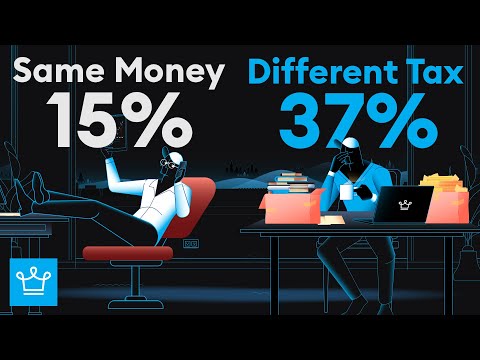
- "Not all income is created equal. Two people can make the same amount of money, but one ends up paying twice the taxes, while the other one gets rich quietly. That's the difference between earned income and capital gains. One is taxed like labor, the other is rewarded like ownership." This concisely encapsulates the core argument of the video.
- "The top 1% of earners receive more than half their income from capital gains, dividends, and business income, not from jobs." This data point highlights how the wealthiest primarily derive income from assets rather than employment.
- "If you don't understand how your money is categorized, you will always be the one working harder and paying more." This is a strong call to action, emphasizing the importance of financial literacy.
- "In 1970, workers got about 64% of the money the economy made. In 2023, they got less than 59%. That difference adds up to trillions of dollars." This data powerfully illustrates the shift in wealth distribution away from labor.
- "We're moving toward a world where people who own income generating assets have more freedom and security than people who only work for money." This is a clear statement about the changing nature of work and wealth accumulation.
Detailed Summary
Here's a detailed summary of the YouTube video transcript, focusing on key topics, arguments, and information:
-
Introduction:
- Not all income is taxed equally; capital gains are taxed differently and often at a lower rate than earned income.
- The wealthy often build assets that generate capital gains instead of relying solely on earned income.
-
Types of Income and Taxation:
- Three main types of income in the US: earned income, portfolio income, and passive income.
- Earned income (wages, salaries, freelance work) is taxed the highest.
- 2024 Federal Income tax rates range from 10%-37% based on tax bracket.
- Plus flat 15.3% in payroll taxes for social security and Medicare (for self employed)
- Capital gains (selling stocks, real estate, assets held over a year) are taxed at lower rates (0%, 15%, or 20%) and avoids payroll taxes.
- Qualified dividends are taxed like long-term capital gains (often 15%, sometimes 0%).
- Passive income (real estate, LP investments) may benefit from depreciation and other tax shelters.
- High-earning employees can pay 40-50% in taxes, while private equity investors might pay under 20%.
- The top 1% of earners receive more than half their income from capital gains, dividends, and business income.
-
Illustrative Example:
- Person A earns $200,000 as an employee (doctor, lawyer) and pays approximately $60,000 in taxes (including federal income and payroll taxes), netting $140,000.
- Person B earns $200,000 by selling stocks held over a year (capital gains) and pays $30,000 (15% rate), netting $170,000.
- $30,000 difference in net income due to the type of income.
-
Wealthy Strategies for Minimizing Taxes:
- Structuring income to fall under capital gains (founder shares, equity).
- "Buy, Borrow, Die" strategy to avoid realizing gains.
- Leveraging Qualified Small Business Stock (QSBS) exemptions (up to $10 million in tax-free gains).
- Earned income has no such flexibility; it's taxed fully before access.
-
Warren Buffett Example:
- Warren Buffett pays a lower effective tax rate (17.4%) due to capital gains and dividends, compared to his staff (33-41%).
-
Capital Gains Explained:
- Capital gains are income from the increase in value of an asset over time, not effort.
- Assets like stocks, real estate, and crypto generate capital gains when sold at a profit.
- Long-term capital gains (held over 12 months) are taxed at preferential rates (0%, 15%, or 20%).
- The top marginal tax rate for ordinary income can be nearly double the top capital gains tax rate.
-
Real-World Example:
- Investing $100,000 in stock, holding for 5 years, growing to $180,000, resulting in an $80,000 capital gain.
- Taxed at 15%, resulting in $12,000 in tax.
- A freelancer earning $80,000 would pay $13-17,000 in taxes and work full-time.
- Tax code rewards capital growth over labor.
-
Tax Loss Harvesting:
- Capital losses can offset gains, further reducing the tax bill.
-
Historical Context:
- 1921: Government incentivized investment with lower capital gains taxes.
- Rich individuals and investors capitalized on this.
-
Global Perspective:
- Capital gains enjoy favorable treatment in many developed countries (UK, Germany, Australia, Singapore).
-
The Changing World:
- Ownership is increasingly rewarded over labor.
- Workers' share of the economy is decreasing, while business owners' share is increasing.
- Investments have grown faster than wages.
- Technology (AI, automation) makes jobs less stable.
-
Conclusion:
- Jobs are important for getting started, but long-term freedom comes from building or buying income-generating assets.
- The tax code rewards this; investments are taxed less than salaries.
- The future of work is "smarter ownership," not just more hours.