[@DwarkeshPatel] What remains scarce after AGI? – Alex Imas and Phil Trammell
![[@DwarkeshPatel] Summarizer](https://summaries.pages.dev/img/logo.webp)
Link: https://youtu.be/Jj-kBHzUohs
Duration: 76 min
Transcript: Download plain text
Short Summary
Alex Imas (Director of AGI Economics at Google DeepMind and Professor of Economics at the University of Chicago) and Phil Trammell (Head of Economics at Epoch and a research scholar at Stanford) discuss why historical automation predictions have repeatedly failed to materialize—prime-age employment in 2026 is near all-time highs despite centuries of technological change. They introduce the "relational sector" concept where human involvement resists automation (doctors, art, personal services), analyze the O-ring model where automating nine-tenths of a job at lower quality could destroy the product, and explore implications for developing countries, UBI sustainability, and how concentrated frontier AI labs could distribute gains broadly.
Key Quotes
- "If you look at Ricardo's predictions, they're actually right. All those jobs that made money in Ricardo's time got automated. If David Ricardo woke up and somebody told him all those jobs did get automated, and then asked him, "What do you think the prime-age employment rate is in 2026?", I think he'd be surprised to be told it was the highest it's ever been other than 2000." (00:03:54)
- "If you don't take anything else out of this conversation from me: We don't have any data. I've been saying we need a Manhattan Project for data. We don't have data on consumer demand elasticities. We don't know what they are." (00:05:18)
- "It's incredibly surprising that it's over 60% after the Industrial Revolution and all of the automation we've ever seen." (00:07:19)
- "If there's an AI that has its own welfare, is fully autonomous, and is making its own decisions that are welfare-relevant, to be honest, I have absolutely no prior that it would prefer to deal with humans." (00:44:03)
- "On the other hand, with social media, it was the opposite case. Social media was everywhere. Everybody uses social media, but the rents went to the platform." (00:21:11)
Detailed Summary
Episode Overview
Alex Imas (Director of AGI Economics at Google DeepMind and Professor of Economics at the University of Chicago) and Phil Trammell (Head of Economics at Epoch and a research scholar at Stanford) engage in a comprehensive discussion about why historical predictions of automation-driven job displacement have consistently failed to materialize. The conversation spans historical labor economics, theoretical frameworks for understanding job tasks, political economy challenges, and implications for developing countries and wealth distribution.
- The episode explores why prime-age employment in 2026 is near all-time highs despite centuries of technological change since Ricardo's era
- Speakers examine how the "relational sector" concept explains why human involvement resists automation in fields like medicine, art, and personal services
- The discussion analyzes the Gans and Goldfarb O-ring model to understand how automating nine-tenths of a job at lower quality could destroy the finished product
- Political implications include whether concentrated frontier AI labs could distribute gains broadly or concentrate wealth further
Labor Share and Historical Evidence
Alex Imas introduces Robert Atkinson's research demonstrating that if accounting methods remain constant, labor share hasn't fallen, directly challenging popular claims of automation-driven job displacement. The conversation establishes that labor share has remained over 60% for hundreds of years since the Industrial Revolution—a finding known as a "Kaldor fact" that contradicts fears of permanent labor decline. The speakers note that prime-age employment in 2026 is at its highest point other than 2000, despite jobs from Ricardo's era getting continuously automated.
- Robert Atkinson's research shows labor share hasn't declined when accounting methods stay consistent, contradicting automation displacement claims
- Labor share has remained above 60% since the Industrial Revolution, representing a stable "Kaldor fact" across centuries
- Prime-age employment in 2026 is at its highest point except for the year 2000, despite massive technological changes
- Jobs that existed during Ricardo's time have been automated yet employment levels remain high
- A paper by Andrey Fradkin, Brian Jabarian, and Andrew Koh shows economists' forecasts about the labor market are disagreement in every direction
- Historical evidence suggests automation has consistently created more jobs than it destroyed in aggregate terms
The Relational Sector and Task-Based Model
Phil Trammell explains the task-based model of jobs, breaking down how positions like doctors consist of numerous distinct tasks including insurance documents, pharmaceutical calls, and patient diagnosis. While many tasks can be automated, some remain fundamentally relational and resist automation due to the human connection component. An experiment revealed that people are willing to pay significantly more to keep a human in the loop for jobs involving diagnosis and emotional support.
- The task-based model divides jobs like medical positions into component tasks (insurance paperwork, pharmaceutical calls, patient diagnosis)
- Many doctor tasks can be automated, but relational tasks involving human connection remain resistant to automation
- An experiment showed human-made art prints were valued significantly higher than AI-made ones when unique and singular
- When 500 copies of both human and AI art existed, human art prices dropped substantially while AI prices remained unchanged
- This demonstrates humans are not treated as commodities—people value the irreducible human element in certain work
- People are willing to pay premium prices to keep a human in the loop for diagnosis and emotional support services
The O-Ring Model and Automation Quality Thresholds
The conversation explores the Gans and Goldfarb O-ring model, which demonstrates that automating nine-tenths of a job at lower quality than humans could actually destroy the finished product, thereby preventing automation adoption in many contexts. The model reveals that if AI automates nine out of ten tasks, the remaining task increases in value as workers can focus their attention and productivity rises. The speakers discuss how licensing requirements and regulatory layers independently keep humans in the loop for lawyers and accountants, regardless of relational considerations.
- The Gans and Goldfarb O-ring model shows automating nine-tenths of a job at lower quality could destroy the finished product
- In the O-ring framework, completing 90% of tasks at sub-human quality can doom the overall outcome
- If AI automates nine out of ten tasks, the remaining human task increases in value as workers can focus and productivity rises
- Licensing requirements keep humans in the loop for lawyers and accountants independent of relational ability
- Regulatory layers in professional services maintain human involvement regardless of automation capability
- This suggests many jobs have irreducible human components not due to preference but due to quality thresholds
Political Economy and Unemployment Risks
The speakers examine how unemployment spikes create political vulnerabilities, referencing Andy Hall's observation that a 2% increase in unemployment completely changes political winds, potentially making a 2-3% unemployment spike a national emergency. Historical examples show that phone operators between 1920-1940 took 20 years to be fully automated despite the technology existing earlier, with workers reabsorbed at lower salaries and mostly underemployed. The conversation raises concerns about political sustainability of redistribution schemes when high-earning workers like laid-off Meta employees earning $200,000 annually may resist redistribution.
- Andy Hall documented that a 2% increase in unemployment completely transforms political winds and coalition alignments
- A 2-3% unemployment spike could become a national emergency, fundamentally changing political priorities
- Phone operators between 1920-1940 took 20 years to be fully automated despite technology existing earlier
- Historical phone operator automation resulted in workers reabsorbed at lower salaries, mostly underemployed
- A Meta worker laid off and earning $200,000/year may not accept redistribution comparable to much lower-earning workers
- Political sustainability questions arise for Universal Basic Income schemes when high-earners resist wealth redistribution
- Concentration of economic gains creates political vulnerabilities that could trigger defensive policy responses
Universal Basic Income and Distribution Mechanisms
The discussion explores how UBI creates dangerous power-sharing arrangements where citizens become dependent on government checks controlled by elected officials. The speakers propose that governments could hand out shares of AI companies like Anthropic to everyone via broad-based taxation, potentially representing a better approach than direct cash transfers. The conversation notes that the US marginal income tax rate is on the order of 40%, and in certain states reaches upwards of 50%, creating high marginal rate contexts for potential redistribution schemes.
- UBI creates a dangerous power-sharing arrangement where elected officials control citizens' basic needs
- Direct cash transfers via government checks create dependency on political structures vulnerable to policy changes
- The speakers suggest the government could hand out shares of AI companies like Anthropic to everyone via broad-based tax
- Broad-based equity distribution would give citizens ownership stakes in AI productivity gains
- US marginal income tax rates are on the order of 40%, reaching 50% in certain states
- High marginal rates provide fiscal capacity for redistribution schemes
- Equity-based distribution aligns incentives between citizens and AI company success
AI Model Capabilities and Compute Economics
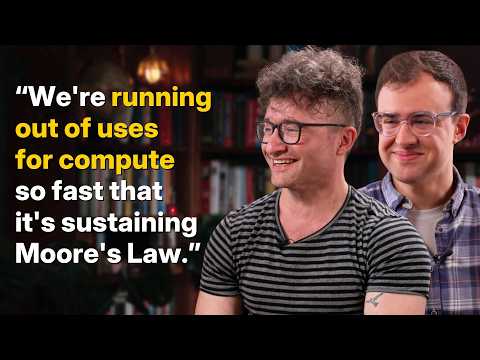
The speakers examine Chad Jones's research showing that the share of the economy going toward computing and transistors has been decreasing despite massive increases in quantity, driven by Moore's law efficiency improvements. An observation emerges that an H100 GPU costs more to rent now than it did three years ago despite much superior technology, because smarter models raise the opportunity cost of compute. Google announced Gemini Omni with video editing capabilities and multi-modal data transfer, demonstrating continued frontier advancement. The Sim2Real gap in robotics—where collecting real-world data is harder than simulation—could be addressed by good video models.
- Chad Jones's research shows the economy's share going toward computing/transistors has decreased despite massive quantity increases
- Moore's law drives efficiency improvements that reduce computing's share of economic output
- H100 GPU rental costs have increased over three years despite substantial technology improvements
- Smarter AI models raise the opportunity cost of compute, increasing demand and prices for processing capacity
- Google announced Gemini Omni with video editing capabilities and multi-modal data transfer capabilities
- The Sim2Real gap exists because collecting real-world data is harder than simulation environments
- Good video models could help robotics progress by providing synthetic training data for real-world applications
Developing Country Implications and Leapfrogging
The speakers analyze how developing countries not in the AI production chain, including India and Nigeria, face two scenarios: either leveling up through AI dissemination or being left behind as automation commoditizes production. Mobile banking is noted as being more prevalent in Nigeria than Germany, exemplifying how developing countries can leapfrog intermediate steps in technology adoption. The speakers recommend that developing countries should prioritize buying the index of AGI rather than investing in retraining programs for specific skills that may become obsolete.
- Developing countries not in the AI production chain (India, Nigeria) face binary outcomes: leveling up or being left behind
- Automation commoditizes production, potentially marginalizing countries that can't participate in AI development
- Mobile banking is more prevalent in Nigeria than Germany, demonstrating leapfrogging of intermediate steps
- Developing countries can adopt advanced technologies without going through legacy infrastructure phases
- The speakers recommend developing countries prioritize buying the index of AGI rather than retraining programs
- Index-based investment provides exposure to AI gains without requiring specific skill development
- A golden window existed from index fund creation until about five years ago when wealth could grow at economic growth rate
- Returns are now highly concentrated in private companies, making broad participation more difficult
Wealth Concentration and AI Evolution Dynamics
The conversation explores how AI evolution may favor firms or agents that grow, since selection pressure favors entities that accumulate resources and don't satiate quickly in capital accumulation. Mark Zuckerberg's wealth is mostly stock in Meta, and as controlling shareholder he reinvests rather than converting to dividend income, concentrating rather than distributing wealth. The speakers note that historically, wealth concentration has been limited by dissipation shocks where heirs squandered wealth or foundations spent it down. The discussion references Bostrom's astronomical waste point, suggesting building Dyson spheres and happy simulations as a way to use wealth without satiation.
- AI evolution may favor firms or agents that grow, as selection pressure favors resource accumulation
- Entities that don't satiate quickly in capital are advantaged under AI-driven economic selection
- Mark Zuckerberg's wealth is mostly stock in Meta, not liquid assets
- As controlling shareholder, Zuckerberg reinvests rather than converting to dividend income, concentrating gains
- Historically, wealth concentration has been limited by dissipation shocks where heirs squandered wealth
- Foundations spending down over generations provides another dissipation mechanism for concentrated wealth
- Bostrom's astronomical waste point suggests building Dyson spheres and happy simulations as wealth utilization without satiation
- The conversation explores whether AI will accelerate or constrain wealth concentration dynamics
AI Distribution Models and Political Vulnerability
The speakers compare AI to electricity (broad access, benefits to users) versus social media (rents to platforms) to determine likely distribution patterns of AI benefits. If AI access resembles electricity with broad distribution, broad prosperity is more likely; if it resembles social media with platform rents, concentrated gains are more probable. The Defense Production Act threat against Anthropic demonstrates that concentrated frontier labs become clear political targets, unlike distributed technology. The speakers note that if open models stay six to nine months behind the frontier, broad AGI access arrives quickly for everyone after initial development.
- If AI is like electricity (broad access, benefits to users), broad prosperity is more likely
- If AI is like social media (rents to platforms), concentrated gains are more likely
- The Defense Production Act threat against Anthropic shows concentrated frontier labs become political targets
- Distributed technology avoids political vulnerability that concentrated labs face
- If open models stay six to nine months behind the frontier, broad AGI access arrives quickly after development
- Open source development could democratize access once frontier capabilities are demonstrated
- Most average Americans' capital is in a house, ill-suited to be complementary to AI or robotics production
- Capital ownership patterns affect how AI gains are distributed across the population