[@hubermanlab] Essentials: Psychedelics & Neurostimulation for Brain Rewiring | Dr. Nolan Williams
![[@hubermanlab] Summarizer](https://summaries.pages.dev/img/logo.webp)
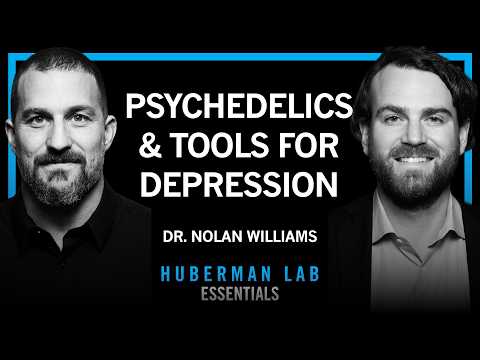
Link: https://youtu.be/GkG1hMhIQ_Q
Duration: 36 min
Transcript: Download plain text
Short Summary
Dr. Nolan Williams, a dual-trained neurologist and psychiatrist at Stanford, discusses how rapid Transcranial Magnetic Stimulation (TMS) restores brain circuitry governing mood in severe depression, challenging the outdated "chemical imbalance" theory. The conversation explores psychedelics including psilocybin, MDMA, and ibogaine as breakthrough treatments for PTSD and depression, with clinical trials showing two-thirds of patients achieving clinically significant improvement. Stanford Neuromodulation Therapy delivers 5 days of intensive TMS achieving 60-90% remission rates, while psychedelics appear to work through the same brain network changes as TMS by inducing highly plastic brain states for trauma reconsolidation.
Key Quotes
- "TMS is almost like exercise for the brain, right? You're kind of exercising this region over and over again with a physiologically relevant signal and kind of turning that system on." (00:06:19)
- "These drugs can't be recreational drugs. They really shouldn't be recreational drugs, right? They're really too powerful to be used in the context of recreation." (00:18:03)
Detailed Summary
Depression as a Coronary Risk Factor
Depression has been classified by the American Heart Association as the fourth major risk factor for coronary artery disease, placing it alongside hypertension, hyperlipidemia, and diabetes as a significant driver of cardiovascular mortality.
- The American Heart Association formally recognizes depression as a major coronary artery disease risk factor, ranking it fourth after hypertension, hyperlipidemia, and diabetes.
- Dr. Nolan Williams serves as a dual-trained neurologist and psychiatrist at Stanford University, bringing both perspectives to understanding mood disorders and their physiological consequences.
- This classification reflects growing evidence that depression affects not only mental health but also somatic outcomes through bidirectional brain-heart communication pathways.
The Neuroscience of Prefrontal-Limbic Dysregulation
In depression, the left dorsolateral prefrontal cortex fails to adequately regulate—or "clamp down on"—the anterior cingulate, a conflict detection system that operates continuously to identify potential threats or problems requiring attention.
- The left dorsolateral prefrontal cortex (DLPFC) normally provides top-down inhibitory control over the anterior cingulate cortex (ACC), preventing excessive vigilance and emotional reactivity.
- When the DLPFC fails to regulate the ACC effectively, deeper limbic regions dominate prefrontal control, leading to sustained negative affect, rumination, and threat hyper-sensitivity.
- The anterior cingulate serves as the brain's conflict detection system, continuously monitoring for discrepancies between expected and actual outcomes.
- This model explains why depressed patients experience difficulty disengaging from negative thoughts—they lack sufficient prefrontal resources to inhibit limbic override.
The Brain-Heart Pathway and TMS Signal Propagation
TMS stimulation of the dorsolateral prefrontal cortex produces a signal that distributes down through the anterior cingulate, insula, and amygdala into the nucleus tractus solitarius, ultimately reaching the heart via the vagus nerve.
- Researchers in Europe, including groups in the Netherlands, have replicated the brain-heart pathway four or five times, confirming that prefrontal TMS creates measurable downstream effects on cardiac function.
- The signal propagation follows a specific anatomical route: DLPFC → ACC → insula → amygdala → nucleus tractus solitarius → vagus nerve → heart.
- This pathway explains why depression and cardiovascular disease are so tightly linked—the same neural circuits govern both emotional regulation and cardiac homeostasis.
- The vagal connection means that mood interventions can directly influence heart rate variability and other cardiac parameters through established neurophysiological routes.
Why the Chemical Imbalance Theory Fails
The "chemical imbalance" theory of depression—that low serotonin causes depressive symptoms—has been incorrect for some time, and modern neuroscience confirms that SSRIs work through brain plasticity rather than directly correcting neurotransmitter deficits.
- Dr. Williams emphasizes that psychiatry has known the chemical imbalance theory is wrong for years, yet it remains entrenched in public understanding.
- SSRIs (Selective Serotonin Reuptake Inhibitors) work by inducing neuroplastic changes in the brain rather than simply boosting serotonin levels.
- The serotonin hypothesis emerged from early observations that tricyclic antidepressants affected monoamine neurotransmission, leading to an oversimplified model that persisted despite evidence to the contrary.
- Depression is better understood as a circuitry disorder—a problem of dysfunctional neural networks—rather than a simple neurotransmitter deficiency.
- This reconceptualization has major implications for treatment: targeting receptor sites and synaptic plasticity is more effective than attempting to manipulate neurotransmitter concentrations directly.
Stanford Neuromodulation Therapy Protocol
The Stanford Accelerated Intelligent Neuromodulation Therapy, now called Stanford Neuromodulation Therapy or S.T.A.R.T., uses a rapid 5-day TMS protocol designed for severe depression in inpatient settings where standard oral antidepressants have failed.
- The protocol delivers 7.5 months worth of TMS dose concentrated into a single 50-hour block, representing approximately 5x the normal cumulative dose.
- Patients receive 90 minutes of actual stimulation spread across each day, delivered in hourly intervals to maximize efficacy through spaced learning theory principles.
- Treatment occurs in an inpatient setting, allowing continuous monitoring and optimization of the therapeutic protocol.
- The protocol is specifically designed for treatment-resistant depression—patients who have failed to respond to standard oral antidepressants.
- Spaced learning theory suggests that intermittent, distributed stimulation produces stronger and more durable neural changes than continuous stimulation.
SNT Mechanism: Mimicking Hippocampal Output
The TMS signal works by sending the same signal the hippocampus normally outputs directly into the prefrontal cortex, essentially instructing the brain to "turn on, stay on, remember to stay on."
- Under normal conditions, the hippocampus sends periodic signals to the prefrontal cortex that help maintain cognitive and emotional regulation.
- In depression, this hippocampal output becomes insufficient or dysregulated, leaving the prefrontal cortex unable to maintain proper control over limbic structures.
- The SNT protocol essentially replaces this missing hippocampal signal, providing the prefrontal cortex with the instruction it needs to re-establish control.
- The metaphor "turn on, stay on, remember to stay on" captures the triple function: immediate activation, sustained engagement, and long-term consolidation of the neural pattern.
- This mechanism explains why effects can persist for years—the brain learns to maintain its own regulation pattern through the brief intervention.
SNT Clinical Outcomes and Patient Experiences
Open-label trials show 60-90% of patients achieve full mood remission within 1-5 days, with remission duration varying from 1-4 years depending on individual factors.
- Approximately 60-90% of treatment-resistant depression patients achieve full remission within the first week of SNT treatment.
- Some patients experience remission lasting 1-2 years, while others maintain improvement for 3-4 years without additional intervention.
- Multiple patients who achieved early remission reported spontaneous mindfulness and present-moment experiences they had never achieved before.
- One patient described sitting at the beach fully present for an hour—something they had never accomplished in their adult life.
- These spontaneous mindfulness experiences suggest that restored prefrontal-limbic regulation creates conditions for natural meditative states.
- The rapid onset distinguishes SNT from traditional antidepressants, which typically require weeks to months for full effect.
MDMA-Assisted Therapy for PTSD
MDMA-assisted therapy showed approximately two-thirds of PTSD patients achieving clinically significant improvement after one to a few sessions in clinical trials using the MAPS protocol.
- Clinical trials conducted under MAPS (Multidisciplinary Association for Psychedelic Studies) demonstrated that approximately 67% of PTSD patients achieved clinically significant improvement.
- Improvement typically required only one to a few sessions rather than months of ongoing treatment.
- The standard MAPS protocol dose is 150-175 milligrams of MDMA, administered in a supportive therapeutic setting.
- Effects of MDMA-assisted therapy can last for years, distinguishing it from interventions requiring ongoing maintenance.
- The therapeutic mechanism involves MDMA reducing fear responses while enhancing emotional openness and trust between patient and therapist.
- Compared to ketamine's roughly 1.5-week duration, MDMA produces more durable PTSD resolution.
Psilocybin for Depression
Psilocybin for depression showed efficacy in half to two-thirds of open-label studies and approximately one-third in blinded trials, with neuroimaging revealing distinctive patterns of altered brain connectivity.
- Open-label studies (where participants know they receive the active treatment) showed 50-67% efficacy for psilocybin in treating depression.
- Blinded trials (where participants don't know if they received psilocybin or placebo) showed lower but still significant efficacy around 33%.
- The efficacy gap between open-label and blinded trials suggests a meaningful placebo or expectancy effect, though the drug clearly produces therapeutic benefits beyond this.
- Neuroimaging research by David Nutt and Robin Carhart-Harris found that psilocybin decreases overall brain activity while paradoxically increasing global connectivity.
- This pattern—less activity but more integration—may explain why psilocybin can produce lasting changes in mood and perspective.
- The increased connectivity may help "reset" depressive thought patterns by allowing new neural associations to form.
Ibogaine Treatment for Military Populations
Navy SEALs and Army Rangers treated with ibogaine—a 24-36 hour-acting alkaloid from the iboga tree native to Gabon, Africa—reported dramatically improved outcomes including self-forgiveness and renewed self-empathy.
- Ibogaine is derived from the iboga tree (Tabernanthe iboga), which grows natively in Gabon, Africa, and has been used in spiritual traditions there for centuries.
- The psychoactive effects of ibogaine last 24-36 hours, requiring a substantial time commitment for treatment and significant clinical monitoring.
- Military special operations personnel reported self-forgiveness and renewed self-empathy as key outcomes, addressing the unique psychological burdens of combat operations.
- Ibogaine carries cardiac risks, including QT prolongation, that require thorough ECG screening before administration.
- The treatment addresses what might be called "moral injury"—the psychological damage from actions that violate one's ethical code—which is common among combat veterans.
- Despite cardiac risks, the dramatic outcomes in this population have generated ongoing research interest.
The Three Eras of Psychiatry
The discussion frames psychiatric history as three eras: Psychiatry 1.0 focused on psychotherapy and early experiences, Psychiatry 2.0 centered on the chemical imbalance model, and Psychiatry 3.0 focuses on brain circuitry and neuromodulation.
- Psychiatry 1.0 emphasized psychodynamic theory and the importance of early childhood experiences in shaping adult mental health.
- Psychiatry 2.0 emerged with the development of psychotropic medications and the influential (though ultimately incorrect) chemical imbalance hypothesis.
- Psychiatry 3.0 represents a shift toward understanding psychiatric disorders as circuit dysfunction and treating them with targeted neuromodulation technologies.
- This framework helps explain why previous treatment approaches may have been limited in efficacy—the theoretical foundations were incomplete.
- Neuromodulation technologies like TMS represent the first treatments specifically designed to correct circuit-level dysfunction rather than simply altering neurochemistry.
PTSD, Moral Injury, and the Military Context
PTSD symptoms persist due to evolutionary neurobiology—hypervigilance was adaptive in combat but maladaptive in civilian settings, with soldiers experiencing moral injury when they accidentally cause civilian or child deaths.
- The evolutionary perspective explains why PTSD is so difficult to treat: the hypervigilance, threat detection, and threat response systems were optimized for survival in combat environments.
- These same traits become maladaptive when veterans return to civilian settings where most environmental stimuli are not actually threatening.
- Moral injury specifically refers to the psychological damage from committing, witnessing, or failing to prevent acts that violate one's deeply held moral beliefs.
- Dr. Williams notes that soldiers in Afghanistan and Iraq sometimes accidentally caused civilian or child deaths, creating lasting psychological trauma that extends beyond combat stress.
- Standard PTSD treatments may not adequately address moral injury, which is why novel approaches like ibogaine show promise in military populations.
- The combination of hypervigilance and moral injury creates a particularly treatment-resistant form of PTSD that responds poorly to conventional interventions.
The Neuroplasticity Therapeutic Hypothesis
The therapeutic hypothesis across treatments involves inducing a highly plastic brain state to reexperience and reconsolidate traumatic memories, potentially unpairs negatively valanced mood systems from self-representation.
- All effective neuromodulation and psychedelic treatments appear to work by creating periods of extreme neuroplasticity—windows where the brain is particularly amenable to reorganization.
- During these plastic states, traumatic memories can be reconsolidated with updated emotional associations, reducing their negative charge.
- The goal is to unpair negatively valanced mood systems from self-representation—so that traumatic memories no longer automatically trigger feelings of worthlessness or hopelessness.
- TMS, psilocybin, and ketamine all act on the same brain regions and produce the same connectivity change: downregulation between the subgenual anterior cingulate and the default mode network in depressed individuals.
- This common mechanism suggests that multiple treatment approaches may converge on the same fundamental circuit correction.
- The subgenual anterior cingulate (sgACC) is a hub for mood regulation, and its abnormal connectivity to the default mode network (DMN) maintains depressive rumination and negative self-referential thinking.
Conclusion: Converging Mechanisms and Future Directions
Both TMS and psychedelics appear to work through the same brain network changes—inducing highly plastic brain states that enable trauma reconsolidation and circuit normalization across different therapeutic approaches.
- The convergence of TMS, psilocybin, MDMA, and ketamine on similar neural mechanisms suggests that psychiatry 3.0 is identifying fundamental circuit-level targets rather than disease-specific interventions.
- This framework raises the possibility that multiple treatment modalities could be combined for synergistic effects—using rapid TMS for circuit normalization while psychedelics enhance therapeutic plasticity.
- The 60-90% remission rates achieved with SNT represent a dramatic improvement over the approximately 30% remission rates typical of standard antidepressant treatments.
- The durability of these interventions—lasting years rather than requiring ongoing medication—represents a paradigm shift in how depression might be managed.
- These advances are moving psychiatry from a purely symptom-suppression model toward genuine circuit-level correction and restoration of healthy brain function.