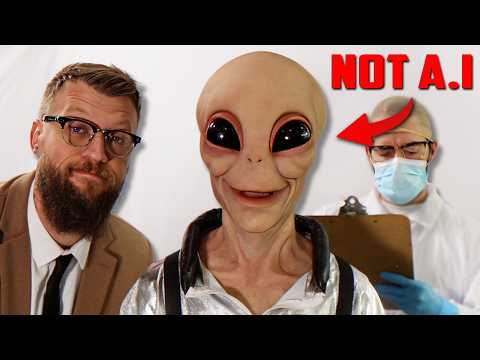
[@Area52Investigations] New Rule: NO MORE FAKE ALIENS
· 4 min read
Link: https://youtu.be/SLf7nbCr_M8
Duration: 11 min
Transcript: Download plain text
Short Summary
The host announced the channel is dropping AI-generated imagery in favor of hand-drawn artwork and practical filmmaking. The decision is framed as creative rather than moral, aimed at producing more original investigations and preserving the channel's midcentury analog aesthetic. The host also showcased new archival UFO photos acquired from researcher Wendell Stevens' collection.
Key Quotes
- "This alien is not AI. And in fact, moving forward, I will no longer be using AI generative imaging on this channel. Goodbye slop. Hello props." (00:00:01)
- "So to be completely transparent, this is not a moral stance. It's not a political stance and it's also not an environmental stance. Uh this has everything to do with my own creativity." (00:00:37)
- "I've noticed that since I've began using AI imagery, I've shot a lot less. I've done a lot less videos like I used to do." (00:00:49)
- "And it's just been really easy to use for me. And so, it's been kind of a crutch and I just want to get away from that." (00:01:26)
- "I think it's important, especially with the subject matter that we're dealing with, which is UFOs, to be as honest and transparent as we can and without muddying up the waters even further." (00:02:25)
Detailed Summary
Episode Summary: Channel Drops AI Imagery, Embraces Human Art and Archival UFO Photos
Announcement Overview
- The host announced that the channel will no longer use AI generative imaging in videos, framing it as a creative rather than moral, political, or environmental decision.
- The change marks a return toward the channel's earlier style of full-blown investigations mixed with archival B-roll.
Reasons for Dropping AI Imagery
- Reduced original output: Since adopting AI imagery, the host has shot less footage and produced fewer full investigations than the channel's earlier style.
- Aesthetic mismatch: The channel's sets emulate a midcentury 50s/60s/70s analog aesthetic featuring typewriters and tape recorders, and AI imagery breaks that immersive fictional bubble.
- Creative challenge: The host wants to push the team by tackling trickier subject matter, doing boots-on-the-ground filming, and building immersive sets with props.
- UFO subject sensitivity: Because UFO material already suffers from muddied imagery of unknown authenticity, AI imagery risks further obscuring the truth, especially as detection of AI-generated images becomes harder.
Historical Context: UFO Magazine Photo Contests
- UFO magazines in the 1960s–70s ran one annual photo contest per year with prizes for the best UFO photos.
- The host cited this incentive structure as likely encouraging hoaxes.
Replacement Strategy
- The host is working with close to a dozen community artists who hand-draw, paint, and sketch scenes for upcoming episodes.
- Additional replacements for AI imagery include costumes, props, hired actors, digitized archival reels/videos (microfiche, 16mm reel), and page-by-page B-roll scans of UFO magazines from the host's personal collection.
- Contributing artists will be paid, credited in video descriptions and on screen when featured, and can submit work via the channel's Discord community art subsection.
New Archival Acquisitions: Wendell Stevens Collection
- The host acquired original UFO photos from the archive of famed UFO researcher and author Wendell Stevens.
- Featured items include a 1942 photo purchased from a Japanese general in China (with writing possibly by Stevens), the Amorei Rivera F-14/flying disc photos, a 1965 Albuquerque New Mexico disc, a Honolulu Hawaii UFO photo, a Kfax Wisconsin coal train photo, William 'Bill' Herman's photos, and a Santa Fe Argentina UFO.