[@Area52Investigations] The Man Who Killed an Alien - Dr. Jonathan Reed |ep 105
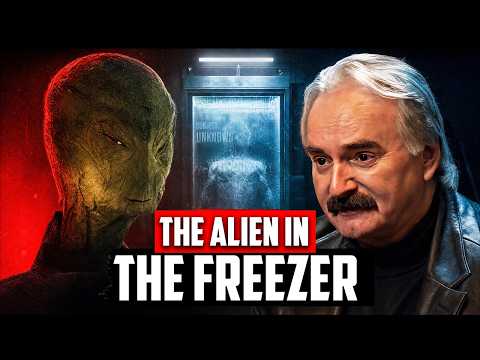
Link: https://youtu.be/7_oGuXHkWOw
Duration: 171 min
Transcript: Download plain text
Short Summary
In a nearly three-hour Area 52 interview, pseudonymous "Dr. Jonathan Reed" — a former University of Washington Medical Center worker — recounts an October 1996 encounter in which a gray he calls Freddy tore his golden retriever Susie apart, a hidden body, frozen tissue samples with nine non-human chromosome pairs, and decades of alleged persecution. He details the MUFON-backed two-year investigation, his metal "link artifact," and his argument that full UFO disclosure would hand human consciousness to aliens. The host asks listeners to suspend disbelief and consider what if even 1% of Reed's allegations is true.
Key Quotes
- "Every day I wake up and I know that there's 14 people who are dead because of me." (00:01:23)
- "first of all, I found 46 chromosomes, same as you and I have, same as humans have, 46 chromosomes." But he said nine pair of them were not human and I could only reference them in close proximity to dolphin and sea tortoise." (00:24:52)
- "But I will tell you first that 3 days after I met with him and he gave me this stuff, somebody came into his office and shot him in the head and killed him." (00:26:29)
- "Disclosure is never going to happen like you and I would like it to. And the reason is a broad there's a broad amount of reasons, but the number one is control. It's all about control." (00:16:32)
- "if the government gives and opens the door to the Pandora's box, it probably never will be able to be closed again. And that will change our total concept of human life in an instant. We will become slaves to this. And I don't know if that means actual slaves or slaves to the idea of it." (00:29:48)
Detailed Summary
Area 52: The Alleged Jonathan Reed Encounter, Artifact, and Decades of Persecution
Episode framing and Jonathan Reed’s identity
The nearly three-hour Area 52 interview presents the case of “Dr. Jonathan Reed,” a pseudonymous Seattle-area man who claims an October 1996 encounter with an alien led to his dog’s death, the concealment of a body, and decades of surveillance and persecution. The host acknowledges that the story is intensely polarizing: some viewers regard the footage as objective evidence of extraterrestrial contact, while others think it was fabricated for attention.
- Interview setting: The host traveled to Seattle to speak with Reed in person and asks listeners to suspend disbelief long enough to consider what might follow if even 1% of the account were true.
- Pseudonym and credentials: Reed says he adopted the name Jonathan Reed to protect himself, either from the people he believes are hunting him or because his real identity does not match the academic credentials associated with the name.
- Scope of the account: The narrative spans an alleged alien attack, concealed remains, unusual physical symptoms, a metal device, nonhuman DNA claims, laboratory evidence, alleged government cover-ups, repeated assaults, and continuing communication with beings he calls grays.
- Epistemic posture: Reed presents the episode as testimony rather than independently verified proof, while the host repeatedly separates the parts he finds compelling from those he regards as speculative or fabricated.
Susie’s death and the October 1996 encounter
Reed dates the central incident to October 1996, when he was hiking with Susie, a seven-year-old golden retriever. He describes the attack as a sudden, sub-10-second event that left him physically incapacitated and transformed what might otherwise have been an unidentified body into something he carried home in his Jeep.
- Susie’s background: Reed says Susie was an orphan who arrived as a puppy on his front porch and became his dog; he describes her as unusually perceptive around wildlife and animals.
- Evidence of her forest behavior: According to Reed, Susie ran approximately 100 yards and returned, then stopped and refused to move when she detected a deer and its fawn about 300 feet ahead.
- Life at the medical center: He also says Susie freely rode elevators through the hospital to visit his patients, supporting his view that she was exceptionally intelligent and socially outgoing.
- The branch strike: Reed had picked up a six-foot branch to untangle Susie from what he initially thought was another wild animal; after seeing what he called Freddy, he struck the being’s head with the branch.
- The alleged attack: Reed says a black-suited appendage reached over Susie’s head, seized her snout, and tore it apart; another opening then formed in her chest like a drain, pulling her fur inward and leaving what he describes as a pile of white ash.
- Speed and duration: He says the whole sequence lasted less than 10 seconds and that Freddy moved Susie back and forth so rapidly that she appeared as a blur, comparable to a paint shaker.
- Rejection of the heroic framing: Reed rejects the idea that striking the being was courageous, calling it rage-driven insanity after Susie’s death; without that loss, he says, he would never have encountered Freddy.
Collapse, missing time, and the drive home
After the encounter, Reed says he experienced symptoms resembling a heart attack, radiation exposure, and severe autonomic collapse. He remained near the body for more than 40 minutes before barely moving, then drove home while gasping and vomiting rather than approaching the police.
- Immediate physical reaction: Reed fell to the ground vomiting, gasping, and losing control of his limbs as well as his bladder and bowel.
- Time near the body: He says he lay face-to-face with the being at a distance of about three feet for 40 to 45 minutes, then crawled only three or four feet before collapsing from exhaustion.
- Recognition of missing time: He noticed the time loss only after reaching his Jeep. His partner Suz was not in the passenger seat where she normally sat, which he describes as the moment he first recognized that “Suz is gone.”
- Concealment in the Jeep: Reed lifted the rear door, placed the body inside, closed it, and sat in the driver’s seat trying to slow his breathing. He stopped twice to vomit during the drive and exited at the “Ranger Station,” only to find nobody there.
- Why he did not call police: He says he had not thought of reporting the incident because he wanted to escape the turmoil and because home represented “salvation” and safety in his state of fear.
- Arrival at the house: The drive took approximately 50 minutes on the highway. He sat in the carport for several minutes, drank as much water as he could while gasping, and then decided he could not leave the body in the vehicle.
- Storage in the freezer: Directly across his detached garage stood an old half-size freezer, rather than a full eight-foot unit. Reed says he placed the body inside because it was “meat,” would decompose, and needed to be “out of sight.”
Gary, the garage, and the first viewing
Reed’s first call for help went to Gary, a licensed architect he had known since early high school. Gary’s reaction became the first major turning point: after initially resisting the account, he saw the body and footage and eventually described the object as an alien.
- The initial call: Reed left a message asking Gary to call because Suz was not answering, then called him directly: “Gary, Susie’s dead. Come over… I’m really sick.” Gary returned the call in about 15 minutes and arrived roughly 10 minutes later.
- Gary’s physical concern: Gary focused first on Reed’s condition, gave him water, and initially declined to discuss the story until Reed insisted that he come into the garage.
- The freezer is opened: Reed laid the body on the floor and opened the thermal blanket. Gary went white, backed against the garage wall, and initially said nothing.
- Gary’s conclusion: The men finished a bottle of tequila before Gary asked what the thing was, said the situation “doesn’t make sense,” and insisted that there had to be something else.
- The seven-minute video: Reed showed Gary approximately seven minutes of footage on his player. Gary called it “insane” and eventually concluded that the object was an alien, whether extraterrestrial or extradimensional.
- An alien interpretation only after Gary’s response: Reed says he initially considered Freddy a living nonhuman being, possibly a deformed human, and resisted calling him an alien. The alien framework arose only after Gary said, “I know what this is.”
- Damage to the body: Reed found a chunk missing from the head, consisting of bone and scalp with the inner cranial sac attached and apparently more water than blood. He replaced the piece and duct-taped it in place so it would not move around, while telling himself the body had to be Susie because that was less disturbing than considering an unknown person.
- Filming the body: The body was filmed the next day. Because Gary had gone and Reed had no tripod, Reed placed one camera on a box in the garage and duct-taped another camera to the side of a ladder.
The black object in the fern-covered valley
After recovering enough to move, Reed heard an extremely low resonance and found a dark object lying in a shallow valley of ferns. He says its dimensions were reconstructed later from photographs rather than supplied by Freddy, and his first physical contact produced both an injury-like cold sensation and a momentary experience of being elsewhere.
- Initial concealment: Reed says he first mistook the object for a crushed Coca-Cola can, but noticed prominent etchings along one edge. He described it as a silvery object and carried it away from the scene, later leaving it unwrapped on a shelf in his garage.
- The sound: A low, ebbing harmonic tone was so low that it might not have been audible; Reed felt it in his body and initially assumed it came from a hiker with a boom box.
- Location: The object was about 75 feet away in a fern-filled depression approximately four feet deep, with roughly five evergreens between six and eight feet tall separating Reed from it.
- Estimated dimensions: Reed describes it as a black, floating “marquee diamond” lying on its side, approximately 10 to 12 feet long, 2.5 feet high, and 3.5 feet wide—roughly twice as long as he is.
- How the size was calculated: His expatriate team, which he says included people skilled in geometry and technology, scaled the object against a photograph of Reed standing in the same alley-like space and used his height as the reference.
- Source of the measurements: Reed stresses that these figures came from analyzing photographs, not from Freddy, whom he says has never explained his own technology.
- First contact: When Reed slipped and touched the object, he says it was so cold that it burned the pad of his hand like dry ice. Pushing it produced a brief sensation of being inside a vast black room resembling an airplane hangar, with small lights far in the distance, before he returned instantly to the forest.
- Effect on the sound: After contact, the low resonance became less irritating and more comforting, and Reed says he could feel it inside his body. He then used a stick to pull ferns from under the object so he could photograph it.
- Others’ interpretation: Reed says other experiencers told him the machine was monitoring movement or breathing, mistook him for the alien, and expelled him after he touched it. He clarifies that this was what he was told, not something he personally remembers.
Photography, physical distress, and the loss of evidence
Reed documented the object and body with 35mm still and 8mm video equipment despite worsening respiratory symptoms and repeated vomiting. Although he retained some negatives, he says most of the evidence was stolen over the first decade and the original tape was confiscated.
- Still camera: Reed used a 35mm Nikon EM with a fast lens, which he describes as the first Nikon model with an electrically controlled shutter.
- Shutter technique: He lay on the ground and pressed the camera against his forehead as an improvised tripod, using shutter speeds between one-quarter and one-half second in dense canopy that blocked light around 3:00 p.m.
- Stopped watch: His mechanical watch stopped at 2:53. A jeweler opened the back and reportedly said it had melted inside, damaging some of the gears; Reed says he still has the watch.
- Video camera: He used a Nikon-Sony rebranded 8mm camera with a tiny one-inch black-and-white viewfinder. Because breathing was too difficult to look through it, he held the camera at waist level and urged the subject to “come on.”
- Viewfinder distortion: The image became more distorted as he moved closer, so he backed up to about 100 feet away and obtained clearer 35mm images.
- Minimal equipment: His supplies included a pocketknife, dog food, snack bars, water, his cameras, and the thermal blanket.
- Unexpected duration: Reed had expected to be gone for two hours, but hours passed while he lay there unable to calm his breathing. He vomited for a couple of hours until only blood and saliva emerged.
- Plan for the body: He intended to cover it with the thermal blanket and place branches, logs, or rocks over it to discourage animals because the high-altitude wilderness contained bears, wild cats, and mountain lions.
- Persistent symptoms: Moving 100 feet away from the body did not reduce his symptoms. His breathing was so severe that he feared losing consciousness from hypoxia, although he does not believe he ever did.
- Evidence losses: Reed says approximately 75% of the evidence was stolen during the first 10 years and that the original video tape was confiscated. He says some of the 35mm negatives remain in his possession.
The odor, bodily symptoms, and other experiencers
Reed treats a distinctive smell as part of the phenomenon rather than as a consequence of Freddy’s injuries. He also rejects psychological shock as a sufficient explanation, pointing instead to a pattern that he believes other witnesses have experienced.
- The smell: About six feet from the path, Reed noticed a pungent odor resembling rotting fruit or meat with a slightly sweet component. He says it was different from ammonia.
- A “calling card”: He claims the odor appears within a minute before Freddy materializes, remains afterward, and can sometimes be detected on his own body or arm after he returns home.
- Rejection of shock as an explanation: Reed argues that the breathing difficulty, weakness, and other physical effects were too immediate, obvious, and persistent to be ordinary shock, comparing them more closely to radiation poisoning.
- Mario Woods comparison: Mario Woods, a former Air Force security police officer at Ellsworth Air Force Base in the mid-1970s, reportedly experienced similar gasping, freezing, and pleading for air while guarding silos associated with ICBMs and a “Walmart-sized orb.” Woods passed out when the beings approached.
- Proposed mechanism: Reed and others theorize that moving flesh into and out of a high magnetic field produces an odor which, at sufficient exposure, becomes a pungent “death smell,” possibly indicating travel between dimensions.
- Other recognition: Reed says he has told the story around the world three times and spoken with hundreds of people, some of whom he believes are sincere and have said, “I know that smell.”
Freddy, the grays, and nonhuman DNA
Reed claims Freddy is a gray with whom he has conversed for roughly 30 years and that Freddy has communicated information about gray history, human development, and the nature of consciousness. He presents Freddy as timid and curious, but also as part of a broader extraterrestrial effort to preserve the gray race.
- Thirty years of contact: Reed says Freddy does not look exactly like the stereotypical small gray and that he has never seen any photographs of Freddy except his own.
- A photographic limitation: Reed says Freddy’s own technology prevents him from being photographed while conscious, so the surviving images were taken when Freddy appeared dead.
- The prime-directive comparison: He says the grays are not supposed to be visible to or interact with humans, comparing this restriction to the Star Trek prime directive.
- Physical and racial diversity: Reed describes the grays as small-bodied creatures with large heads and large eyes. He lists black, white, green, yellow, and red human-type races and says they all function in essentially the same way.
- Human “tuning”: According to Freddy, the grays have interfered with humans throughout history and have “tuned you up.” Reed interprets this as gradual DNA enhancement that makes humans incrementally smarter rather than suddenly attaining a finished state.
- Hybridization plan: Reed believes the grays seek to avoid extinction by blending their DNA with human DNA and living among humans everywhere; he also describes Freddy as a hybrid.
- Personal characterization: Reed calls Freddy a friend who is curious and timid and says he does not hurt people. He adds that some people reportedly witnessed Freddy in their homes and contacted Reed after the documentary to confirm his account.
- Memory projection: Reed says Freddy can extract and replay memories, such as the smell of grass while he was five years old and picking dandelions. He distinguishes these experiences from imagination because they are sharper and clearer.
- Overwhelming input: These projections occur during waking states and arrive suddenly—“just boom, it’s there.” Reed asked Freddy to slow the process because the input was like a fire hose.
Frozen samples and pathologist Roger Haggot
While Freddy appeared dead, Reed photographed and videoed him, placed him in a freezer, and removed biological samples from the body. He delivered the samples to a University of Washington pathologist under the story that he had found them in the woods, then alleged that the doctor and other laboratory personnel suffered violent consequences.
- Freddy in the freezer: Because Freddy had no visible breathing or pulse and could not be photographed while conscious, Reed assumed he was dead. He photographed and recorded him and placed him in the freezer.
- Three days later: Reed says Freddy awoke screaming after three days, leaving the photographs taken during the presumed-death period as the only images he possesses.
- Samples taken: Reed says he collected tissue, blood, brain-cell, and bone samples. He notes that Freddy had a hole in his head that Reed himself had made.
- The pathologist: Reed identifies the doctor as Roger Haggot, MD, a head pathologist at the University of Washington who worked three floors below Reed’s own workplace.
- Claimed chromosome result: According to Reed, Haggot found 46 chromosomes in the samples—the same total as human chromosomes—but nine chromosome pairs were not human and matched most closely to dolphin and sea tortoise.
- 1996 laboratory methods: Reed says DNA extraction and analysis took about a week in 1996 because the work was performed through hands-on chemistry rather than computer analysis.
- A current DNA caveat: He adds that humans still cannot blend DNA in the way he describes and says CRISPR can identify or move DNA but cannot create a complete blended “milkshake.”
- Haggot’s death: Reed places Haggot’s death around 2000 and says that three days after their meeting, a man entered Haggot’s office, shot him in the head, and then killed himself within 10 minutes.
- Seizure of records: According to Haggot’s secretary, military-like men removed paper files and computers before police arrived roughly 15 minutes later. They also went to Haggot’s home and took his and his wife’s computers.
- Other laboratory personnel: Reed says other staff who assisted with the analysis were intimidated or killed, that only one remains, and that the survivor has left the country. Reed says he has retained the frozen DNA for years and continues to hide some materials.
The two-year MUFON-backed examination
After Reed’s public appearances produced only fragments of the story, UFO researchers approached him about a full case examination. The resulting MUFON-associated investigation lasted far longer than planned and became entangled with threats, insecure living conditions, and the protection of the alleged artifact.
- Initial meeting: Wendell Stevens, Bob Dean, Don Ware, and John Mack met Reed in Laughlin, Nevada, and asked him to undertake what they called a textbook case examination.
- Reason for the review: They said the public had received only disconnected pieces of the story and that a structured investigation would be more useful.
- Point man: Dan Makavey Senior of Delaware, a longtime MUFON associate investigator described as a Green Beret and paratrooper, was appointed to coordinate the work.
- Expanded timeline: The examination was expected to take about one week but continued for two years. Makavey reportedly slept where Reed slept and witnessed the artifact being used on Reed’s arm with two other people in the room.
- Artifact guardians: Reed appointed two former military “Green Beret type” men to safeguard the device, saying that doing so required him to place complete trust in them.
- Destroyed lodging: Reed says the place where he was staying was ransacked and destroyed within about 10 minutes after he left for breakfast. He and the team then occupied derelict buildings and businesses, rigging electricity and telephone lines, mostly illegally.
The link artifact and Team Reed’s alleged violence
Reed describes a tangible metal cuff called the “link artifact” that closes around his arm and initiates a severe physical and perceptual episode. He says he has repeatedly tried to return it to the entities and has built elaborate safeguards around the people and evidence protecting him.
- A physical metal cuff: Reed says the link is a tangible metal device that has been placed on his arm and appears on camera.
- Requests for its return: He says he has repeatedly asked the entities to take it back because he fears it will be stolen and does not want the responsibility. He says they have not answered those requests.
- A responsibility he cannot transfer: He was told once that holding the artifact is a good responsibility. Although he says he does not know where it is physically at present, he claims he could retrieve it within 24 to 48 hours and has done so previously.
- Dead-man switch: After the last time “they” killed someone, Reed says he created a fail-safe arrangement and demonstrated its existence to agents he characterizes as dark-government agents. He says it would expose one of them and all his information to the media even if it cost him his life.
- Team Reed: He describes Team Reed as a group of expatriates who have followed him for years, claims they will shoot someone before asking questions, and says they have “taken people out.”
- SUV attack: Reed says a car pursued him and his driver, repeatedly striking the rear of their SUV. After he ordered the driver to pull over, the pursuing vehicle rammed and flipped theirs.
- Fatal shooting: He says the driver was killed by a rifle shot and that he later learned the driver had also been shot in the head, with photographs and hospital testimony supporting the account.
- Reed’s response: He says he entered one attacker’s vehicle, drove over him, backed up, and drove over him again. A second attacker ran away and was never caught.
The claimed cost of more than 25 years of persecution
Reed says the response to his story has included repeated shootings, beatings, surveillance, and threats to his family and associates. He describes a deliberately rootless lifestyle in which even the materials he preserves have repeatedly been taken or destroyed.
- Intelligence personnel: Reed says technicians hired by the FBI and CIA for intelligence work donated their time to him for more than 20 years without payment and sometimes stood in front of bullets and vehicles to protect him.
- Deaths among associates: He claims 14 people have died since he became public because they chose to protect him.
- His parents: Reed says his elderly parents, both in their late 70s, were intimidated so severely that they died within a few months of each other. The alleged pressure included calls day and night and burning effigies on their lawn.
- Violence against Reed: He says he has been shot three separate times, beaten approximately eight times, thrown into a van, beaten unconscious, drugged with heroin, and dumped on the road.
- A rootless life: Reed says he lives without a permanent home or address and compares himself to a mole. He adds that nearly everything he has saved has repeatedly been gone through.
- Withdrawal from public life: After about 10 years of active promotion of the case, he stepped back because several friends were harmed. He says internal crew conflicts included arguments over who would lead each day, and that a member he dismissed subsequently published negative material about him.
Disclosure, consciousness, and the irreversible “door”
Reed argues that official UFO releases are controlled and incomplete because disclosure would alter human consciousness itself. His concern is not simply that governments have withheld sensational photographs, but that comprehensive information could give advanced extraterrestrials access to a collective human energy they seek to exploit.
- Disclosure will not happen: Reed says full government disclosure of UFO information will never occur, with control of the population as the leading reason.
- The “drip drip”: He characterizes official releases as a controlled, incremental process forced by public pressure rather than a genuine desire to disclose, citing small examples such as fighter-jet videos showing an unidentified white light.
- Information rather than images: His central warning concerns the information itself. Opening what he calls Pandora’s box could never be closed again and could instantly change the total concept of human life, making people “slaves” to it.
- Freddy’s warning: Reed says Freddy told him that full disclosure would allow aliens to take over human consciousness because they want human soul energy.
- The superiors: He says he checked that warning with Freddy’s superiors, describing them as huge beings of pulsating energy “like angels” whom he has stood in front of.
- No closing the door: Because the aliens are allegedly millions of years more advanced than humans, Reed says their entry into human consciousness could not be reversed. He calls this a catch-22: refusing disclosure looks like an attempt to keep people from the truth, but opening the door may be irreversible.
- Cross-verification: Reed says he asks Freddy about what Freddy has told him and then repeats the questions to Freddy’s superiors, who reportedly confirmed his answers.
- Required human development: He argues that people must evolve with expanding consciousness, becoming more intelligent and better able to handle complex risk, although he says this does not mean becoming angels.
- The “box of understanding”: Reed proposes that humans know only what can be learned inside their limited conceptual box. In his estimate, compartmentalized science and physics address only about 1% of a much larger reality, leaving roughly 99% unexplained.
- Collective consciousness: He claims consciousness is not individual but a collective energy projected and amplified far from us. He says alien races are interested in it partly because it could be used as a weapon against other warlike and aggressive beings.
- Entities from the extreme future: Reed estimates that the entities may come from humanity’s “extreme future” and speculate that they might be trying to prevent obstacles humans must overcome so civilization does not end.
- Host’s framing: The host adds that once humans can observe the aliens, the aliens begin observing humans, as though a door is opening in both directions.
Public career and contact with Travis Walton
Reed’s public history began in 1996 and continued for roughly a decade before the associated stress and backlash led him to withdraw. His strongest reported personal connection to another publicly known experiencer was Travis Walton, whose abduction predated Reed’s encounter by more than two decades.
- First public appearance: Reed says he first came forward in 1996 on The Art Bell Show, when Bell was reaching an audience of nearly 25 million as the internet was beginning to expand. Reed and Bell reportedly remained friends until Bell’s death.
- A decade of promotion: For the first 10 years, Reed appeared on podcasts and at public UFO conferences whenever possible. He stopped because he felt many participants were motivated by money or audience-building rather than sincere interest and says the negativity burned him out.
- Meeting Travis Walton: Reed met Walton on a plane flying into Nashville for a conference. Walton introduced himself, they talked for about 15 minutes before landing, and they took a picture together.
- Tom Reed and the limousine: Walton was being collected by Tom Reed, whose case Reed describes as large and similar in some respects. Tom Reed owned the limousine in which they traveled.
- Walton’s case: Walton’s widely covered abduction occurred in 1975. Reed saw an advertisement for Walton’s appearance on Oprah around 1990 but never watched it, and Fire in the Sky was released in 1992 or 1993.
- Film versus experience: Walton told Reed that the filmmakers took substantial artistic license with his story, while conceding that he accepted the paycheck. After three consecutive days of shared dinners, Reed says he had no doubt that Walton believed his account and calls him an honest soul.
- Walton’s advice: Walton told Reed that he did not have to tell anyone anything and had nothing to prove. At public lectures, Walton said he learned to address a crowd, play to what they wanted, omit unnecessary detail, and say “I don’t know” when he could not remember specifics such as whether the abductors treated him well.
Escape to Vancouver and the suicide decision
Reed left Seattle while still physically ill and emotionally overwhelmed, eventually reaching a burned-out Vancouver basement where he says he intended to end his life. A phone number given months earlier connected him to a group that intervened without immediately demanding an explanation.
- Avoiding the hospital: He did not go to the hospital because he did not want to be around the people he worked with and remained sick, writhing, and unable to breathe or calm down.
- The borrowed car: Reed left Seattle in a borrowed used car with approximately $200 and drove to Vancouver, Canada.
- Prior familiarity: He knew the area because his father had worked there and his family visited once or twice every couple of months, staying in a hotel and going to Stanley Park with his mother.
- Avoiding his contacts: Although he had friends in Vancouver, he did not contact them because he did not want to bring “this whole basket of trouble” into their lives. He parked the car where it was likely to remain undisturbed and then walked.
- The basement and pistol: In winter, Reed was staying in the basement of a burned-out apartment building. He says this was one of the lowest points of his life, that he held a pistol with a couple of bullets, and that he had decided to kill himself.
- Preparing for identification: He removed his fake identification and laid out his real ID so that his body would be identified.
- The stranger’s paper: Ten months before leaving Seattle, a stranger in a store had handed him a phone number while Reed was fleeing men in a car he believed were hostile. He kept the paper and later found it in his wallet in Vancouver.
- The first call: Reed called the number from a pay phone and hung up immediately because of his suspicion. Hours later, the person answered knowing his identity and circumstances.
- The offer: The group offered housing, medical attention, money, and clothing. Reed asked only for money, requesting that it be taped inside an envelope under the third bench of a park and that he be picked up at noon the following day.
- A warning attached: He told the group he would shoot anyone who appeared. Reed surveilled the park from approximately 6:00 a.m. until about 1:00 p.m. and then found an envelope containing $300 USD under the bench.
“The Alliance,” trusted contacts, and the 1,500-page journal
The group Reed calls “the Alliance” met him at the requested time and kept its promises, including not interrogating him about Freddy. Two contacts he personally trusted then persuaded him to abandon suicide and reconstruct his story chronologically.
- Keeping the name generic: Reed calls the group “the Alliance,” saying that is not its real name.
- The hotel meeting: The group met him at a small Vancouver hotel at the requested time, provided warm lodging with a bathroom, and kept every promise, including not questioning him about the incident or Freddy.
- What the group already knew: The group had learned nearly the whole case from police reports and neighbors who called about someone breaking into his house, but it lacked details about what happened after he left Seattle.
- Encouragement to recover: One member told him not to worry about the case details and instead to become stronger, saying what he had learned was important and other people needed to know it had happened to him.
- Proof of trustworthiness: When Reed asked why he should trust them, the group offered to bring any two people he trusted. He selected a Seattle police officer he had known since childhood and Senator Gorton of Washington State.
- The intervention: Both contacts talked with him for hours and ate in his room. Reed says they convinced him not to kill himself, to return to Seattle and deal with the situation, and to write down the events chronologically.
- The journal: The resulting journal reached 1,500 pages. Reed describes writing it as therapeutic—the kind of account “you would have told a patient.”
Robert Ray and physical recovery
A few months into the journal project, the group gave Reed names of writers and ghostwriters who might help present the case. One contact did not work out, but a second introduction to Robert Ray gave Reed both professional help and a place to stabilize.
- Choosing a writer: Reed called one woman but disliked the interaction, then called a second name: Robert Ray of the Sacramento, California area.
- Ray’s background: Reed describes Ray as a lifelong Californian who had written about atomic energy and trade magazines and had ghostwritten another author’s unrelated book.
- No prior subject expertise: Ray said he had never worked on the subject but that “we can figure it out,” and offered to fly from Sacramento to interview Reed.
- A safe apartment: Ray proposed renting an apartment in his own name with no connection to Jonathan, allowing Reed to live there or come and go freely. Reed ended up living there.
- Recovery: Reed says proximity to Ray nursed him back toward health, and that he gained 25 pounds during that period.
Institutional retaliation and the erasure of Reed’s identity
After Reed returned from Vancouver, his former workplace, bank, educational institutions, and documentary collaborators became part of what he describes as a coordinated campaign to isolate him. He says the campaign affected witnesses as well as him and erased both his access to money and his professional history.
- Loss of employment access: A facility told him that no one worked there under his name. When he contacted an administrator he knew, her secretary said people were claiming that he had become a felon involved in illegal activity and warned that staff associating with him could be fired.
- Sealed bank accounts: His bank told him that all accounts had been sealed and their money extracted as a federal-government matter, that he was a felon, and that nobody else could mention or discuss him.
- Partial legal recovery: Reed sued the bank and recovered approximately 20% of his money.
- The banker’s consequence: The female banker who disclosed the sealed accounts was fired and never rehired. She was later interviewed on tape by “Haimey,” changed careers, and remained Reed’s friend.
- The nurse: A nurse in Reed’s department who supplied information about him was allegedly harassed for years, and Reed no longer knows where she is.
- Documentary producers threatened: Reed says the directors and producers of Contact in the Woods were threatened as soon as they became known to be working on a film about him and wanted to remain anonymous.
- Education records erased: He says people were sent to the three universities from which he graduated and warned staff not to discuss him or risk losing their jobs; he also says all records of his education were erased.
- Steven Greer’s refusal: Reed says he gave the case to Steven Greer after speaking publicly for 10 years, but Greer declined because the erased credentials left him, in Greer’s words, with “no credentials anymore.”
- A fatal intimidation claim: Reed says he knows someone whose dog was killed on a front porch as a consequence of the intimidation campaign.
- Medical findings and implants: CAT scans and MRIs obtained from people he knew found nothing, but Reed believes he has been implanted, describing the process as a download or upload. He says he noticed something while sitting across from Robert Wraith years after first meeting Freddy.
Gary’s injury and the operation of the link device
Years after their early collaboration, Reed learned that Gary had been violently attacked and left permanently disabled. Reed’s effort to use the link while reaching Gary became the clearest detailed account of the device’s purported physical effects.
- A long disappearance: Reed had not seen Gary—whom he called his best friend apart from Robert Ray—for more than a year and could not contact him. He assumed Gary had disappeared permanently.
- The reported assault: Relatives in another state told Reed that Gary had been beaten with a pipe in the head, suffered brain damage, could no longer walk, and was in the hospital with little chance of survival.
- Reed’s response: Reed drove with others to Gary’s location, put on the link while holding Gary, and says both of them traveled to wherever the superiors are. He says the superiors promised to take care of Gary.
- Closure and needles: The link closes tightly around Reed’s arm and cannot be removed. Reed says it contains large needles that penetrate the skin and reach the nerves, producing pain he describes as ten times worse than a hypodermic needle.
- Pain and cold: Once the needles enter, the pain stops and is replaced by intense cold. Reed then feels his heart beating hard or unevenly, a sensation another speaker characterized as thrombosis.
- The episode sequence: His body shakes uncontrollably, sensation becomes exaggerated through his limbs and legs, tunnel vision narrows to darkness, and the screen or field of view becomes completely white. When the whiteness clears, he is “somewhere else” and the pain has ended.
- First activation: Reed says the first time he handled the device he was sitting with Robert Ray. Ray picked it up, put it back down, and watched it close tightly around Reed’s arm.
The live Toronto television demonstration
Years after first meeting a Toronto television producer, Reed was invited to replace a lecturer who withdrew from an afternoon talk show. Reed’s live activation of the link became the episode’s most dramatic claimed demonstration.
- The initial meeting: Reed met the co-producer of a local Toronto afternoon show at a UFO convention in Los Angeles, where the producer said he had heard Reed’s radio interview.
- Years later invitation: After another guest canceled a lecture, the producer called Reed and invited him to take the slot.
- The canceled guest’s context: The lecturer’s wife had been stabbed to death in their home, leaving the couple with no prior negative experience in their lives. The producer later told Reed about the murder and said he did not want to be part of it and was sorry he had met him.
- The broadcast setup: Reed flew to a small studio outside Toronto with four members of his crew. The studio held approximately 150 to 200 people, and the program aired live.
- Request for complete coverage: Reed asked to be filmed with one camera and one operator, without cutaways, so viewers could see the entire process.
- On-camera activation: The device closed around his arm. Reed describes being enclosed in a bubble of energy like sparklers, followed by tunnel vision, total whiteness, and arrival with the superiors.
- A sense of misuse: He felt guilty because he used the device for a personal purpose rather than to help someone. He says the superiors knew what he was thinking and responded, “It’s okay. We’ll send you back.”
- A warning and a responsibility: The superiors reportedly told him the device was not a toy and must not be abused, but also that holding it was an honor and a responsibility greater than he had realized.
- Secondary recording: Because the program aired live, an unidentified person recorded the segment from a television screen. Reed obtained the copy and saw a white orb on-screen during activation.
- Reversal claim: Reed says people who attempted to reverse the recorded footage produced a completely different reverse path rather than retracing the forward motion exactly.
The gold ring and the Osaka laboratory testing
Reed says a piece of gold-colored foil lay beside the artifact at the discovery site. He eventually transformed it into a ring, then took the artifact to Japan for independent-looking analysis, though the original records were later taken and the Japanese researchers stopped communicating with him.
- The gold-colored residue: When he picked up the artifact, Reed found what looked like a puddle of gold-colored metal foil on the ground. He kept it for years, melted it, polished it, and formed it into a ring.
- Exact composition and weight: He says the finished ring weighs exactly one ounce and is made from 24-karat gold with 1% platinum.
- Jeweler’s assessment: A jeweler who was a friend of a friend analyzed a small sample and reportedly said, “You can’t get gold this pure anywhere.”
- King Tut design: The interior was deliberately left rough so it would not slide around on his finger. Reed modeled the shape on King Tut’s ring, which included a flat end bearing the king’s insignia that could be dipped in blood and used like a seal or sigil.
- Predictive heat: He says the ring becomes warm and then very hot approximately 10 minutes before Freddy arrives.
- Osaka examination: Reed took the artifact to Japan, where metallurgists affiliated with the University of Osaka reportedly used X-rays to reveal about 15 layers.
- Unusual construction: One layer reportedly consisted of living plant fiber resembling the inside of a leaf, while other layers were thinner than a human hair at approximately 10 microns. Reed says they were arranged like a circuit board connected both mechanically and to the living leaf.
- Unsolved leaf sample: The Japanese team sampled the leaf layer but could not determine what kind of leaf it came from.
- Researchers go silent: Reed says the metallurgists now refuse to speak with him or return his calls and have told him that they were instructed not to and that the matter is final.
- Missing documentation: He says his original evidence and documentation were stolen, including the written English records of the Osaka testing, and that he therefore cannot release the laboratory results publicly.
Public warnings and witness testimony
Reed says public disclosure of the artifact and the wider case brought danger to everyone connected with it. His testimony therefore mixes warnings for other experiencers with evidence from witnesses who say they suffered professionally after helping him.
- The Art Bell recording: On The Art Bell Show, Reed played a scream he recorded by taking a camera and recorder to an old freezer. The freezer reached zero but no lower, and opening it prompted the sound; this was his first public discussion of the artifact.
- An overwhelming outcome: Reed says the experience has been nearly a disaster in every aspect of his life and that Contact in the Woods exposes a side of him he wishes he had never revealed.
- Guilt over consequences: He says he feels responsible for what happened to the people involved and expects most of them to stop speaking with him once they know he is the person behind their difficulties.
- Advice to other experiencers: Reed urges people with similar experiences to keep the account to themselves and their families rather than passing it on. He warns that it “is not going to get better,” is not “Disneyland,” and becomes “an ongoing nightmare.”
- FBI contact: An FBI agent Reed met in Seattle reportedly told him there was nothing he could do because it was a different department and advised him to stay out of the way. The agent had read Reed’s book and given him a card, but he met Reed before Reed’s ten-month disappearance.
- Two filmed witnesses: Contact in the Woods includes testimony from a banker and a nurse who worked in Reed’s department. They describe knowing him, his money disappearing, his department being torn apart in one day, and being told not to discuss him.
- Preservation of raw footage: The witness footage exists in Spanish and English. Reed says “Haimey” holds all the raw tape because the material he possessed was stolen.
The host’s changing assessment of the evidence
The host describes parts of the documentary footage as unusually compelling but does not endorse the broader story. His conviction rises slightly for the recorded material and falls sharply when the discussion turns to the bracelet, teleportation, and ring.
- Compelling apparent footage: The host calls the apparent contact footage among the most compelling UFO evidence he has seen and says that close inspection makes the beings appear to blink.
- Always-low baseline: He emphasizes that his personal level of conviction remains low even before the interview. He considers it possible that the initial encounter was real while later episodes were made up or confabulated.
- A slightly higher video assessment: After the interview, his conviction in the documented video is somewhat higher because Reed answered specific questions promptly and his body language and recall appeared consistent with belief.
- Low confidence in the device: The host says his conviction remains very low regarding the gadget, teleportation, and the ring.
- “Questionable at best”: At another point, he calls Reed’s footage questionable at best and asks why someone who possessed genuine alien footage would fabricate material, speculating that Reed might seek attention or sell a book.
- The bracelet prop: The bracelet displayed during the Area 52 conversation was made by Lawrence Kellau, a friend of the show, in only a few days. The host questions its authenticity because the version Reed presents looks pristine and asks whether a professional prop maker or factory produced it.
- The supposedly hidden original: Reed says the real bracelet is stored somewhere safe and that he does not know exactly where because knowing could endanger him. He also provided another artifact reportedly made from residual metal found at the site, which the host calls interesting.
- The episode’s compressed claim: The host summarizes the full interview as an account involving murders, cover-ups, alien technology, and televised teleportation.
Reed’s own limits and the case’s unresolved status
Reed closes by limiting his authority to his own experience rather than claiming expertise over every UFO case. The episode therefore leaves its central material—extraordinary physical evidence, alleged memories, hidden records, and persecution—within a framework of unresolved testimony and sharply divided interpretation.
- Not a general UFO authority: Reed says he was never interested in lights in the sky or UFOs, stating that the moon landings interested him but never made him want to become an astronaut. He says he is “only an authority on my case.”
- Dependence on firsthand encounters: He cannot meaningfully compare his experience with others unless those experiencers are present and willing to speak with him.
- Secondhand knowledge: Reed acknowledges that much of what he knows about Freddy, the grays, and the entities’ motives comes from Freddy and other people rather than direct observation.
- Repeated testimony: He says he has traveled around the world three times telling the story and speaking with people who have experienced related events.
- The central unanswered question: Although Reed supplies detailed chronology, names, measurements, medical claims, and witness accounts, the host closes by asking viewers to consider whether anything in the case is true and to examine the documentary footage for themselves.