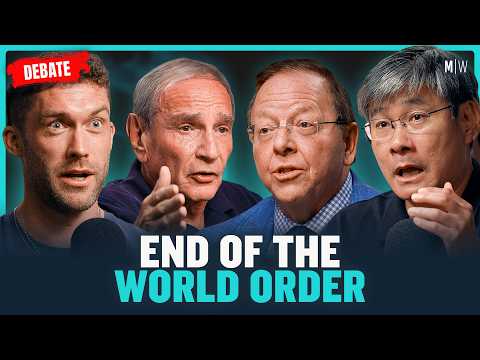
[@ChrisWillx] WW3 DEBATE: “We’re On the Brink of Global Collapse”
![[@ChrisWillx] Summarizer](https://summaries.pages.dev/img/logo.webp)
Link: https://youtu.be/4klivapz4Gw
Duration: 186 min
Transcript: Download plain text
Short Summary
University of Chicago professor Robert Pape, author of 'Our Own Worst Enemies: America in the Age of Violent Populism,' joins host Chris Williamson and analysts Ian Bremmer, George, Eu Jang, and Thomas for a long-form panel on the biggest threats to global peace. The conversation covers US internal political violence, the unraveling of Pax Americana, US-China rivalry, potential US territorial expansion into Canada/Greenland/Venezuela, and the unfolding Iran war with mounting risks of nuclear escalation. The episode also examines Trump's alignment with the 1996 Clean Break memo's Greater Israel Project, the Israel lobby's domestic influence, the November midterms, and the humanitarian catastrophe of targeting Iran's electric grid.
Key Quotes
- "I think the United States right now is the greatest threat to global peace because for the past 30 years Pax Americana has been dominant and now with the rise of other powers, United States refuses to seed its global hijgemony and this is why we're seeing conflicts all around the world specifically in the Middle East." (00:01:44)
- "I think what's really important to appreciate is that yes, these conflicts are regional, but there's a power orchestrating these conflicts, and that is United States." (00:04:46)
- "I would say it's not losing it, it's wanting to lose it. The past 80 years was not been a happy time for the United States." (00:09:56)
- "But I I do think that right now at this point uh domestic violence is almost unavoidable." (00:47:58)
- "America was preeminent from 1991 until this war. America's being knocked back because for the first time since '91, a state beat America." (02:37:41)
Detailed Summary
Threats to Global Peace: US Decline, the Iran War, and Greater Israel
Overview and Episode Setup
This is a long-form panel discussion hosted by Chris Williamson featuring University of Chicago professor Robert Pape (author of Our Own Worst Enemies: America in the Age of Violent Populism, Substack "Escalation Trap"), geopolitical analyst Ian Bremmer, and foreign policy commentators George, Eu Jang, and Thomas ("Predictive History").
- Pape states he advised four White Houses from 2001 to 2024—two Democratic and two Republican—and has been modeling the Iran conflict annually for 20 years as the next Germany-style challenge.
- The conversation surveys US internal political violence, the unraveling of Pax Americana, US-China rivalry, potential US territorial expansion into Canada, Greenland, or Venezuela, and the unfolding Iran war with mounting risks of nuclear escalation.
- Additional topics include Trump's alignment with the 1996 Clean Break memo's Greater Israel Project, the Israel lobby's domestic influence, the November US midterms, and the humanitarian catastrophe of targeting Iran's electric grid.
Pape's Research Framework on US Political Violence
Pape's book Our Own Worst Enemies is grounded in 5 years of research and 20 national surveys conducted through the University of Chicago's Chicago Project on Security and Threats.
- He identifies two structural drivers of American political violence: (1) the US transitioning from white-majority to white-minority democracy for the first time in its 250-year history, and (2) massive wealth concentration among the top 1%.
- The George Floyd protests involved roughly 28 million people, with 7% engaging in riots or political violence; Pape describes January 6th as the first time a violent mob supported by a president tried to stop a peaceful transfer of power.
- Tens of millions of Americans on both left and right now view political violence as acceptable—a condition not seen in the United States since the 1960s.
- Pape cites John B. Calhoun's 1960s rat utopia experiment as an analogy for status-deprived young men turning violent when crowded together with no outlet for advancement.
Why Pape Predicts a Decade More of Violence
Pape argues the 1960s political violence ended because the underlying structural drivers were resolved, but the current drivers remain intact.
- The 1960s violence subsided after the Black Caucus gained congressional representation in the mid-1970s and the end of conscription in 1973 removed the draft as a grievance.
- Because today's drivers—demographic transition and wealth concentration—have not been addressed, Pape predicts another 10 years of violent populism at minimum.
- He frames current US internal divisions as the single greatest threat to global peace, with political violence normalized over the past 5–10 years.
Disagreement: Cycle Versus Crisis
Host Chris Williamson pushes back on Pape's framing, arguing that American political violence is cyclical rather than structural.
- Williamson cites the Civil War's 600,000 dead followed by national reconstruction, and the 1970s wave of political violence (Weather Underground, Symbionese Liberation Army) that ultimately subsided.
- He compares current US dynamics to the Roman Republic around 150 BCE, just before the Third Punic War, when institutions were rotting but the state remained powerful.
- Pape responds that the present combination of demographic transition and wealth concentration, alongside a baby boomer gerontocracy, makes internal violence almost unavoidable.
The End of Pax Americana
Multiple speakers argue the US is deliberately choosing to retreat from its 80-year role as global hegemon, offloading regional security burdens.
- The Pentagon's National Defense Strategy reportedly calls for US withdrawal and the creation of regional balances of power in Europe, the Middle East, and Southeast Asia.
- The plan would push primary responsibility onto NATO, Israel, the Gulf Cooperation Council (GCC), and Japan.
- One speaker frames this as the United States choosing to lose its global role rather than being defeated in war.
US-China Rivalry: GDP and Growth
The panel compares current US and Chinese economic positions and discusses trajectories that could reshape global power.
- The US accounts for 26% of world product versus China's 17%, but the gap could flip within 20 years.
- China's growth has fallen to roughly 4%, down from 5%, and previously 15%.
- A speaker touring Chinese industries in June 2025 (visiting Beijing, Wuhan, Hangzhou, and Shenzhen) noted the Wuhan-to-Shenzhen crescent has uplifted roughly 50 million people over 10–12 years—comparable in scale to the US Chicago-Pittsburgh-St. Louis rust belt.
US-China Rivalry: Vulnerabilities and Pressure Points
China's economic and strategic vulnerabilities are enumerated, alongside pressure points in US-China trade relations.
- China is ranked 71st in per capita income, is export-dependent with the US as its largest importer, lacks a blue water navy, and conducts most of its trade in US dollars protected by the US Navy.
- The one-child policy has created a demographic crisis that will constrain Chinese growth and military manpower.
- China's growth model is pivoting toward Asia rather than US/Europe exports; BYD and Xiaomi are not selling cutting-edge models in the United States.
- Trade aggression from Trump's first term (2017) pushed China to disengage next-generation industry development from America, accelerating decoupling.
- Trump reportedly declined to answer Xi's question about whether the US would defend Taiwan; Xi raised the Thucydides Trap framing.
Potential US Territorial Expansion
Pape puts a roughly 20% probability on US territorial expansion into Canada, Greenland, or Venezuela—and considers this more likely than China taking Taiwan.
- Trump has spoken directly with Canadian PM Mark Carney about moving the US-Canada border and abandoning the 1908 treaty.
- Carney's Munich Security Conference speech reportedly signaled that he sees something on the horizon requiring preparation.
- Pape ties the probability heavily to the 2028 US election outcome and whether a MAGA "red wave" grows stronger.
The Iran War: Origins and Trump's Strategy
Iran is described as the most difficult US challenge since Nazi Germany in World War II, with several prewar moves framing the conflict.
- The Ayatollah (who had issued a fatwa against nuclear weapons) was assassinated on day one of the war; the US head of counterterrorism resigned, saying the president wouldn't see him and was listening to the Israelis.
- Pape gives a 0% probability that Trump will voluntarily end the war; Iran's strategy is to drag negotiations past October into a post-election period when Trump cannot make a deal, forcing major concessions.
- Pape estimates less than a 10% chance Iran will implode before November.
- Before February 28, Pape's model put US nuclear-use odds below 5% and Israeli use at roughly 15%; he has since roughly doubled both estimates.
Prewar Pro-Israel Actions and the Soleimani Strike
The panel traces a pattern of Trump first-term decisions that Pape argues were counterproductive if the goal was preventing an Iranian bomb.
- Trump's actions include JCPOA withdrawal, moving the US embassy to Jerusalem, recognizing Israeli control of the Golan Heights, and the January 2020 assassination of General Qasem Soleimani.
- Each of these moves reduced Iran's incentives to constrain its nuclear program and increased its motivation to develop one.
- Internal Iranian division persists: roughly 20,000 were killed in a prewar uprising, and a senior IRGC commander publicly called for the war to stop two days before the discussion.
Escalation Risks and Nuclear Threats
The panel details military indicators that have raised the probability of nuclear use and Iranian breakout.
- Israel's Dolphin submarine was moved into the Red Sea within firing range of Tehran, raising Iran's incentives to prepare and conduct nuclear tests.
- Bombing the Fordow facility would be roughly 90% likely to destroy enrichment capability, but it is unknown whether the 60%-enriched "fizzle" uranium stockpile was destroyed.
- Satellite imagery from approximately February showed material being moved out of Fordow, complicating post-strike verification.
- Iran's "Mosak defense" decentralizes command across 31 commanders; the IRGC command structure has been replaced in a single direction aligned with the Supreme Leader.
Economic Consequences of the Iran War
The panel argues the economic fallout from the Iran war is catastrophic rather than a short-term shock.
- The GCC economy being destroyed by the war is weakening Japan's yen.
- The US and GCC can no longer provide global liquidity to buy US treasuries, meaning the US cannot refinance its roughly $4.2 trillion debt.
- Iran may attempt to close the Strait of Hormuz to damage Trump politically before the midterms; roughly $10/gallon gas prices were discussed as a trigger threshold.
- The Middle East provides 25–33% of world fertilizer; losing supply for a year could cause millions to starve.
- AI data centers account for 50% of US GDP growth and are financed by the GCC—a vulnerability if the war spreads.
- Restoring damaged energy facilities would take roughly six months even if the war ended immediately.
Historical Lessons: Sanctions and Blockades
Pape argues that since World War I, heavy economic pressure alone has never won a major war.
- The British blockade of Germany in World War I killed 700,000+ civilians but did not defeat Germany.
- Sanctions on Japan before and during World War II did not prevent atomic bombs or the need for ground invasion.
- Iraq sanctions (1991–2003) crushed the Iraqi economy at roughly 50% per year, but the 2003 war still required roughly 150,000 troops to invade.
The 1996 Clean Break Memo and the Greater Israel Project
Pape links Trump's pro-Israel actions to a 1996 policy document prepared for incoming Prime Minister Benjamin Netanyahu.
- The Clean Break Memo envisioned Israel withdrawing from the Oslo process, pursuing regime change in Iraq and Syria, becoming self-sufficient, and resolving the Palestinian issue through defeat rather than compromise.
- Associates of the memo—Richard Perle, Douglas Feith, and Paul Wolfowitz—later served as Pentagon architects of the Iraq War.
- The Greater Israel Project envisions land from Egypt's Nile to Iraq's Euphrates, with the US military described as the only real impediment.
The Israel Lobby and Domestic Politics
The panel cites John Mearsheimer and Steve Walt on the structural influence of the Israel lobby in US politics.
- Jewish donors contribute roughly one-third of US election money.
- Christian evangelicals, roughly a quarter of the US population, include Christian Zionists; Christians United for Israel has approximately 7 million members.
- Specific spending cited: $30 million to defeat Thomas Massie in Kentucky and $70 million to defeat Abdul El-Sayed in Michigan.
- Larry Ellison bought CBS News and installed Bari Weiss, cementing a Zionist-capital/evangelical alliance described as "almost unprecedented."
- Both parties are now described as opposing the war, with Tucker Carlson and Joe Kent on the right calling for Israel funding to be zeroed out.
Middle East Realignment
A new regional bloc is reshaping the Middle East, with consequences for Israel and US posture.
- A Saudi Arabia–Turkey–Pakistan alliance is forming, with the Turkish army three times the size of Israel's.
- Israel reportedly bombed Turkish officials in Syria and then lied to the US ambassador about it.
- Houthi forces have closed the Bab el-Mandeb Strait, and Saudi Aramco facilities are being hit.
- Iran may be invited into the Saudi-Turkey-Pakistan coalition.
- Jang predicts the Ukraine war and the Iran war are merging, with China and Russia likely to be drawn in; Zelensky reportedly bombed an Iranian cargo ship in the Caspian Sea.
- Israel has only 7 million Jews in a country roughly 71 miles wide, surrounded by 300–400 million Muslims, while Saudi Arabia quietly works with Israel on intelligence and the Egypt-Israel peace treaty has held for decades.
November Midterms and Congressional Power
The panelists identify the US midterms as roughly 75 days away and a decisive threshold for Democratic control of Congress.
- If Democrats win, Pape predicts "tremendous pressure" to end the Iran war and zero out Israel budgets, marking the first major congressional constraint on executive foreign policy since 1974 (Vietnam).
- January is identified as the inflection point regardless of outcome.
- Pape predicts the 2028 Democratic nominee will be avowedly anti-Zionist.
Targeting Iran's Electric Power Grid
Thomas Griffith's mid-1990s paper "Targeting Electric Power" has served as a 20-year warning about the consequences of striking power infrastructure.
- Roughly 25% of Tehran's food is refrigerated; loss of power would collapse water pumping and food supply for 10 million people.
- Hitting power-plant cables knocks out electricity for 4–5 days; destroying the generating hulls themselves takes 6 months to replace.
- Striking just 10 power nodes could leave 70% of Iran's population without electricity, which the panel describes as worse than a tactical nuclear strike on a city.
NATO and the Move Toward Anarchy
The panel describes NATO as effectively dead and the world as moving toward fragmented "anarchy" rather than multipolarity.
- Article 5 puts a US general in command of all allied forces, a structure Trump reportedly rejects; Trump is said to believe Obama conspired with Europeans to defeat him in 2020.
- Japan, Poland, and Saudi Arabia are building independent military capabilities; Poland may pursue nuclear weapons despite 10,000 US troops on its soil.
- After the 1991 Gulf War, world trade rose from 38% to 62% of world product; renewed instability is making trade and insurance more expensive.
- The US share of world GDP has been flat at 26% since 1990; China rose from 2% to 17%, Japan fell from over 10% to roughly 4%, and the UK fell from 6–12% to under 4%.
- Nuclear proliferation and preventive wars are identified as rising risks in this fragmenting order.
Forward Look and Pivotal Dates
The panel closes by identifying specific dates and decision points likely to shape the next phase of global order.
- January 2027 is identified as a pivotal moment for the US, China, and Iran to reset and recalibrate for either a post-Trump or future-Trump world.
- Scott Bessent faces an "economic D-Day" the day after the discussion, reflecting the immediate refinancing pressure on US debt.
- The combination of demographic transition, wealth concentration, an unraveling Pax Americana, an active Iran war, the Greater Israel Project, and a fragmenting global order leaves multiple flashpoints converging within the next 18 months.