[@hubermanlab] How to Accelerate Learning & Improve Education | Joe Liemandt
![[@hubermanlab] Summarizer](https://summaries.pages.dev/img/logo.webp)
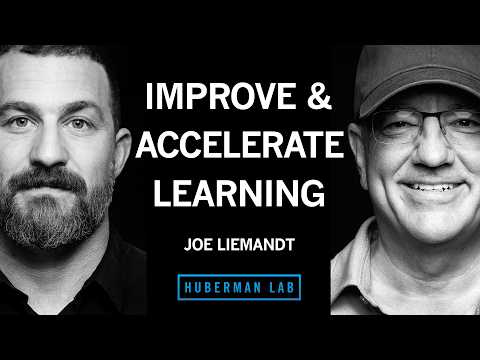
Link: https://youtu.be/Uzoe1RYVjiA
Duration: 153 min
Transcript: Download plain text
Short Summary
In this Huberman Lab episode, host Andrew Huberman interviews Joe Limont, principal of Alpha School, about reinventing K-12 education with AI-driven 2-hour mastery learning paired with life-skills afternoons. They discuss results like 1530 average SATs, top-1% national rankings, and plans for sub-$1,000 Africa schools, a free educational game for 500 million kids, and a 'philosopher-builder' Founder School. The conversation also critiques the Prussian classroom model and explains learning science principles (worked examples, spaced repetition, fluency) that enable 5-10x faster learning.
Key Quotes
- "We don't do the basics. We need to nail the basics. Just like in sports, my famous example I always use is if you lose the ball 20% of the time going down the court. The coach is not saying, "Let's work on the dunks and the alleyoops or the even the layups." They're like, "Ball handling. We're going to get ball handling. 20% isn't acceptable. 15% isn't acceptable. You can't be 85 80% accurate."" (00:00:00)
- "The average eighth grader to 12th grader goes up one point from a you know it depends on the subject but 233 to 234 four years later they don't learn anything." (01:11:30)
- "Our average student does not sit in class for six and do homework. They sit at an AI app and they spend two hours a day. The average kid spent 121 minutes last year in the apps and learned more than 2x they what they would have in sitting in class for six and doing homework." (00:30:33)
- "Learning science there's a whole field of learning science right you can cognitive load theory cognitive science there's a famous paper from the 80s Bloom's two sigma program where he's he's like if you give an individual tutor to mastery level kids can learn at two sigma right two sigma it is top 2% we could get everybody so when you talk about the frontier he's basically claiming you can get everybody to the top 2% performance today assume having high levels of motivation." (00:30:04)
- "And I can't run a school that they love more than vacation if I have low standards. And it is that paradox, right? That tension that is the magic of Alpha School." (00:16:07)
Detailed Summary
Episode Overview and Participants
Andrew Huberman (Stanford neurobiology/ophthalmology professor, separate from his university role) interviews Joe Limont, principal of Alpha School, about reinventing K-12 education through AI-driven mastery learning and high-standards/high-support mentorship. Limont, now entering his fifth year as principal, was won over after his own daughters chose Alpha over summer camp and describes the past four years as the best of his life; Alpha was founded by Brian and Mackenzie roughly twelve years ago.
- Huberman frames himself as a former high-school academic slacker who aimed for a 90 at Stanford, wrote a 1985 paper on AI noting neural nets were decades away when expert systems dominated, and studied under Ed Feigenbaum ("father of expert systems") before dropping out to build a startup.
- Huberman's father publicly criticized the dropout in a Forbes quote; 18 months later, seeing 100-hour weeks and his son sleeping under a desk, he reversed to "Thank God you dropped out."
- The episode covers Alpha's two-hour academic model, learning science principles (worked examples, spaced repetition, fluency), motivations, life skills, scale plans, and a new Founder School for "philosopher-builders."
Alpha School's Core Two-Hour Model
Alpha students spend only two hours per day on core academic learning via AI-delivered apps targeting "2x in 2 hours" — twice the expected learning rate in that time — then spend the rest of a six-to-seven-hour day on sports, life-skill "stacks" (leadership, entrepreneurship, financial literacy, socialization, storytelling, grit), passion projects called Alpha X's, and tactile lab work.
- Three explicit commitments: kids love school more than vacation, they hit 2x in two hours academically, and they learn life skills.
- Five grit milestones span kindergarten through eighth grade: kindergartners climb rock walls, second graders run a 5K, and eighth graders complete a "tough mutter" teamwork challenge.
- Daily structure uses roughly 25-minute Pomodoro blocks, accommodating ADHD students who reportedly lock in during the apps and then build all afternoon.
- Costs are framed around an average US public school spend of about $20,000 per student per year, an afternoon workshop budget dropping from $40,000+ to $20,000 in public placements, and IMG Academy tuition exceeding $100,000.
Student Outcomes and Anecdotes
Alpha's measured results are striking: K-2 students test in the top 1% nationally, graduating seniors average a 1530 SAT (described as nearly perfect), and honors-track freshmen average 1400. By self-report, 90% of Alpha students say they love school, 40–60% say they would rather attend than go on vacation, and 85% of parents reported their child doing something they thought impossible for that age (e.g., kindergartners climbing a 40-foot rock wall, a second grader riding five miles across the Golden Gate Bridge).
- Last year roughly 100,000 people applied to be Alpha "guides" (teachers).
- An Alpha student was the first high-school lead researcher published in Nature, a journal with pre-review rejection rates above 90% and an overall acceptance rate of about 1%; the LLM reportedly outperformed the student's parents at teen dating advice because parents lacked the online context.
- A female student produced a Broadway musical with TikTok-sourced music that filled a 1,000-person venue and streamed 1 million times on day one; she was one of 790 auditioners and was accepted to Northwestern, NYU, USC, and UCLA.
- An Alpha X mountain-biker built an Austin bike park written up in Texas Monthly, which a Walton family member cited as motivation for Bentonville and which SpaceX hired him to replicate at Starbase.
- Austin fifth and sixth graders ran "Alpha City Limits," a music festival with bands and instruments, raising $25,000 from sponsorships; the kids were surprised that companies paid $1,000 for flyer placement.
- A fourth grader started a podcast called "Quantum Plations"; an "Open Claw" AI-kids team presented at Southby and Claude Con and earned $50,000 in 10 days; one student is marketing Martin Scorsese's latest film.
- A Sports Academy student formerly skipping 25% of school days now wakes his mother to make his two-hour academic block with his coach.
Learning Science: Worked Examples, Spaced Repetition, and Mastery
Huberman opens with a basketball analogy: a player turning the ball over 20% of the time would be drilled on ball handling, not allowed to dunk; in schools, a B (80%) is too often accepted and students advance with gaps. The Alpha protocol combines three evidence-backed mechanisms — worked examples (show first, scaffold removed over time), spaced repetition timed to each learner's forgetting curve, and initial mastery (~95% proficiency) before moving on.
- Bloom's 2 Sigma problem: 1-on-1 tutoring plus mastery learning moves average students into the top 2%, decomposed roughly as 1 sigma from tutoring and 1 sigma from mastery.
- Worked examples plus spaced repetition worked well for grades 8–12 (multi-line algebra) but underperformed grades 4–7; adding initial mastery the next year recovered scores.
- At a staff day with hundreds of teachers, only about 5% had learned direct instruction and none had read Project Follow Through during their master's programs; cognitive load theory and the science of learning are not central in many schools of education.
- A Houston teacher now at Alpha tweeted she learned more in six hours with Limont than in her master's or PhD program.
Fluency, Working Memory, and Verbal Gains
A separate but critical lever is fluency: memorized multiplication tables and similar automaticities free working memory slots so multi-step problems become solvable. A student went from a 710 to a 790 SAT after memorizing her multiplication tables.
- Vocabulary gains come from reading about 10,000 pages and looking up unknown words, pushing verbal scores into the 90th-plus percentile.
- The hosts frame "fluency" as the foundational layer that makes all higher-order academic work possible — without it, students hit cognitive load ceilings long before they hit content ceilings.
Why the Current System Fails
The Prussian classroom model gave roughly one billion kids access but lacks individualization; class size settled at 30:1 about 100 years ago as the best societies could afford, and smaller classes trend toward 1:1 (20:1 is better than 30:1, etc.). COVID learning loss combined with rigid grade-level mandates means eighth-grade teachers must teach eighth-grade content to students functioning at third-through-seventh-grade levels.
- NWEA MAP data show the median US student gains only about one point from eighth to twelfth grade (e.g., 233 to 234 on a 300-point scale).
- In Austin, public schools have failed academic standards for five years running; some eighth graders cannot read at a third-grade level.
- About 2,000 professors backed standardized testing in UC admissions; the UC Board of Regents voted no; one dean of education likened the state of facts in education to Galileo's trial, calling it a "religious war."
- Family income is described as the single biggest predictor of student performance, followed by IQ and Big Five conscientiousness; the current system rewards time-based mastery (80% = B) rather than actual mastery.
- The hosts argue schools should be measured by the slope of learning (growth rate, e.g., 2x in 2 hours) rather than achievement, because schools should develop kids rather than just select them.
AI in Education: Misuse vs. Best Use
Limont argues that dropping chatbots into standard schools is misused: about 90% of students use them to cheat regardless of grade, and an unnamed Ivy League professor saw nearly an entire class fail an in-person final because of chatbot-written papers.
- The best use of AI, he argues, is individualized lesson plans that loop students to mastery — analogous to how the microscope, telescope, and analytical balance transformed other sciences.
- Transferring students from $50,000/year private schools tested 2.2 grade levels behind on Alpha's assessment; two-to-three-grade-level gaps can be closed in 20–30 hours per grade (roughly one hour of homework per day).
- Alpha reframes "three years behind" as "22 hours behind" to remove shame and shift engagement; remediation happens privately on a digital tutor so peers don't observe.
Motivation, Life Skills, and the Frontier Curve
Motivation is roughly 90% of the learning problem, and Alpha's first commitment is that kids will love school. Alpha runs "alpha tests" for life skills about ten weeks into school (e.g., rock climbing with a guide below until the child rings the bell) as modern rites of passage.
- Limont cites a "cultural epidemic" of middle-school girls believing they aren't good at math or science; he bet his own daughter $1,000 she'd reach the top 1%, and Alpha pays kids $1,000 to reach top 1% as a motivational lever — citing self-determination theory concerns but reporting it does not backfire in practice.
- The hosts distinguish: not every kid can reach MIT eligibility, but every kid can reach their personal frontier if shame and bad habits are removed.
- They describe "aligned willing hard work" as beating adult-imposed harder work; a co-host reframed this as "suffering with a purpose" internalized by the student.
Sports Academy and Texas Voucher Program
Sports at Alpha are gated behind academic performance: hit 2x in two hours and students are released by noon to train. Attendance reportedly doubles D1 scholarship odds because coaches prefer athletes with strong academics and grit.
- Texas Sports Academy launched a voucher sign-up site January 1; over 120,000 Texas families expressed interest in 100 days.
- Alpha received just over 1,000 Texas vouchers, all for families under $65,000 income, making it the state's largest voucher recipient.
- The Dallas high school is led by six-time NBA All-Star Jermaine O'Neal and is described as the #1 basketball team in the country, with claims of also having the best baseball team.
- Sports workshops were called among the cheapest offerings, with over 1,000 kids receiving it free via vouchers; one coach can manage 30 kids, and fields are capex-heavy with minimal opex.
Scale, Research, and International Expansion
Alpha is committing $1 billion in resources to expand beyond high-end private students, aiming to reach all 55 million American kids via vouchers, philanthropies, and public-school placement. The system is described as not about producing "crypto bros who hack the world to make money."
- Alpha will become the largest school in Texas serving kids under $65,000 income, learning at the same rate as private students despite entering below grade level.
- MIT Blueprint Labs is running RCTs to validate the system and identify where it fails.
- The GT Squared program plans to make 100,000 rural kids MIT-eligible academically by middle school via about four hours of app work per day; the speaker estimates a 20-year arc to change the educational system and warns that overnight change would be false advertising.
- Africa school expansion targets a sub-$1,000 price point; Alpha high schoolers help build it on a year-abroad commitment ("the hardest year of their life"), bringing solar, Starlinks, and a well.
- Alpha is building a program to find the 100,000 smartest US kids and target MIT eligibility by middle school (1580 SAT, 5s on AP Calc BC, AP Physics C, and AP Lang).
Founder School and "Philosopher-Builders"
Founder School is Alpha's new entrepreneurial high school guaranteeing each student $1 million in business profit or a full tuition refund, with Alexi helping design it. The framework: "philosopher-builders" with a rigorous, non-classics book list, intentionally not producing "crypto bros."
- Financial literacy was called the #1 thing parents request schools don't teach: kindergartners learn earn/save/spend/invest/donate, scaling to middle schoolers running Airbnbs, food trucks, and vending machines.
- The Founder School info event drew 150 attendees versus an expected 10–15; families are reportedly relocating so that 10-year-olds will be ready for Founder School.
- Limont appealed to college-age through retired listeners, including game designers who never worked in education, to join the team.
Educational Video Game for 500 Million Kids
An educational video game targeting 500 million kids is being built by top video-game developers with zero prior education background, embedding learning science concepts and launching free at home. The stated goal is to beat entertainment games for kids' time and deliver top-1% academic performance.
- Alpha raised hundreds of millions of dollars to build these products.
- Limont frames the game as a "Trojan horse" for kids — entertainment-first packaging with mastery learning underneath.
Drivers of Demand and Critical Voices
Two forces drive demand: broad unhappiness with academic standards and parents seeing AI make the current system inadequate. Kindergarten parents forecast 12 years out and demand a different system; twelfth-grade parents are at the finish line and accept it. Huberman projects that in 10–20 years about 90% of parents will still drop kids at a building with adults and peers for socialization.
- Giving a student material at their correct level, alongside AI, lets disengaged students do things their parents thought impossible; Limont claims 85% of Alpha kids are doing "impossible" work.
- The hosts push back against the "AI is just cheating" narrative by arguing that AI tutors are no different from calculators, spellcheck, or any other cognitive tool — the constraint is the pedagogy, not the technology.
Upcoming Events and Book
Live events were announced at Radio City Music Hall (September 17), Dolby Theater (October 8), and The Masonic in San Francisco (October 28), promoting Huberman's new book Protocols: An Operating Manual for the Human Body (5+ years in development, 30+ years of research), covering sleep, exercise, stress control, motivation, and focus. Tickets are at hubermanlab.com/events; previous events sold out.
- The Neural Network Newsletter is promoted as a free monthly with 1–3 page protocol PDFs; Huberman Lab is on Instagram, X, Threads, Facebook, and LinkedIn.
- Listeners were directed to subscribe on YouTube, Spotify, and Apple and to leave comments, with Huberman noting he reads YouTube comments; show notes and captions contain Alpha School links.