[David Senra] A Deep Dive Into Palmer Luckey’s Bank | Jacob Hirshman, Erebor
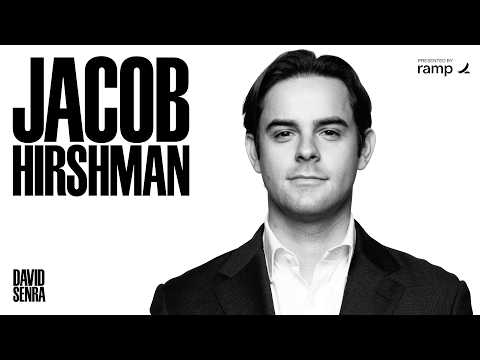
Link: https://youtu.be/O_dAi5KlVO0
Duration: 61 min
Transcript: Download plain text
Short Summary
This is a founder interview with the co-founders of a newly chartered U.S. bank (transcribed variously as Airbor, Airborne, Long Lake and Arabore), built with Palmer Luckey to lend to capital-intensive founders in advanced manufacturing, robotics, AI and defense. The guests explain why de novo chartering became possible, why they wrote their own bank core and underwriting software, and why they cap lending at a 50% loan-to-deposit ratio. The episode also covers global deposit sourcing, a wild post-January-2026 trip into Venezuela, historical analogies to J.P. Morgan, and Sam Zell-style lessons about relationships and character. A second guest segment features Jacob, a financier with a law-school background who works calls from 5:30 a.m. to midnight and frames his ambition through America's industrial rise between the world wars.
Key Quotes
- "Most banks buy their technology from third party bank core providers which means that they aren't actually driving innovation in the technical stack." (00:01:38)
- "so by policy we constrain ourselves to a 50% loan to deposit ratio what does that actually mean right it means that we're materially less levered than the average bank which has a 70% loan to deposit ratio And today we're lending significantly less of the deposit base than that." (00:02:57)
- "But you should go to sleep every night knowing that your money is going to be there." (00:03:13)
- "if I'm a fintech, if I'm borrowing someone else's balance sheet or I'm borrowing someone else's bank charter, I'm not owning my own destiny." (00:05:30)
- "because my customers aren't building niche products. My customers are building the future of America. That's what we're going to back." (00:29:15)
Detailed Summary
Detailed Episode Summary
Episode Scope and Naming
Max Levchin and fellow founders describe a newly chartered U.S. bank created with Palmer Luckey to finance capital-intensive founders building in advanced manufacturing, robotics, AI, and the defense-industrial base. The conversation connects the bank’s launch to regulatory change, its proprietary technology and conservative balance sheet, and an ambition to become a long-term capital partner for companies building the American economy.
- The bank positions itself around the repeated phrase “a real bank for real Americans building real things,” targeting founders whose businesses need substantial equipment, facilities, and production capacity rather than only conventional working capital.
- The founders claim the bank is the fastest-growing bank in American history, with deposit growth coming primarily from U.S.-based founders and builders.
- The transcript renders the institution’s name inconsistently as “Airbor,” “Airborne,” “Long Lake,” and “Arabore,” while Palmer Luckey also appears as “Lucky”; these appear to be transcription variations rather than four distinct institutions.
Why a New Bank Became Possible
The 2023 failures of Silicon Valley Bank and First Republic exposed the shortage of banking options for defense, manufacturing, and AI companies. A more permissive regulatory environment then made it conceivable to charter a bank and build its technology from the ground up rather than acquire an older institution.
- The company was started in May 2025, applied for a U.S. bank charter in June 2025, and opened by February 2026, a timetable far shorter than the historical norm.
- Before this window, would-be banking founders generally had to purchase and convert an existing bank because de novo chartering had largely disappeared in the post-financial-crisis period.
- The historical wait between applying for a charter and receiving one was two to three years, making the founders’ application unusually fast even before considering the technology build.
- Levchin says the Office of the Comptroller of the Currency moved swiftly to admit new banks as a source of competition and innovation, and that the company recognized the opportunity early and raised capital quickly.
- He also anticipated a policy shift after new administration appointees publicly emphasized the importance of new banks, allowing the founders to commit to the regulatory process before many competitors.
- NewBank was conditionally approved for a U.S. charter and had to raise roughly $560 million in capital; Mercury and Revolut were also conditionally approved, indicating that the window extended beyond one company.
- The U.S. banking system fell from more than 8,000 banks before the financial crisis to roughly 4,000 today, with one guest estimate closer to 4,800, as failures and consolidation concentrated assets in a small number of large institutions.
Building and Controlling the Financial Stack
Owning a charter lets the bank control both its product roadmap and the technology underneath it, rather than renting those capabilities from another bank or core provider. The founders argue that this vertical integration is essential for both speed and innovation in a business where every layer is regulated.
- The founders compare regulation in financial services to supply chains in manufacturing: founders generally want to control each layer of cost, and providing financial services necessarily puts at least one part of that stack under regulatory oversight.
- Owning the charter allows the bank to select its own services, set underwriting standards, and move faster than an institution dependent on another bank’s infrastructure.
- The regulator required approval of an exhaustive business plan before the bank could open, making the launch dependent on proving that the charter, funding, staffing, and operating model were viable.
- The company built its own bank core and proprietary underwriting software, with every line of code written as of May 2025 rather than assembled from conventional third-party banking systems.
- The founders intend to apply newer AI tools to underwriting and credit decisions while also differentiating the bank as AI-assisted fraud and cybersecurity threats increase.
- An Apollo–Athene merger is offered as an analogy for vertical integration: combining a balance sheet with the operating company can reduce repeated calls on outside capital and make the firm a more dependable provider.
- The speakers contrast this operating model with manager-led companies, where a relatively simple change can pass through 18 committees and 16 employee layers before anything happens.
Risk Limits and Credit Philosophy
The bank deliberately caps lending at half of its deposit base, giving it substantially more balance-sheet room than a conventional bank. That conservatism supports a strategy centered on permanent relationships with capital-intensive founders rather than maximizing near-term interest income.
- By policy, the bank limits its loan-to-deposit ratio to 50%, compared with an average bank near 70%; the speakers say actual lending is currently below that ceiling.
- The core offering is credit rather than dilutive equity for founders building AI infrastructure, drones, factories, and other defense-industrial businesses.
- Its underwriting advantage comes from understanding the specialized equipment and operating assets on a borrower’s balance sheet, including businesses that large banks may not know how to evaluate.
- The desired model is “the farmers bank for tech”: historically, specialized farmers banks supported Iowa corn growers and similar customers through cycles, but most of those institutions have disappeared.
- Two barriers keep large banks from serving this market effectively: they carry branches, employees, and regulation outside the United States and hedge more broadly, while this bank is regulated exclusively in the U.S.
- Speed is the second competitive advantage; a founder might obtain a facility priced 25–50 basis points more cheaply from J.P. Morgan, but a faster commitment can be more valuable because it reduces the risk of missing a time-sensitive investment opportunity.
- The guests describe lender economics as asymmetric: a lender receives capped upside but carries the downside of an unsuccessful borrower, so it must protect principal and only back companies whose people and assets it believes it deeply understands.
- The bank president evaluates credit through the traditional four C’s, including character—specifically, whether the borrower can look the lender in the eye and is someone with whom the bank should do business.
Relationships, Trust, and Underwriting
The host uses stories about Sam Zell to explain why the bank treats trust, relationships, and judgment as central underwriting inputs rather than secondary considerations. These anecdotes emphasize the value of finding the one variable that determines a deal and of choosing borrowers who care deeply about their operations.
- Sam Zell worked with Jay Pritsker, whom the host described as roughly two decades older and “the best deal guy I ever met”; Pritsker reduced a deal with about eight variables to the single issue that mattered most and instructed Zell to ignore the other seven.
- Zell was willing to pay above a lender’s request: on a deal quoted at 7.25%, he proposed paying 7.75% because the additional cost purchased a relationship expected to last 5, 10, or even 25 years.
- On a borrowing of roughly $150 million, the extra cost was described as about $2 million, an amount Zell accepted to preserve access to the same lender over decades rather than optimize only the current transaction.
- The host had lunch with Zell shortly before Zell’s death without knowing he had cancer; Zell said he loved doing deals and would continue until he died, and he died roughly six months later.
- Zell’s friend Rick, who said he had been mentored by Zell for about 25 years, described the same approach as identifying the one factor on which the outcome depended.
- The bank distilled these stories into two underwriting principles: relationships and trust, and understanding what actually matters rather than treating every variable as equally important.
- A South American banker with roughly 40 years of experience in manufacturing lending walks borrowers through their factories and asks questions unrelated to the immediate transaction, because visible passion for the business suggests the owner is more likely to repay than abandon the company when conditions worsen.
- Warren Buffett recounted a business owner who discovered that his employees were being shortchanged on toilet paper and went to count the rolls himself; the lesson was to work with people who obsess over details and optimize even small elements of an operation.
- To become founders’ preferred capital provider, the bank wants to make access to capital the easiest path for entrepreneurs, understand each borrower’s balance sheet, cash flow, and revenue in depth, and deliver an indication of interest faster than the market.
Origins, People, and Hiring
The bank’s early organization combined outside capital, a very small engineering team, and Palmer Luckey’s unusually hands-on approach to customers and messaging. Its hiring model similarly blends seasoned banking judgment with the speed and ownership habits of former founders.
- Joe Lonsdale and Kahn Ventures were the first investors; Lonsdale remains on the board and has invested early in numerous Elon Musk companies.
- During the charter process, the company operated from Palmer Luckey’s garage with roughly 10 engineers working 80–100-hour weeks.
- After backing the company’s lawn sale, Lonsdale proposed building a replica of Gringotts from Harry Potter as its headquarters, arguing that a strong physical environment where customers linger could help create trust and scale the bank.
- Luckey builds customer relationships in a highly informal, high-touch manner, including taking customers out to shoot grenade launchers together.
- The speakers describe Luckey as a marketing genius who packages complicated ideas into simple messages, and one founder says working with him changed the approach from taking incremental steps in a heavily regulated business to pursuing one of the country’s largest banks on the fastest feasible timetable.
- Luckey’s original proposed name was “the real bank,” one of several alternatives considered before the final naming story was selected.
- The bank uses a “barbell” hiring model: a president with decades of banking experience supplies institutional wisdom, while approximately 40% of employees are former founders who contribute speed and an owner’s mentality.
- Former founders are expected to think of themselves as business owners, take responsibility for profit-and-loss performance, and thereby build personal equity in the bank’s stock; Levchin says recruiting founders is also the easiest part of this strategy for competitors to copy.
- The idea that “the best hire you’ll ever have will be this person’s last job” is attributed in the episode to Jimmy Soni’s book The Founders about PayPal, and Levchin says he wants to be the last employer of the people he hires.
- Nick of Revolut argued that more founder banks would produce better consumer products because he was, at that point, the only one; Revolut was described as Europe’s most valuable private startup at roughly a $15 billion valuation.
- The episode says Revolut had secured advertising inventory in more than half of Europe’s airports, including entire hallways, which one speaker characterized as real-world advertising arbitrage; Jamie Diamond was said to run Revolut like a founder.
Global Deposits and the J.P. Morgan Comparison
The bank’s funding model depends on gathering deposits globally, not only opening American branches. The comparison with J.P. Morgan illustrates how low-cost retail funding, physical distribution, and trusted digital infrastructure can become decisive advantages.
- In banking, assets are funded by liabilities, and the cost of those liabilities is principally the interest paid to depositors; J.P. Morgan’s strength is partly attributed to paying almost no interest to retail depositors.
- The guests illustrate the margin effect with a four-point spread: a loan priced from 2% to 6% has the same width as one priced from 3% to 7%, so the savings on deposits can be passed to borrowers without reducing the bank’s spread.
- J.P. Morgan grew from being one of the large banks before the crisis into the premier U.S. financial institution, controlling more than 10% of assets in the U.S. banking system.
- Since 2018, J.P. Morgan opened about 1,000 physical branches while peers closed and consolidated locations, leaving its branch count roughly unchanged in net terms.
- As AI-driven fraud and cybersecurity risks increase, the speakers argue that face-to-face relationship building becomes more valuable, making branch networks a major defensive asset for mass-market franchises such as J.P. Morgan.
- The new bank’s stated strategy is to source billions of dollars of deposits globally at a structurally lower rate than domestic U.S. deposits and use that funding to finance American factories and businesses.
- A 100-basis-point reduction in borrowing cost is framed as an extra 1% that a factory builder can reinvest in the business, making the funding strategy directly relevant to the customer’s operating plan.
- The dollar is sold “in its best form” as a U.S.-regulated bank deposit, giving non-U.S. holders a way to access the global financial system through an American institution.
- The guests warn that in some inflationary environments a local currency can lose 25% to 30% of its value in a quarter, leaving local-currency savings unable to cover ordinary bills, whereas Americans have largely not faced the same erosion in domestic purchasing power.
- Global fintechs and banks can build products on the bank’s APIs and use its infrastructure to make dollar-denominated deposits available to their own customers, creating a global liability base.
- The funding is expected to be cheaper than U.S. deposits because there is less direct competition for the product and because the dollar-access offering is differentiated from local banking alternatives.
- Operating across borders adds three specific complications: deposits must be sourced through local institutions because of regulation, frontier and emerging markets require specialized risk and compliance expertise, and partners want technology on which they can build their own products.
- The team’s experience comes from large international banks and U.S. government positions covering risk, compliance, and anti-money-laundering work.
AI Infrastructure and National Security
The conversation extends the bank’s lending thesis from individual founders to the strategic supply chains required for AI and defense. Government credit support, domestic manufacturing, and long equipment lead times are presented as national-security issues rather than merely financing opportunities.
- The Pentagon has approximately $25 billion in credit-subsidy authority through its Office of Strategic Capital, created under the Biden administration to support risk-adjusted financing for investments in strategic U.S. supply chains and infrastructure.
- The bank advised a company on securing a loan to manufacture mechanical and electrical infrastructure for data centers in the United States, with the company’s broader goal being a vertically integrated AI-infrastructure business.
- Approximately 40% of the relevant data-center supply chain currently exists offshore, leaving the American AI stack dependent on foreign manufacturing capacity despite the strategic importance of that stack.
- Transformers have a lead time of 128 weeks for new data-center construction, a schedule the guests describe as a threat to the United States’ ability to remain at the cutting edge of the AI race.
- The argument is that AI infrastructure is itself national-security infrastructure, not merely a commercial technology sector separate from weapons and defense.
- By sourcing inputs more broadly rather than placing every facility on its own balance sheet, a company can devote more capital to creating jobs, expanding production, and developing additional inputs.
- The speakers argue that technology is the core driver of U.S. economic growth and that AI will redirect people who might have built 15 years-ago B2B SaaS companies toward buying factories and scaling physical operations.
- Alex Talman at Long Lake is cited as an example of using a differentiated technology stack to scale acquired businesses, making corporate acquirers an important target customer group that needs external capital.
- The bank’s stated strategy is to identify founders, back them repeatedly, and become their key long-term partner, with Levchin arguing that repeat financing is how the bank ultimately wins.
The Venezuela Banking Trip
The Venezuela sequence is the episode’s most involved personal story, beginning with an unexpected banking opportunity and becoming a multi-day effort to cross borders and reach a meeting. The outcome was a series of visa, aviation, and ground crossings that culminated in the trip’s business purpose.
- Venezuela was once a top-five country by GDP per capita and among the wealthiest in the world in the late 1990s, when the New York–Caracas flight was among the most traveled routes operated by major airlines; that period ended after Hugo Chávez took over.
- Following Venezuela’s political change in January 2026, the executive saw an opportunity to reconnect the country with the U.S. banking system and visited in February 2026.
- American companies in oil and gas, metals, and mining were eager to invest in Venezuela but could not find banks willing to work with them, accept no residual exposure to the market, and move quickly.
- While in Washington, D.C., for a conference, he applied for a Venezuelan visa on Monday night and was told at about 8:00 p.m. Tuesday that it would clear at 8:00 a.m. Wednesday.
- Although the visa cleared, there was no direct U.S. flight, so the travelers chartered a plane from Dallas; at roughly 4:00 a.m., the charter company refused to board him because it said he lacked a visa.
- He had already canceled a full day of meetings to investigate the banking opportunity, and the inability to enter became a matter of personal pride as well as business.
- His team proposed flying commercially to Bogotá and arranging a land crossing; Venezuelans cleared a small charter from Bogotá, but Colombian approval had not arrived by 11:30 p.m.
- At 4:00 a.m., his chief of staff called after roughly 100 missed calls and said Colombians would not grant him airspace; the only way to avoid missing his meetings was to cross the border and depart from Venezuelan airspace.
- He flew to Cúcuta, a dangerous crossing where FARC and ELN operate, and a driver took him through back streets and alleys because neither spoke the other’s language.
- When a man in a tank top knocked on the car window, the chief of staff explained that he was the driver’s cousin, easing an alarming moment during the journey.
- Venezuelan border officials were friendly but surprised by a visitor in a suit and tie; they spent about 30 minutes processing him and stamped his passport.
- Plain-clothes armed men then detained him, made him stand against a wall with his passport held against his chest, photographed him, and signed the document for about 30 minutes.
- They returned the passport with the message “Welcome to Venezuela, sir,” and he reached the meeting he had crossed the country to attend.
The Bank’s Name and Historical Ambition
The chosen name draws on a fantasy image of reclaiming a strategic mountain and building a prosperous society from its resources. The broader ambition is to finance another American industrial transformation, using figures such as Rockefeller, Carnegie, Vanderbilt, and J.P. Morgan as models.
- The name was inspired by the Lonely Mountain in The Lord of the Rings, where the dwarves reclaim it from Smaug and build a prosperous society by mining gold, silver, and other precious materials.
- The mountain metaphor also conveys safety and security, qualities central to a bank that intends to hold deposits for long periods while financing difficult industrial projects.
- Other names considered included “the real bank” and “Feyonor,” or Fënor, one of the oldest elves in the Undying Lands who crafts the Silmarils; the theft of those objects triggers civil war, and the story is used to frame the sacrifice required to build something great.
- The stated goal is to support the most important entrepreneurs of the generation as they build something comparable to another industrial revolution.
- The speakers draw explicit parallels with John D. Rockefeller in oil, Cornelius Vanderbilt in transportation, Andrew Carnegie in steel, and J.P. Morgan’s financing of the railroads.
- J.P. Morgan did not found the family’s banking institution; his father established the business and developed it into a leading New York and London institution before Pierpont Morgan helped elevate it to the number-one bank.
- The rise of Morgan is attributed not only to an individual but to the cast of people around Pierpont Morgan, the growth of the United States as an industrial and financial base, and a culture of founder-like employees who supported customers and generated trust.
- The guests invoke Charlie Munger’s view that trust is one of the greatest economic forces in the world, describing merchant banks as commodity-trading houses that evolved into family-run lenders capable of bridging gaps in trust.
- In 1905, J.P. Morgan helped stem a stock-market panic by publicly expressing confidence in the market; the host cites The Hour of Fate and describes a practical partnership with Theodore Roosevelt despite their being adversaries in some respects.
- The host argues that Morgan’s ability to stabilize the 1905 market through the power of one institution ultimately strengthened the case for a Federal Reserve rather than leaving the financial system dependent on a single powerful individual.
- Between the world wars, Morgan’s bankers operated as a kind of neo-state department out of the bank, acting as the most important financial institution of their era and the capital provider of choice at home and abroad.
- The proposed modern equivalent of Morgan’s “Morganization of the railroads” is increased U.S. manufacturing, artificial intelligence, and defense capacity financed at scale.
- The bank rejects the “niche bank” label with the statement, “My customers aren’t building niche products. My customers are building the future of America.”
- Luckey is compared to Rockefeller because of his consistent investment in the United States and its future, and he is described as a progenitor of defense-industrial-base manufacturing companies that have raised substantial capital.
- Levchin says Chase Manhattan grew through its Rockefeller relationship and is now a core part of J.P. Morgan, while predicting that the next Rockefeller will emerge from AI applications that reduce costs and build more efficient business structures rather than from foundation-model companies alone.
Jacob on Ambition and Morgan’s Mandate
The final guest segment shifts from the bank’s operating strategy to Jacob’s personal definition of ambition and the historical role he wants a modern financial institution to play. The comparison with Morgan is used to argue that financing national industrial expansion can remain both mission-driven and profitable.
- Jacob attended law school because he found it intellectually interesting and wanted to understand how financial systems work.
- The host says Jacob works roughly seven days a week, taking calls from around 5:30 a.m. until midnight.
- The host’s wife Laura, who appears off camera, characterizes Jacob as having always been “nakedly ambitious.”
- Jacob connects that ambition to his Jewish identity, saying he believes America has been the greatest society for Jewish people in world history and wants to drive value and give back to the country.
- During law school, a friend told Jacob that his life’s goal might be to become a New Jersey city council member, that the best anyone could hope for financially was retirement at 55 rather than 60, and that “you’re never going to have a billion dollar company”; Jacob stood up and left.
- The host frames the years between World War I and World War II as the decisive period in the growth of American industrial power, when Morgan’s bankers executed high-influence financings and raised capital from every available source so domestic industrials could make necessary investments.
- Jacob says any business he starts should be mission-driven, investing in companies that are investing in the country’s future while still making money and building something substantial.
- The proposed modern mandate is to mirror Morgan’s function as the trusted capital provider for domestic industrial expansion rather than reproduce the historical bank’s exact methods.