[@JesseMichels] Why This Japanese Monk Has a Piece Of The Roswell UFO

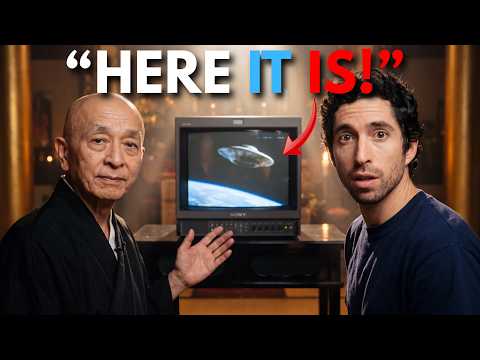
Link: https://youtu.be/NO-z5BaM61U
Duration: 94 min
Transcript: Download plain text
Short Summary
The host interviews Takeno Jouen, a Japanese Buddhist priest, researcher and curator who has run the flying-saucer-shaped Cosmo Isle Hakoule UFO museum on the Noto Peninsula for 30 years, housing real NASA hardware alongside UFO artifacts and documents he says he gathered himself. The conversation traces his alleged NASA access, his confrontation of Edward Teller over Project Sign/Grudge, and the 1962 Bluegill Triple Prime nuclear test, before turning to Roswell, alien bodies at Cape Canaveral, and the spiritual meaning of the UFO question. Several of his most dramatic claims are undercut on air by the host's own checking, leaving his real connections intact but his evidence unreliable.
Key Quotes
- ""Hong was leased to Britain for 100 years. So please lend it to me for 100 years."" (00:07:52)
- "you don't say UFO not to Houston. You say bogey. You say skunk, you say Santa Claus, or maybe you say moon pigeons." (00:15:53)
- "Well, we always have to airbrush them out before we sell them to the public." (00:21:47)
- "If you ask that question on camera, I will shut up. I will sit silent." (00:41:47)
- "It is our duty to let the truth get in the way of a good story." (01:30:07)
Detailed Summary
Takeno Jouen and the Cosmo Isle Hakoule UFO Museum
The Episode’s Central Tension
The long-form interview examines Takeno Jouen’s claims about NASA, UFO documentation, alien bodies, and the spiritual purpose of extraterrestrial contact. The host repeatedly separates the apparent reality of Takeno’s access and artifacts from the much less certain conclusions he draws from them.
- Takeno is presented as a Japanese Buddhist priest, researcher, writer, television producer, curator, and mystic who has operated the flying-saucer-shaped Cosmo Isle Hakoule museum on the Noto Peninsula for 30 years.
- Cosmo Isle displays genuine NASA material, including moon rocks and a Redstone rocket, alongside UFO artifacts and documents Takeno says he collected himself.
- The strongest evidence concerns Takeno’s physical connection to NASA and other institutions; his more dramatic interpretations are challenged by the host’s image searches, document checks, and comparison of competing accounts.
- The episode moves chronologically through claimed NASA access, Apollo-era encounters, Project Sign and Grudge, the 1962 Bluegill Triple Prime test, Roswell, and alleged alien storage at Cape Canaveral.
Takeno’s Temple and the Noto Peninsula Museum
Takeno’s institutional identity is rooted in a Buddhist temple with a documented family lineage, while his museum occupies an isolated location that has become a public collection of space and UFO material.
- Cosmo Isle Hakoule stands in a small town roughly 185 miles northwest of Tokyo on the sparsely populated Noto Peninsula, overlooking the Sea of Japan.
- The museum has operated for 30 years and combines authentic space hardware with UFO-related objects, photographs, recordings, and government documents.
- Takeno is the 41st-generation head priest of the Nittan Buddhist temple Honchozan Mohoji, a temple that has stood for more than 500 years and where he was born.
- Thousands of pages of purported Air Force and CIA UFO documentation are stored on the temple grounds, including material that the episode connects to Project Grudge, Bluegill Triple Prime, and alleged alien activity.
- Takeno says his NASA relationships were facilitated by the agency’s public-relations director, who gave him access to a storage facility containing space artifacts.
Nitaren Buddhism and the Meaning of UFOs
Takeno interprets the UFO subject through Nitaren Buddhism rather than treating unidentified objects solely as hardware or extraterrestrial visitors. His religious framework also supplies the episode’s central metaphor for approaching an “other” without immediately treating it as an enemy.
- Nitaren Buddhism traces its origins to the 13th-century priest Nitaren Shonen, who lived from 1222 to 1282 during the Kamakura period.
- The tradition regards Nitaren as a messenger of the Buddha and holds that every person has the potential to attain Buddhahood.
- Its central concept, Ichinen Sanzen, means “3,000 realms in a single moment of thought”: the entire cosmos is present within one instance of one mind.
- Takeno traces that teaching to 6th-century China and a teacher named Xi, and describes it as the heart of Buddhist teaching in the Nien tradition.
- Takeno sees UFOs as part of a larger spiritual system in which invisible forces guide certain people through history; he believes both Nitaren and he himself were protected by UFOs at moments of danger.
- The host uses the lotus as a counterpoint to reflexive fear: it grows from the mud at the bottom of a pond, not in spite of the mud but because of it.
NASA Access, the “10 Decades” Loan Form, and Alleged Smuggling
The interview’s first major thread concerns how Takeno obtained access to NASA material and how he and other Japanese collaborators allegedly removed UFO-related recordings. The host’s investigation turns this claim into a searchable media question rather than accepting the provenance at face value.
- Takeno says he personally smuggled UFO footage out of NASA’s Johnson Space Center and concealed it inside a Japanese video game.
- Japanese museum curator Takano, also called Tako Takeno in the discussion, said he copied NASA UFO footage and photographs in the early 1990s, made duplicates, and still possessed those duplicates.
- Takano said he did not notify NASA before the material was used in a TV Asahi video-game project and that the agency reportedly had no idea.
- On a NASA loan form, Takeno wrote “10 decades” as the requested loan period; when NASA laughed, he invoked the 99-year British lease of Hong Kong and asked for 100 years instead.
- After roughly 30 years of searching, the host identified a leading candidate: the 1996 Japanese PlayStation game Junichi Yi: Top Secret Project: Chase the UFO, released only weeks before Cosmo Isle opened.
- The game’s description claimed that it contained previously unreleased NASA photographs and videos, hundreds of additional UFO images, and more than 50 video clips.
- Inspection of the candidate footage found low-resolution, grainy, almost abstract objects resembling fireflies rather than a decisive “smoking gun,” although the images partially matched Takano’s description.
- Takano remembered the company as “Melddak,” associated with Japan Clary Business or Nipon Clary Business; Junichi Yowi was a prominent Japanese UFO television personality connected with programs such as “11 p.m.,” for which Takano wrote.
- The host left open whether the footage was recycled 1990s fabrication or authentic NASA material, turning the search for the original game into a public evidentiary challenge.
NASA’s Alleged Radio Codes and Donna Hair
Takeno argues that NASA maintained recognizable radio terminology for unidentified objects, allowing the host to compare those alleged codes with surviving Apollo transmissions. A separate account from photo specialist Donna Hair claims that unidentified objects were deliberately removed from public imagery.
- Takeno’s alleged distance-based terminology used “bogey” for objects within 400 kilometers of Earth, “skunk” for objects beyond that threshold, and “Santa Claus” for objects encountered around the Moon.
- On Christmas morning 1968, during Apollo 8’s engine burn behind the Moon, Jim Lovell reported, “Please be informed there is a Santa Claus.”
- NASA officially interpreted the transmission as a playful Christmas message confirming that the burn was proceeding as planned.
- Takeno scored the supposed NASA terminology as one identifiable use out of three before the Apollo 8 call and two out of three afterward.
- Donna Hair, a NASA photo-instrumentation specialist in Building 8 at Johnson Space Center, went public through the Disclosure Project and said her work included airbrushing UFOs out of photographs and videos before public sale.
- Hair recalled a restricted-area laboratory worker showing her a round white dot on a photographic panel and noting that “dots on the emulsion don’t leave round shadows on the ground.”
- Although that worker refused to confirm the object as a UFO—“I can’t tell you that”—the account also included the statement, “We always have to airbrush them out before we sell them to the public.”
- Hair additionally relayed that a man present in the astronaut quarantine area during a debriefing described three craft on the Moon during a landing and astronauts repeatedly seeing craft follow them.
- The host argued that such procedures would indicate planning to prevent astronauts from saying the forbidden word “UFO” on an open microphone, rather than an accidental slip of the tongue.
Apollo Commanders, Telepathic Warnings, and Contradictory Sightings
Takeno’s personal relationship with Apollo 17 commander Eugene Cernin—also rendered “Cernet” in the episode—provides his most direct astronaut testimony. The host places that testimony beside official transcripts and later explanations that substantially narrow or contradict the interpretations.
- Takeno says Cernin told him at his own home that he had seen structures on the Moon and received telepathic messages warning humanity not to return.
- A letter from Cernin greeting visitors to the Cosmo Isle Space Science Center remains displayed at the museum, supporting the reality of at least some contact between the astronaut and museum.
- The episode cites an Apollo 17 transcript highlighted in what it calls the Pentagon’s 2026 UFO file release, recording a bright object that flashed at regular intervals and appeared to rotate.
- Houston’s response in that transcript was, “We don’t doubt it, Jean… but there’s something out there.”
- Takeno said he sent photographs allegedly showing artificial structures on the far side of the Moon, but the host’s reverse-image search identified the image as a high-contrast black-and-white aerial photograph of the ruins of Ardishir’s palace in Iran.
- Takeno linked Cernin’s alleged telepathic warning to apocryphal remarks attributed to Neil Armstrong, supposedly overheard at a party, that the grays own the Moon.
- Apollo-era audio cited in the episode has Frank Borman distinguishing an unknown object at 10 o’clock from the rocket booster at 2 o’clock and saying, “They are clearly different objects”; Borman nevertheless described the sighting as booster fragments for the remainder of his career.
- Edgar Mitchell said the Apollo 14 ride “cracked him wide open,” producing an overwhelming sense of unity and the recognition that separateness is an illusion; the former naval officer, test pilot, and MIT-trained astronaut returned home to meditate, experienced samadhi, and founded an institute devoted to consciousness.
Edward Teller and Projects Sign, Grudge, and Twinkle
Takeno’s confrontation with Edward Teller is presented as the moment when his documentary investigation became personal. Although Teller refused to answer on camera, the declassified papers shown on the episode establish a real network linking Teller to the Air Force’s 1949 green-fireball investigations.
- Takeno confronted the hydrogen-bomb physicist with documents bearing Teller’s name and directly asked whether he was involved in Project Sign and Project Grudge.
- After copying the UFO footage, Takeno flew to San Jose to interview Teller, whom the episode describes as an intellectual mastermind of Ronald Reagan’s Strategic Defense Initiative.
- The interview ended abruptly, after which Takeno said he felt he had approached something too sensitive; in a hotel hallway on the way back, he realized he might have gone “too deep.”
- Teller refused on camera to discuss nuclear propulsion or his relationship with Bob Lazar, stating, “If you ask that question on camera, I will shut up. I will sit silent,” and repeated that refusal when confronted with the Grudge material.
- Lazar first drew Teller’s attention through a newspaper front-page article. After Lazar left Los Alamos and sent Teller a résumé, Teller remembered him and directed him to EG&G and the S-4 installation.
- Teller’s name appears in Takeno’s copy of a green-fireball document and in other declassified 1949 records describing the same circle of specialists, some of which the host found on a Freedom of Information Act website.
- A declassified report dated February 16, 1949, by Commander Richard Mandelorn names Project Grudge as the successor to Project Sign and describes highly cleared personnel meeting at Los Alamos to investigate green fireballs over sensitive nuclear sites in New Mexico.
- The green-fireball problem developed into Project Twinkle, a separate surveillance effort under the Grudge umbrella rather than remaining a single temporary meeting.
- In a May follow-up memorandum, meteorite expert Dr. Lincoln LaPez recommended attempting to collect physical specimens and advised that Teller and several others remain involved as consultants.
- The host treats the specimen-collection recommendation as concrete evidence of at least an attempt to retrieve material from unexplained airborne objects.
- Takeno also displayed Atomic Energy Commission documents stored at his temple and said they showed that the United States had actively tried to shoot down a UFO, marking the beginning of UFO research.
Bluegill Triple Prime: The 1962 Nuclear Test
The episode’s central historical case is the October 25, 1962 Bluegill Triple Prime detonation, where filmed nuclear-test records are interpreted as showing an object emerging from the fireball. The host does not resolve the extraordinary interpretation, but he identifies specific archival anomalies and missing footage.
- Just before midnight on October 25, 1962, the United States launched a Thor missile from Johnston Island and detonated a nuclear device high above the Pacific.
- The stated purpose was to study whether high-altitude X-ray, gamma-ray, and electromagnetic effects could destroy incoming Soviet ballistic missiles and warheads.
- Two KC-135 aircraft filmed the detonation from separate vantage points that Australian intelligence analyst Jeffrey Krookshank called Kettle 1 and Kettle 2.
- In the Kettle 1 footage, an object appears to shoot from the nuclear fireball, while the corresponding area in Kettle 2 is obscured by a conspicuous white triangle.
- Takeno said he saw these films in 1967 or 1968 and interpreted the object as a UFO emerging from the plume.
- When Krookshank formally requested declassification and removal of the white triangle, officials reportedly replied that the relevant footage had been lost.
- Takeno also claimed to have seen Bluegill footage during the 1960s, although it was officially declassified in 1998, leaving two possibilities identified by the host: someone had broken the law, or Takeno possessed undisclosed security clearance.
- Presidential adviser Harold Molgren—also rendered “Malmgrren” in the episode—said he had physically handled debris attributed to the alleged object and later told his daughter Pippa that the test had deliberately been designed to shoot down a UFO.
- Molgren also relayed that Bissell told him the Navy had downed a UFO monitoring the test, that it tumbled into the ocean, and that the Navy recovered it.
- The host said Navy chief oceanographer Admiral Tim Galedet personally reviewed deck logs from the period and concluded that an anomalous object may have been recovered aboard a ship.
- In-person witness David Noble White Crow said the officer directing a Marshall Islands test ordered the crew to look 10 degrees off the starboard bow, where he saw a huge cigar-shaped object approaching at 10 degrees and roughly 15–20 degrees off the horizon.
- On his deathbed, Molgren told Pippa that the idea of using directed nuclear-powered X-ray blasts against UFOs came from an alien survivor of the 1947 Roswell crash who was detained and interrogated for years.
- Molgren further claimed that he saw video of that interrogation and that the captive alien gave the concept to both the CIA and the Atomic Energy Commission.
Roswell Debris, Symbols, and the Air Force Explanation
The Roswell portion contrasts the physical and symbolic descriptions associated with the 1947 debris against the official Project Mogul explanation. The episode treats the official account as implausible in particular details while stopping short of establishing an extraterrestrial origin.
- In summer 1947, rancher M. Brazzle found unusual debris across the JB Foster ranch near Corona, New Mexico, approximately 100 miles outside Roswell.
- Army intelligence officer Major Jesse Marcel collected the material and later described it as almost weightless, crumpleable inside a fist, springing back, and non-flammable—a substance he called “memory metal.”
- Jesse Marcel Jr. said his father showed him metal beams marked with strange symbols that he initially mistook for Egyptian hieroglyphics before recognizing them as curved geometric forms.
- Takeno preserved a sketch of those symbols made by Jesse Marcel Jr. before the younger Marcel’s death.
- Takeno says Jesse Marcel Jr. gave him a treasure map marked with an X at the location where his father secretly buried Roswell wreckage that the Army did not know about.
- The Marcels were also said to have dug a hole near their home and buried additional material, although the map identifying that second site was lost.
- The Air Force’s official report attributed the markings to printing on tape used in the top-secret Project Mogul weather-balloon program.
- The episode cites Colonel Trowski as claiming that the radar targets came from a New York toy company and had been reinforced with purplish-pink tape bearing flowers and hearts.
- The host argued that flowers and hearts are among the easiest symbols to recognize, making it unlikely that a trained intelligence officer and his son, an Air Force flight surgeon, would mistake them for hieroglyphics.
- He also noted that it would be difficult to explain why Marcel Jr. drew abstract symbols rather than recognizable Valentine hearts when documenting the material decades later.
- Cosmo Isle holds a Roswell fragment, and the host calls for mass spectrometry, X-ray fluorescence, isotope-ratio analysis, and cosmic-ray-exposure testing to determine whether it matches Marcel’s descriptions.
The 1979 Yamato Memo and Alleged Cape Canaveral Body
The episode’s most direct alien-body allegation comes from a Japanese Defense Ministry memorandum summarizing an alleged 1979 meeting with an American Air Force officer. The memo describes temporary storage at Cape Canaveral, but the account’s rough translation and uncertain provenance remain central limitations.
- Takeno says an Air Force officer named Officer Yamato met Japan’s Defense Ministry in 1979 and reported an alien body held at a NASA-linked Cape Canaveral facility.
- Yamato was described as coming from the Air Force Office of Special Investigations.
- The memo is dated May 1, 1979, and was written by Isuki Turuda of Japan’s Ministry of Defense.
- A rough translation says the Air Force had closed its UFO-information program at the CIA’s request but restarted it in 1979, and that an Adamsky-type object had been recovered near the Mexican border around April 26.
- The memo’s second page describes an unused building at a Cape Canaveral missile-launch facility, connected with astronaut training, that allegedly held a partially destroyed Adamsky-type craft.
- It also describes an unconscious humanoid alien or “artificial life form” inside a glass case.
- The episode clarifies that “Adamsky type” refers to the craft’s visible form—a metallic, bell-shaped 1950s saucer with a small dome—not to support George Adamski’s contactee claims.
- The memo attributes its account to testimony from a Japanese witness who was present and to a story broadcast on cable news.
- The phrase “only temporarily” is significant in the host’s reading: it implies that the craft and body were mobile cargo and could have been moved from Cape Canaveral.
- Takeno is described as a Japanese witness who claims to have seen an alien body at Cape Canaveral and says an aerospace-engineer friend who “would never lie” also saw one.
- The host asks Takeno to arrange an introduction to that engineer, turning the alleged corroboration into a testable request rather than treating it as complete proof.
Gregory Rogers, Jackie Gleason, and Nixon
Two later episodes are offered as possible corroboration for official handling of unusual craft and bodies. The Gregory Rogers story concerns a craft tested inside the Air Force, while the Jackie Gleason story alleges that Richard Nixon showed him alien bodies at Homestead Air Force Base.
- In 1992, Dr. Gregory Rogers, chief of aerospace medicine for the 45th Space Wing at Cape Canaveral Air Force Station and later a flight surgeon supporting 31 shuttle missions, was summoned into an Air Force major’s office.
- Rogers was shown a live video feed of three men in Tyvek suits standing beside a saucer-shaped craft.
- The craft rose three feet from the floor, hovered, and rotated enough for Rogers to read the words “US Air Force” on its body.
- Rogers observed what appeared to be three umbilical cables attached to the craft and interpreted it as a remotely controlled prototype.
- The host countered that a vehicle could not fly in air or space while tethered by umbilicals and suggested that it was more likely a contractor-built model.
- According to Jackie Gleason’s ex-wife, President Richard Nixon arranged for Gleason to visit Homestead Air Force Base, where he was allegedly shown alien bodies lying on four tables.
- The bodies were described as having bald heads and unusually large eyes; Gleason returned home pale and shaken, experienced insomnia for weeks, and was allegedly sworn to secrecy.
- Gleason maintained a large UFO library and lived in a UFO-shaped New York house called the Mothership, with a spaceship-themed guest house named the Scout Ship.
- Nixon loyalist Roger Stone said Nixon actually showed Gleason pieces of flying-saucer craft and other evidence of extraterrestrial life and believed the story was true.
Ingo Swann’s Remote-Viewing Experiment
Ingo Swann’s 1975 lunar experiment is presented as an unusual example of psychic reconnaissance inside an alleged government program. The account emphasizes both the detailed imagery Swann reported and the threatening implications of his remote-viewing scenario.
- According to Swann’s 1975 book Penetration, he was recruited by a mysterious figure called “Mr. Axelrod,” who ran an off-the-books but well-funded program.
- After passing unusual security checks, Swann was placed underground, given lunar coordinates, and instructed to travel mentally to the dark side of the Moon.
- He reported seeing towers, straight roads, lights, domes, bridges, tractor-like machinery, and a tower as tall as the 39-storey UN Secretariat building.
- Swann also described humanoid men on the Moon looking at and pointing toward him, reasoning that they would need some form of psychic ability to perceive him.
- After reporting that he had been spotted, Swann said Axelrod ordered him to leave immediately; he feared that a psychic “reverse dial” could be used to locate and kill him.
Akinori Kimura’s Orchard and Abduction Claims
Akinori Kimura’s story links unusual agricultural results, physical recognition by a distant abductee, and claims about gray beings. The episode treats his distinctive appearance and decades-long experiment as central parts of the account.
- Japanese apple farmer Akinori Kimura spent years attempting to grow apples without pesticides or fertilizer, a result experts had described as impossible.
- His motivation included his wife Micho losing as much as a week of sleep at a time because of pesticide exposure, while the pursuit of pesticide-free crops cost him harvests, money, and nearly everything he had.
- After nearly 10 years of failure, Kimura’s orchard reportedly bloomed after he decided to let his trees grow like a wild tree he had seen beneath a full moon.
- His story subsequently produced a book and movie, YouTube programs, and a TED talk, and people began waiting in line for hours to buy his apples.
- Kimura was famously toothless, and broadcaster Noua Murakami wrote that his toothless manner of speaking had become his trademark.
- An American female abductee described a mysterious Asian man with darker skin, black glasses, a self-cut bad haircut, and no teeth; when shown Kimura’s picture, she recognized him.
- Kimura wrote a book about UFOs repeatedly appearing in his orchard and leaving messages, and he told Takeno about journeys with grays and tall gray-skinned humans alongside them, possibly the Nordics.
- In Takeno’s interpretation, the grays were present during these experiences but were not the beings running the operation.
Verification, Competing Explanations, and Unresolved Questions
The closing portion weighs the failed image identification and weak game footage against the physical evidence of Takeno’s institutional connections. The host ends by calling for specific tests and comparisons rather than declaring the UFO claims either proven or disproven.
- The host’s reverse-image search identified Takeno’s supposed photograph of lunar structures as the ruins of Ardishir’s palace in Iran.
- The closest video-game candidate produced only grainy, firefly-like objects, weakening its value as a clear demonstration of smuggled NASA footage.
- These reversals do not erase Takeno’s access: his NASA-linked hardware, Teller documents, and other materials appear real, leaving the dispute over what those connections actually prove.
- The host proposes the asteroid belt as a possible graveyard of a destroyed world whose inhabitants advanced their technology and conflict until they ruined their civilization and planet.
- He then asks whether humanity, if descended from that civilization, might repeat the same technological and self-destructive pattern.
- The host calls for full laboratory testing of the Roswell fragment and a filmed reunion between Kimura and the American abductee, who allegedly encountered the same toothless Asian man thousands of miles apart.
- No astronauts have returned to the Moon since the 1970s, while the Artemis mission with NASA astronauts is scheduled for early 2028.
- The discussion closes with Japan’s Utsurro or “hollow ship” legend, usually dated to around 1803 during the Edo period.
- In that legend, fishermen from Hitachi province found a round drifting object combining a boat with a sealed pod containing windows and unreadable writing.
- A young, pale-skinned, red-haired woman speaking an unknown language and holding a mystery box was reportedly found in the pod; the fishermen returned her to it and pushed it back out to sea, making the story Japan’s first documented USO account.