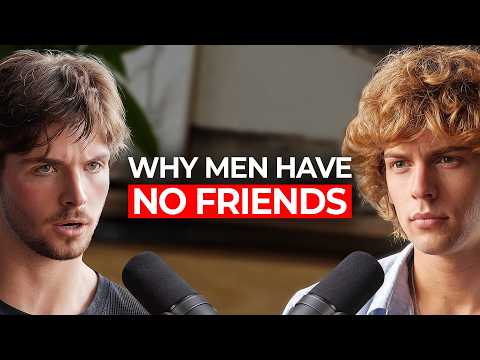
[@jackneel] Jett Franzen: I Spent 6 Years Completely Alone—These Sins Are Destroying Gen Z | Jack Neel Podcast
![[@jackneel] Summarizer](https://summaries.pages.dev/img/logo.webp)
Link: https://youtu.be/fUS4absP_hk
Duration: 110 min
Transcript: Download plain text
Short Summary
This episode of the Jack Neil podcast features extended interviews with Jet Franen (a 22-year-old "Gen Z existential philosopher" from Nebraska with 1.5M+ followers) and guest Alex Ramosi, whose overlapping testimonies of isolation, Christian faith, and self-creation build a shared framework critiquing algorithmic consumption, conformity, and passivity as the structural sins of the social media era.
Key Quotes
- "You are what you think about. You are your thoughts. So, you materialize your life by controlling your thoughts and how you believe and by proxy to actions that you take." (00:00:00)
- "Algorithms are perhaps the most dangerous threat to our society right now." (00:17:15)
- "I would say that that's a skill is genuine. Curiosity is where the desire for the truth is greater than your desire to feel good." (00:15:52)
- "If you're not getting criticism, if you're not getting hate, you're not doing something right." (00:30:36)
- "Everything in life regresses to the mean. And the mean is your identity. You build your identity by taking so much action that it creates a profound amount of evidence and proof which completely destroys any self-doubt beyond reason." (00:18:03)
Detailed Summary
Jack Neil Podcast — Gen Z, Algorithms, Faith, and the Cost of Consumption
Interviewee Backgrounds and Origins
This episode features extended interviews with Jet Franen, a 22-year-old "Gen Z existential philosopher" from Nebraska, and guest Alex Ramosi, whose overlapping testimonies of isolation, Christian faith, and self-creation form a shared narrative.
- Jet Franen is a 22-year-old "Gen Z existential philosopher" who built his following by posting videos from his parents' basement in Nebraska, amassing 1.5M+ followers on the very apps he claims are rotting his generation's brains.
- He grew up in a Christian household in Northern Chicago, played baseball, basketball, and lacrosse, and was well-liked through 7th grade before cutting off friends who began drinking, doing drugs, and partying.
- By sophomore year of high school, Franen had no real friends and was the only one of ~20 classmates not invited to homecoming; he spent Friday–Sunday nights alone and later skipped prom and his own graduation.
- Franen earned a full ride to college, attended the University of Arizona, and lived in a cockroach-infested basement dorm nicknamed "the dungeon."
- At age 19 he went to the gym 218 days straight (minimum 3 hours/day) and gained 65 pounds — mostly muscle — over ~7 months by eating nightly at a buffet, while also losing $3,000 on a failed business venture.
- Alex Ramosi reestablished his Christian faith while living alone in Arizona, away from his family in Chicago and outside parental influence.
- Ramosi quit travel baseball right before turning 15 (with parents supportive despite him having disliked the sport since early childhood — he recalled crying and begging not to go to games as a young child).
- He says he has not felt happy since age 13, when he entered high school and his friendships began dissipating, and at 17–18 he became anti-natal due to depression.
The "Five Deadly Sins" Framework
The interview's central conceptual scaffold is a set of "deadly sins" of the social media era, originally framed as seven but later distilled to five explicitly named categories.
- Originally framed as seven sins with consumption as the "first and biggest," later distilled to five explicitly named: consumption, conformity, entitlement, resentment, and passivity — a discrepancy noted in the framework itself.
- Consumption — scrolling intended for 15 minutes becomes 3–4 hours and repeats for up to 10 years, breeding resentment, depression, and anxiety.
- Conformity — evolutionary and tribal in origin, but social media pushes moderation to "hardcore liberal" in as little as two years via subconscious reinforcement; warns of a "robotic," shallow society 20–30 years out.
- Entitlement — illustrated by a "woman in the red dress" example, where accepting a social invitation becomes a path-of-least-resistance "yes" driven by obligation rather than genuine desire.
- Resentment — paraphrases Carl Jung's idea that resentful people suffer the "effects of their unlived lives," e.g., an English/lit graduate who never writes.
- Passivity — described as the most overlooked sin and "going with the flow the system designed," exemplified by the accountant making $80,000/year who golfs on weekends and assumes that was the life meant for him; 30 years of doing "the right thing" ends mediocre.
- Franen frames hate toward successful people as projection, arguing that if you're getting zero criticism, you're on the wrong path.
The "Marketing Holocaust" and Algorithmic Mechanism
Franen dates the start of a structural shift to 2020 and develops a specific mechanism for how algorithms shape identity and political belief.
- Franen pinpoints 2020 (the pandemic and online transition) as a "psychological line in the sand" marking the start of what he calls the marketing holocaust.
- He argues that if you create, you build your own identity; if you consume, someone else picks it for you while leaving you under the illusion that you reached the conclusion yourself.
- A Jim Carrey quote — "The opposite of depression is expression" — anchors the argument that creative outlets (journaling, painting, video-making) are the cure.
- Algorithms are called "perhaps the most dangerous threat to our society right now" because their harm is hard to diagnose, and "the smartest engineers in the world" build them; Meta, TikTok, and YouTube are named as the major players.
- The "hook-and-curve" mechanism (illustrated with an FC Barcelona/Messi example) starts with content close to existing interests and progressively deviates; after ~200 exposures to an idea, the brain shifts from disagreement to acceptance.
- Franen invokes Aldous Huxley's Brave New World (control through pleasure) versus Orwell's 1984 (control through surveillance), and applies the "bread and circuses" frame to modern algorithmic distraction that prevents populist revolt.
- Cult psychology's "scapegoat method" and ego death are both criticized — Franen calls ego death illogical, arguing identity is continuously shaped through creation rather than something that can be killed.
Loneliness, Isolation, and Identity Formation
Both Franen and Ramosi describe extended periods of isolation, and Franen uses Aristotle and Dostoevsky to frame isolation as a forge.
- Franen spent ~6 years in near-total isolation, with 4 consecutive years without a friend group, and prayed to God to either take his loneliness away or give him someone to be with.
- During a seven-month stretch at college, no one texted him, including his own family — the period Franen credits with forcing growth and dropping an "I'm better than you" act.
- He cites Aristotle's Nicomachean Ethics on the necessity of friends for a virtuous life, and Dostoevsky's Notes from Underground as a parallel for loneliness becoming addictive.
- Isolation can make or break a person depending on agency, but Franen warns against filling it with streamers 3–4 hours a day, which only breeds entitlement.
- He argues a man cannot develop identity without substantial time alone, and that 99% of American hometowns contain "viciously mediocre people" who aren't striving for greatness.
- Franen was planning to move within a month to meet online connections, indicating the isolation period was ending.
Gen Z-Specific Critique
Franen targets the structural outputs that he believes the internet produces in his cohort — selective empathy, gendered media manipulation, and victim mentality.
- He calls Gen Z "the most selectively empathetic" generation — extreme empathy toward in-groups (men/women, whites/blacks, liberals/conservatives) that stops at the boundary.
- He paraphrases C.S. Lewis on directing empathy outward to distant groups while casting hatred on neighbors, calling this pattern "performative empathy" because the outer circle costs nothing.
- New media on Netflix and Hulu is "100% designed to manipulate women," with the male equivalent in the red pill / black pill sphere; "Clav" and "Savannah Stone" are cited as examples of algorithm-amplified extremism.
- Victim mentality, "oppression Olympics," and rumination ("you are what you think about") are flagged as the internet's structural outputs.
- Andrew Tate is named (alongside Jordan Peterson) as one of the first mainstream figures to address young men's struggles, but the "slippery slope" warning applies: following gym advice can lead to being sold meme coins.
Faith, Mental Health, and Philosophical Frameworks
Ramosi develops a Christian framework for self-forgiveness and meaning, alternating between Kierkegaard, Dostoyevsky, and personal testimony.
- Ramosi proposes a framework where Jesus provides an outlet for constant self-forgiveness and shedding shame, while God provides direction aligned with the highest possible good.
- Paraphrased Dostoyevsky: if truth were found outside of Christ, he would still choose faith because faith makes the world a better place.
- Per Kierkegaard's view, true faith requires a leap — logic alone cannot reach faith, and Ramosi frames certainty as an enemy of unity.
- He endorses Kierkegaard's Sickness Unto Death as the single most pivotal book he has ever read for young men.
- His stated best advice received was "pick up the cross and follow Jesus," which he says changed his entire life.
- His alternative best advice: "Everything in life regresses to the mean. And the mean is your identity" — built by taking action that creates evidence destroying self-doubt.
- He defines happiness as the ability to "stay in a good mood in the absence of things to be in a good mood about," arguing this leads to happiness and good relationships.
- He recommends treating shame as a teacher: internalize the lesson to change behavior without constantly ruminating on it.
Mental Health Diagnosis, Treatment, and Critique
Ramosi details his high school diagnoses, the unconventional path he took through them, and a broader critique of the American pharmaceutical industry.
- Diagnosed during high school with depression, anxiety, and bipolar disorder (BBD), and exhibited OCD-like behaviors including a 3-hour nightly routine and walking in and out of the bathroom 7 times before brushing his teeth.
- His doctors and parents tried to get him on medication; he faked taking it and says he eventually conquered the OCD-like behaviors without medication.
- He views medication as "cope" and believes suffering through his mental health issues was the objectively right decision, pointing to his current career and dream life as the outcome.
- He kept diagnoses private, telling only close friends he contacted roughly once every three or four months.
- He believes the American pharmaceutical industry is completely corrupt, arguing the U.S. has more chronic and mental illness while prescribing more medication than any other country.
- The tension: Ramosi positions himself as both a critic of the pharmaceutical industry and a person who overcame serious mental illness without medication, framing suffering as virtuous rather than merely survivable.
Culture, Vanity, and Self-Presentation
Ramosi critiques the "looks maxing" movement and introduces a self-defense mechanism he calls "preemptive self-disclosure."
- He argues the "looks maxing" movement is full of vanity because it focuses on looks for their own sake rather than character development, contrasting it with the Greek view of beauty as virtuous.
- He uses the Icarus analogy to argue that over-emphasizing one virtue (like appearance) leads to downfall.
- He introduced the concept of "preemptive self-disclosure," where admitting to an insult (e.g., "I'm evil") neutralizes the shame others can inflict.
- He cited Nick Fuentes and Clavicular as examples of creators who have used preemptive self-disclosure to become successful.
Conspiracy and Worldview Claims
The final stretch of the interview moves into sweeping claims about structural evil, bot traffic, and a spiritual war narrative.
- Ramosi made a YouTube video claiming school yearbook photos are taken by third-party vendors owned by two large corporations (he says he cannot say much about one due to legal constraints); he would still let his own kids get school photos taken by those vendors.
- He endorses the dead internet theory, claiming over 50% of actions online are now made by bot accounts, noting the metric can be misleading because high-view videos count equally with low-engagement comments.
- He believes in a grand conspiracy framework: a spiritual war between good and evil (Christ vs. Satan), in which all other conspiracy theories are elements of a divide-and-conflict plan.
- He cites the Epstein files as evidence that nothing should be considered too far-fetched in terms of human evil.
- He references Machiavelli's The Prince about a ruler (Cesare Borgia, whom he called "Borsha") who used a right-hand man to carry out cruel tasks so townspeople hated the subordinate while the ruler's own hands stayed unseen.
- The host extended this by arguing the world respects strength, not morality, and that the truly evil operate unnamed.
- He disagrees with the reasoning behind "frequency crystal" practice but believes it works for those who want it to work, equating subconscious programming to historical patterns of worship.
Creator Strategy and Competitive Motivation
Franen describes how he built his audience and how he frames competition with other creators.
- Franen's early competitive driver was creators in the same niche with ~1,000 more followers and a few thousand more views, pushing him to work 16-hour days scripting and filming in his basement.
- He reframes enemies as "competitive friends" and credits the constant comparison with his climb.
- The Jack Neil podcast itself is cited as having 3+ million subscribers — "top 0.001%" territory.
Recommended Inputs and Curated Consumption
The interview closes with lists of approved inputs and famous quotes used as anchors.
- Franen recommends Jordan Peterson as one of the few creators whose content reliably produces positive thoughts.
- Alan Watts is recommended as good for falling asleep; unironic positive affirmations are endorsed.
- A Kanye West quote is invoked: "When you're a fan of Kanye West, you're not a fan of me. You're a fan of yourself."
- Alex Ramosi is quoted: "stay in a good mood in the absence of things to be in a good mood about."
Notable Surprises and Internal Tensions
Several contradictions and asymmetries run through the episode — most centrally, the use of the same platforms both interviewees critique.
- The contradiction at the heart of Franen's brand: a 1.5M+ follower leveraging the very algorithm he describes as perhaps the most dangerous threat to society.
- The seven deadly sins are referenced early but only five are ever explicitly enumerated — a discrepancy in the framework itself.
- Franen turned anti-natal around 17–18 during depression, then independently rediscovered Christianity outside his parents' influence, a non-linear faith trajectory rarely surfaced in the interview.
- Ramosi's self-described happinesslessness since age 13 sits uneasily alongside his own working definition of happiness as a chosen disposition — the same quote is offered as both diagnosis (why he struggles) and prescription (how he escapes it).