[@JesseMichels] Top Navy Admiral: “The Ocean is FULL OF UFOs!”
![[@JesseMichels] Summarizer](https://summaries.pages.dev/img/logo.webp)
Link: https://youtu.be/nRKNVFQBi38
Duration: 119 min
Transcript: Download plain text
Short Summary
Retired Rear Admiral Tim Gallaudet — former Navy chief oceanographer and NOAA administrator — discusses his extensive UAP research, including alleged recoveries from the 1962 Bluegill Triple Prime nuclear test, transmedium USO encounters, ocean exploration gaps, and underwater anomaly expeditions like the Baltic Sea and a planned Atlantis dive. He also shares personal Navy experiences including a dramatic near-collision in the Strait of Hormuz and his wife's remote viewing training with Stargate co-founder Paul Smith.
Key Quotes
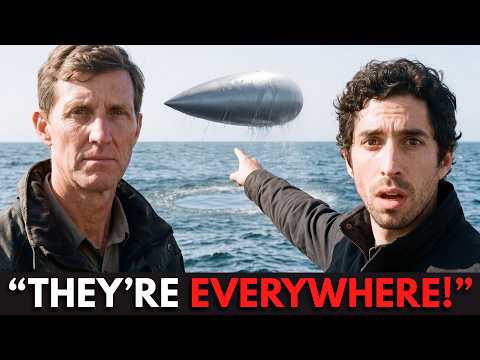
- "That was the day everything changed for me. There's this teardrop shaped looking UAP 20 ft lengthwise or so. It surfaces out of the water and there's no disturbance of the water and after a few moments it just went. It looked like it was being lifted like gravity in reverse." (00:00:32)
- "She says we've been tracking these for some time. and we still don't know their origin or intention." (00:24:22)
- "these objects all the we see them in the ocean more than more than elsewhere coming in and out of the ocean and they seem to be occurring in five to seven areas of the world. um with more frequency than than others." (00:25:10)
- "Three people all had this and the subs did an emergency deep maneuver where they just all of a sudden, okay, we this is what you train to do if an adversary torpedo is inbound and and then in each case whatever the object was, it slowed and it went behind them uh to kind of get out of there." (00:27:11)
- "Uh we've only mapped 27% of of the seafloor to modern standards. That's so much territory. And then and it's 70% of the planet. And so and then we've only explored with with drifters, floats, and drones about 10% of and ROVs 10% of the ocean volume." (01:33:12)
Detailed Summary
Episode Summary: Tim Gallaudet on UAPs, the Ocean, and Disclosure
Retired Rear Admiral Tim Gallaudet discusses his extensive UAP research, including alleged recoveries from the October 1962 Bluegill Triple Prime nuclear test, transmedium USO encounters, ocean exploration gaps, and underwater anomaly expeditions such as the Baltic Sea and a planned Atlantis dive. He also describes his Navy career, a near-collision in the Strait of Hormuz, work with Avi Loeb’s Galileo Project, and his wife Karen’s remote-viewing training with Paul Smith.
1. Guest Background and Institutional Roles
Tim Gallaudet graduated from the U.S. Naval Academy in 1985 and became a restricted-line naval officer, former Navy chief oceanographer, and one-star admiral. He also served as superintendent of the Naval Observatory and as NOAA administrator during the first Trump administration.
- Gallaudet entered the Naval Academy on July 2, 1985, and was the fastest 500-freestyle swimmer in the country among prep schools that year; he says the achievement drove heavy recruitment.
- He failed the Ishihara color-vision test on his first day but received an unprecedented waiver restricted to intelligence, medical, or oceanography specialties, excluding surface, pilot, and submarine roles.
- As Officer of the Deck on USS Kittyhawk, he commanded the carrier for two four-hour stretches per day during Operations Enduring Freedom and Iraqi Freedom strikes in 2003.
- Gallaudet works with Avi Loeb on the Galileo Project and sits on an ODNI UAP science advisory council alongside psychologists, engineers, physicists, and oceanographers.
- He is the author of Holding Fast in Heavy Seas and traces his family lineage to Pierre Gallaudet and Peter Wallace Gallaudet.
2. Navy Operations and the Astronaut-Aquanaut Perspective
Mercury astronauts Wally Schirra, Gordon Cooper, and Scott Carpenter spoke at Stennis Space Center, where Gallaudet’s command was stationed. Carpenter’s account compares the experience of going to space with the difficulty of operating in the ocean.
- Scott Carpenter was one of the few astronaut-aquanauts through the SEALAB program.
- Carpenter told Gallaudet, “going to space was glorious, but operating in the ocean was very hard, cold, and things break.”
- Gallaudet also referenced President Kennedy’s Rice University speech: “We choose to go to the moon in this decade and do the other things not because they are easy but because they are hard.”
3. The Go Fast Video and Classification
Gallaudet says seeing the Go Fast video on the Navy Secret Network while serving as a one-star admiral was the experience he describes as “everything changed.” The footage was recorded during a training exercise off the U.S. East Coast.
- Ryan Graves was among the pilots flying off USS Theodore Roosevelt during the exercise, and the account describes a cube or sphere splitting a section of two F-18s from squadron VFA-11 that were flying in close formation.
- A 2017 New York Times article by Leslie Keane released three videos: Go Fast, Nimitz, and Gimbal.
- The email containing the Go Fast footage was deleted from Navy computers through the “spillage protocol” because the information was classified above the level of the network on which it appeared.
- Jay Stratton, identified with the UAP Task Force and Office of Naval Intelligence, confirmed the account of the email’s deletion and classification handling.
- AARO analysts argue that the Go Fast image can be explained as a parallax effect from the FLIR pod’s tracking, while John Koslowski argued that it was not especially anomalous.
- Gallaudet disputes the AARO interpretation, citing spherical objects with no apparent propulsion or intelligent control and the presence of four objects in formation.
4. Underwater UAP and USO Reports
One underwater account concerns a teardrop-shaped object approximately 20 feet long that surfaced without disturbing the water and lifted off as if gravity were operating in reverse. It was shown in infrared sensor footage to a friend of Gallaudet’s who was a J2 intelligence officer.
- A female naval intelligence commander emailed approximately 100 recipients on compartmentalized four-letter domains stating that UAPs were consistently entering and exiting the ocean in five to seven areas worldwide.
- The account identifies that email as a possible source of Representative Tim Burchett’s statement about five or six alleged alien bases.
- Four UAP reportedly disappeared simultaneously with synchronized, near-instantaneous acceleration; sailors aboard USS Jackson, in the same region as the USS Omaha incident, observed erratically moving UAP at night.
- Other cited USO literature includes Ivan Sanderson’s Invisible Residents and Richard Dolan’s history of U.S. Navy ship encounters.
5. Submarine Baffles and Transmedium Cases
Three submarine officers separately reported underwater objects with torpedo-like profiles that forced their submarines into emergency deep maneuvers. The objects then moved into the submarines’ baffles, a maneuver the account says torpedoes cannot perform.
- The baffle-entry claim is central to the interview’s argument that the objects may have been under intelligent control rather than conventional weapons.
- The 2013 Aguadilla, Puerto Rico, case captured a three-minute transmedium UAP descending into and emerging from the Atlantic.
- In the 1986 JAL case, 45 minutes of publicly available radar data showed two objects and a large walnut-shaped object approximately the size of an aircraft carrier following them.
- Physicist Kevin Knuth, identified as a member of a UAP review panel, confirmed the presence of the objects in the radar data.
6. The Alleged Bluegill Triple Prime Recovery
Bluegill Triple Prime, an October 1962 nuclear test in the Starfish Prime series, is the setting for a reported object emerging from the test plume. The account cites deck-log power losses, a 4 a.m. flight, unusual anchor-chain preparations, and a diver transfer that was absent from the logs.
- Harold Malmgren reportedly held pieces from a UAP crash associated with an object that came down in the Bluegill Triple Prime plume.
- Navy deck logs reportedly showed ships losing power during the recovery operation, with at least one vessel reporting an outage.
- Admiral Starboard reportedly flew back to the United States at approximately 4:00 a.m. that night in what appeared to be an emergency flight.
- The recovery allegedly involved an unusually large amount of anchor chain and shot, suggesting preparation for heavy lifting.
- A personnel transfer of divers between ships was reportedly never recorded in the deck logs.
- Gallaudet helped Jeff Krookchank write a report on the incident and says he is “highly likely convinced” that a UFO came out of the plume, although he is not 100 percent certain.
- An anonymous FOIA request for UAV, UAP, and UFO records from the Starfish Prime series drew a response from the NNSA saying responsive records had to be forwarded to a subject-matter expert.
- Missouri Congressman Eric Burlison visited Pax River, described as possibly the most advanced naval aviation facility in the United States; the account presents the visit as a possible storage or transfer site linked to Bigelow access.
7. Ocean Exploration Gaps
The interview gives several measures of how little of the ocean has been systematically examined. The ocean covers about 70 percent of the planet, approximately 10 percent of its volume has been explored, and only about 27 percent of the seafloor has been mapped to modern standards.
- Humans have mapped more of the Moon and Mars than Earth’s seabed.
- The approximately 10 percent figure concerns ocean volume explored with tools such as drifters, floats, drones, and remotely operated vehicles, while the 27 percent figure concerns modern seafloor mapping.
- Gallaudet advises Deep, which built an ocean habitat deployed in the Florida Keys National Marine Sanctuary; chief scientist Don Krengus has already dived the installed habitat.
- At the EarthX conference, Gallaudet held a fireside chat with Dr. Scott Parazynski, a former NASA astronaut, MD, and head space walker who advises Proteus, an ocean-habitat company founded by one of Jacques Cousteau’s sons.
- NASA astronauts train in Houston’s Neutral Buoyancy Lab, one of the world’s largest pools; Gallaudet says its prime contractor, Rothy, was going public and invited him to join its board.
- NASA funded NOAH ROV work targeting Enceladus and Europa using the Oceanis Explorer.
- A colleague named Kevin argued that water worlds are ideal Goldilocks-zone locations for advanced civilizations on the Kardashev scale, contrasting Mars as too cold and Venus as too hot.
8. The Atlantis Project and Salarian Hypothesis
Gallaudet’s Atlantis team, working under NDA, claims to have located an Atlantic region matching Plato’s description, including the canal and feature dimensions described in Plato’s dialogues. The project is paired with the “Salarian hypothesis,” which proposes that ancient civilizations could have relocated underwater to survive cataclysms.
- The team’s work uses proprietary high-resolution bathymetry.
- The lead researcher is an ER-MD with more than ten years of open-source research and is connected to “Max,” who develops algorithms distinguishing natural from artificial three-dimensional topographical features on the Moon and Mars.
- The Salarian hypothesis includes asteroid impacts and tsunamis among the cataclysms that could have made underwater relocation necessary.
- The hypothesis allows for Earth being approximately four billion years old and advanced civilizations developing after roughly the first billion years.
- The discussion links the Taurid meteor-stream comet-airburst theory to Meltwater Pulse 1B as the cataclysm associated with Atlantis.
- Plato’s version of the Atlantis legend is described as being told around 600 BC and referring to an event approximately 9,000 years earlier.
- The account cites Randall Carlson’s placement of Atlantis in the Azores and Graham Hancock’s discussion of approximately 20,000-year-old footprints in North America.
- Heinrich von Schliemann’s discovery of Troy is offered as a parallel to finding something previously thought fictional, with archaeology described as only about 200 years old.
9. Victor Vescovo and the Five Deeps
Victor Vescovo is the ocean-exploration figure Gallaudet identifies as a potential partner for the planned Atlantis dive. His Five Deeps record includes the submersible Limiting Factor, the ship Pressure Drop, and repeated visits to Challenger Deep.
- Vescovo is a retired Navy commander and former intelligence officer, described in the interview as “the most vertical human on the planet.”
- He completed the Explorer’s Grand Slam and flew on Blue Origin’s spaceflight.
- During 2018–19, the Five Deeps Expedition used Limiting Factor from Pressure Drop to dive the five deepest ocean trenches worldwide.
- Challenger Deep was visited approximately 14 times during that effort, at a depth of about 35,000 feet, or seven miles.
- The first Challenger Deep dive took place in 1960, when Don Walsh and Swiss oceanographer Jacques Piccard descended in the bathyscaphe Trieste.
- James Cameron later made a single solo dive to Challenger Deep.
- Pressure testing for the submersible occurred in Russia, identified as the only facility in the world able to perform the testing.
- Two new U.S. Navy surveillance ships were named Don Walsh and Victor Vescovo, with a naming ceremony at the Naval Academy the prior year led by the Secretary of the Navy.
- Vescovo agreed to join the Atlantis project after Gallaudet presented the research to him.
10. The Baltic Sea Anomaly and Other Sites
The Baltic Sea expedition concerns a Millennium Falcon-shaped object found between Sweden and Finland and originally discovered by Dennis Asper. Gallaudet reports electromagnetic anomalies and GPS failures during work on the object.
- Gallaudet’s account says the Baltic object “has a life of its own.”
- Other named USO or anomaly locations include the Bermuda Triangle, Catalina Channel in Southern California, and Fukushima Prefecture around Mount Senori.
- Reports around the 2011 Fukushima disaster are included among the Fukushima-area UAP cases.
- Gallaudet plans to sail through the Bermuda Triangle with his family and dive off Bermuda.
11. The Nova Scotia Case and Canadian Research
The Nova Scotia 1960 case is presented as a Canadian naval and UAP episode involving possible non-human occupants, pilots, and entities apparently repairing a submersible object. Chris Styles’ Sweep Clear Five documents Royal Canadian Navy divers’ encounters.
- The account says divers witnessed UFO occupants outside two saucer-shaped objects on the seabed and that video of the encounters exists.
- Canadian researcher Brian Fitzpatrick is a former 20-year homicide cop who is pursuing FOIAs for the Nova Scotia UAP video.
- Fitzpatrick authored The Operator, a book about cattle mutilations.
12. The Strait of Hormuz Near-Collision
During Iraqi Freedom, heightened alert followed the USS Cole bombing, and the carrier launched .50-caliber-armed helicopters against small-boat threats. USS Curtis Wilbur was ordered to a plane-guard station approximately 1,000 yards off the port bow but turned to starboard.
- The destroyer’s bow disappeared into an 800-foot shadow zone while the carrier steamed at 12 knots.
- Gallaudet issued right-hard-rudder orders, ordered all engines ahead flank, sounded the collision alarm, and called the crew to brace for shock.
- He anticipated that at least 200 sailors would be killed if the destroyer was cut in half.
- Curtis Wilbur shifted rudder at the last moment, and Gallaudet describes the ships’ survival as the most precarious situation of his Navy career.
- He attributes his survival in the incident to “pure positive intentions.”
13. NURO and the Architecture of Secrecy
Former DNI and Naval Intelligence leader Bobby Ray Inman publicly acknowledged the National Underwater Reconnaissance Office, or NURO, after retirement. Gallaudet says that, despite leading Navy oceanography and having access to classified undersea programs, he had never heard of NURO during his service.
- NURO’s Wikipedia article is described as being only five lines long.
- Sam “UAP Gerb” Gerbus believes Inman established NURO.
- Inman reportedly told UFO researcher Bobby Oxler that UFOs “might come out at some point.”
- The acknowledged counterpart, the National Reconnaissance Office, was declassified only in the 1990s after being secret for approximately 20–30 years.
- A special, highly classified Navy diver unit reportedly experimented with liquid breathing to extend bottom times.
- UAP stigmatization is described as an approximately 80-year, well-funded campaign tracing back to the Robertson Panel.
14. Whistleblowers, Disclosure, and International Action
The disclosure material includes a 4chan whistleblower account, a memo associated with UAP whistleblowers, and Japan’s setting up of a UAP investigation unit. It also distinguishes the ODNI advisory structure from White House-level bodies and cites several named claims about recoveries.
- A 4chan whistleblower claimed there were five to seven ocean-transit locations and that non-human intelligence manufactured UAPs in mobile construction units.
- Aaron Lucas, identified as PDNI, issued a memo waiving NDAs for UAP whistleblowers under a presidential directive.
- The whistleblowers named in connection with that directive are David Grusch, Dylan Borland, and Matthew Brown.
- Japan’s Prime Minister’s Office was setting up a UAP investigation unit after Gallaudet’s virtual presentation to a Diet caucus.
- Gallaudet corrected the idea that the UAP advisory panel reports directly to the White House; it reports to ODNI, while the NSC is the White House body.
- Michael Kratsios is identified as Trump’s science adviser, and Gallaudet says he worked with Kratsios during Trump’s first term.
- Authoritative government acknowledgment, including White House-level acknowledgment, is described as the key to shifting public acceptance; the interview also refers to “pursue files” with no metadata but substantial UAP activity.
- Eric Davis has stated that more crash-retrieval operations have occurred in the ocean than elsewhere.
- Bob Lazar recently revised his S4/Area 51 account to claim that the discovery was a Navy find on the seafloor rather than an archaeological dig.
15. Skinwalker Ranch and Remote Viewing
Brandon Fugal invited Gallaudet and his wife to Skinwalker Ranch, where a DIA-funded study lasting approximately two years was documented by Jim Lacatsky and Colm Keller with George Knapp. The interview connects that setting with Gallaudet’s wife’s remote-viewing training and university research into consciousness.
- Follow-up material associated with the Skinwalker Ranch work includes Future Visions and New Insights.
- The University of Virginia’s Division of Perceptual Studies is cited as conducting legitimate scientific inquiry into out-of-body experiences, near-death experiences, survival of consciousness, and telepathy.
- Diane Hennessy Powell documented conversations between autistic patients, a phenomenon Gallaudet considers real.
- Gallaudet’s wife, Karen, completed basic and advanced remote-viewing training with Paul Smith in Cedar City, Utah, and has practiced for two years.
- Paul Smith co-founded the Stargate program alongside Hal Puthoff.
- Stargate protocols were refined with talented viewers Ingo Swan and Joe McMoneagle.
- The “analytical overlay” component trains viewers to recognize and shut off automatic mental models.
- Karen accurately identified a geological formation in a national park during a remote-viewing trial and drew it in precise detail.
16. Other Figures, Personal Projects, and Diving
Additional figures cited in the episode include Japanese NASA historian Takeno Jouen, underwater photographer Becky Shot, and author Susan Casey. Gallaudet also describes his family’s diving, his book, and a reading recommendation connected to Brandon Fugal.
- Takeno Jouen claims to hold a piece of the Roswell crash and runs a museum containing NASA artifacts on 100-year loan, including rocket boosters.
- Jouen says he met Edward Teller, Jesse Marcel Jr., and Herman Oberth.
- Admiral Byrd’s rumored Antarctic encounter has not produced data from Gallaudet’s contacts; ice divers and underwater photographer Becky Shot have run Antarctic expeditions but reported no sightings.
- Victor Vescovo and Susan Casey endorsed Holding Fast in Heavy Seas. Casey wrote The Underworld about the Mariana Trench, The Wave about Laird Hamilton, Devil’s Teeth about Farallon Islands great whites, and Voices in the Ocean about dolphins.
- Gallaudet and Karen dived the Blue Hole in Belize and wrecks at Iron Bottom Sound off Guadalcanal, where almost a year of continuous naval combat in 1942 sank so many ships that the area acquired its name.
- Brandon Fugal recommended Dan Brown’s Secret of Secrets for its treatment of consciousness.