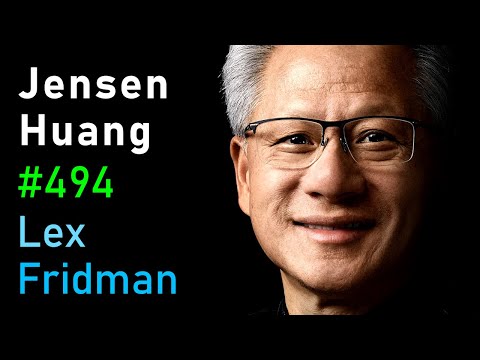
[@lexfridman] Jensen Huang: NVIDIA - The $4 Trillion Company & the AI Revolution | Lex Fridman Podcast #494
· 2 min read
![[@lexfridman] Summarizer](https://summaries.pages.dev/img/logo.webp)
Link: https://youtu.be/vif8NQcjVf0
Duration: 145 min
Short Summary
Jensen Huang, CEO and co-founder of NVIDIA with 34 years of tech leadership experience, details the company's transformation into an AI infrastructure powerhouse. The discussion covers the critical role of the CUDA ecosystem, the shift toward extreme co-design for AI factories, and Huang's philosophical views on leadership and the future of human-AI collaboration.
Key Quotes
- "The better computing company we become, the worse we became as a specialist." (00:04:04)
- "The install base is the number one most important advantage." (00:34:35)
- "I don't think there's ever been keynotes where several hundred CEOs show up." (00:36:16)
- "We need things to be as complex as necessary, but as simple as possible." (00:45:32)
Detailed Summary
NVIDIA's Architectural and Strategic Evolution
- NVIDIA has moved beyond chip design to 'extreme co-design,' integrating GPUs, CPUs, and networking to overcome the slowing of Moore’s Law.
- The Vera Rubin rack system, a new standard for 'AI factories,' utilizes NVLink-72 technology to allow models with up to 10 trillion parameters to function as a unified computing domain.
- The CUDA ecosystem remains NVIDIA's primary competitive moat, enabling significant performance advantages for developers through a long-standing, heavy investment strategy.
Leadership and the Future of AI
- Huang manages 43,000 employees by focusing on continuous knowledge transfer rather than formal succession planning, relying on a flat structure of direct reports.
- He defines intelligence as a utility comprising perception, reasoning, and planning, and expects the number of software requirement definers to reach 1 billion as coding barriers lower.
- Future investments include humanoid robotics for space exploration and advanced technologies aimed at biological breakthroughs, reflecting an optimistic long-term view on eliminating disease.