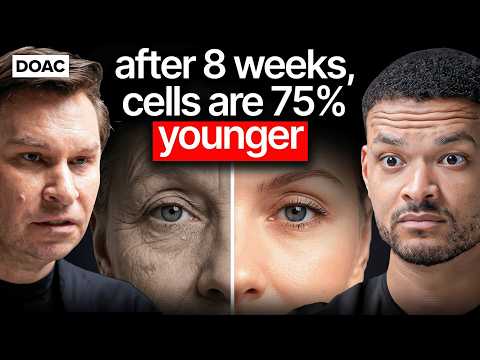
[@TheDiaryOfACEO] Dr David Sinclair: Can Aging Be Reversed? After 8 Weeks, Cells Appeared 75% Younger In Tests!
![[@TheDiaryofaCEO] Summarizer](https://summaries.pages.dev/img/logo.webp)
Link: https://youtu.be/DnvWAP99r3Y
Duration: 149 min
Short Summary
Harvard professor Dr. David Sinclair, a 30-year veteran of aging research, presents his Information Theory of Aging and describes technology that can reverse the age of tissues, with first human trials for blindness expected within months of recording. His lab has demonstrated whole-body age reversal in mice, achieved 100% lifespan extension in animal models, and predicts a pill to slow aging could be available within a decade. The discussion with Peter Attia also covers nutrition, supplements including NMN and resveratrol, and a $10 million gene therapy clinical trial for blindness that restored sight in monkeys.
Key Quotes
- "So aging is an identity crisis of the cells." (00:00:10)
- "DNA is not your destiny. It's the epiggenome. So that how you live your life is really 80 to 90% of your rate of aging." (00:00:03)
- "Youth is more valuable than a billion dollars. It may be the most valuable thing you could ever have is your youth." (00:00:13)
Detailed Summary
Overview
This podcast features Harvard professor Dr. David Sinclair, a 30-year veteran of aging research and author of the New York Times bestseller "Why We Age and Why We Don't Have To," in a comprehensive discussion with Peter Attia covering his groundbreaking Information Theory of Aging, age reversal technology, nutrition, supplements, and gene therapy. Sinclair argues that aging—not individual diseases—is the fundamental driver of mortality, and that reversing aging could potentially cure Alzheimer's, cancer, and heart disease.
- Dr. David Sinclair has dedicated 30 years to studying aging, longevity, and age reversal at Harvard Medical School.
- His lab has developed technology capable of reversing the age of tissues in animals and human tissue grown in the lab.
- First human trials targeting two types of blindness were expected to begin approximately one month from recording, pending FDA approval.
The Information Theory of Aging
Sinclair's central theory proposes that aging is caused by loss of biological information, not simply physical wear and tear, and that a backup copy of youthful information exists in every old person's cells that can be reinstalled. The DNA sequence itself remains largely intact (99.999% of genes are still present in aged cells), but the epigenetic labels controlling gene expression are progressively erased over time, gradually causing cells to lose their identity and function.
- The DNA sequence remains 99.999% intact in aged cells, meaning the genetic "hardware" is largely preserved.
- Epigenetic labels controlling gene expression are progressively erased over time, causing the "software" to degrade.
- When cells experience major stresses such as broken chromosomes, proteins that control gene expression relocate to the damage site and do not fully return to their original positions, causing cumulative epigenetic disruption.
- Each cell experiences at least one broken chromosome per day, amounting to approximately 20 trillion such events daily across the human body.
Key Molecular Mechanisms
The epigenome—information controlling which genes are switched on or off—is distinct from the DNA sequence itself and is transferred from cell to cell. DNA methylation, the addition of a methyl group to cytosine bases, is a major mechanism by which the epigenome controls gene expression, and this process becomes dysregulated with age. Sirtuins have two critical jobs: controlling cell identity as epigenetic regulators and repairing broken DNA, while NAD serves as the essential catalyst and fuel for sirtuin function.
- Sirtuins function like conductors, controlling cell identity as epigenetic regulators and simultaneously repairing broken DNA.
- NAD serves as the catalyst and fuel for sirtuins; by age 50, NAD levels are approximately half of what they are at age 20.
- Reduced NAD levels with age diminish sirtuin function, impairing both epigenetic control and DNA repair capacity.
- Gray hair is cited as an example of cells losing their identity and ceasing to produce melanin, illustrating the information-loss theory.
The ICE Mouse Experiments
Sinclair's lab created "ICE mice" (Inducible Changes to the Epigenome) by breaking their chromosomes without causing cancer or mutations, demonstrating that the mice aged rapidly with gray hair, confirming the epigenetic theory of aging. The experiment took place approximately 12 years before recording, and Sinclair was the only lab member who predicted the mice would show accelerated aging rather than dying or developing cancer—a prediction that proved correct and validated the theory.
- ICE mice were created by breaking chromosomes without causing cancer or mutations, with the DNA sequence remaining intact.
- ICE mice showed no immediate effects after 3 weeks of the DNA-cutting protein being active, but appeared significantly older approximately 10 months later.
- Treated mice showed 50% faster aging compared to untreated twins, demonstrating epigenetic control of the aging process.
- Sinclair was the only lab member who predicted accelerated aging rather than death or cancer, and was correct.
Age Reversal Technology
Sinclair's lab has developed a three-gene approach using Yamanaka factors to reset cell age by approximately 75%, involving introducing genes into the optic nerve and activating them for 6 to 8 weeks. An independent lab has achieved a 100% additional lifespan extension in mice equivalent in age to an 80–85-year-old human by injecting the three reversal genes intravenously, while the lab has also developed an oral technology (drinkable liquid) that can rejuvenate mice within 4 weeks.
- The three-gene approach (Yamanaka factors) resets cell age by approximately 75% through controlled gene activation.
- An independent lab achieved 100% additional lifespan extension in elderly mice using intravenous injection of the three reversal genes.
- The lab has developed a newer oral technology (drinkable liquid) that can rejuvenate mice within 4 weeks, more advanced than the gene-injection approach being tested in humans.
- Whole-body age reversal using the three genes resulted in rejuvenation across skin and all body parts, including improved longevity.
Human Clinical Trials
Life Biosciences (Sinclair's company) has cured complete blindness in monkeys using AAV2 gene therapy, with sight restored in 6 weeks, and manufacturing clinical trial material cost approximately $10 million and took a year. The eye was chosen as the first human trial site not because it was expected to work best, but because it is a safe, enclosed system to study age reversal, with the therapy targeting NAION (affecting 30,000 Americans annually) before expanding to glaucoma, macular degeneration, and eventually the entire body.
- Life Biosciences cured complete blindness in monkeys using AAV2 gene therapy, restoring sight in 6 weeks.
- Manufacturing clinical trial material cost approximately $10 million and took a year to complete.
- The therapy targets NAION (affecting 30,000 Americans annually), then glaucoma, macular degeneration, and eventually the entire body.
- Human trials await FDA approval, treating patients (not healthy volunteers) with binary outcomes, expected to begin approximately one month from recording.
Applications Across Disease Conditions
The three-gene age reversal technology has been tested in mice for the brain, hearing, skin, multiple sclerosis, and motor neuron disease, with reported great effects across all conditions. Treating ovaries of old female mice (16 months old, equivalent to a 65–70 year old human) with a chemical rejuvenation treatment restores fertility and produces healthy offspring, demonstrating the broad applicability of age reversal. Research also suggests cancer is a cellular identity crisis similar to aging, where reversing cellular age causes the majority of cancers grown in the lab to die and shrink when injected into animals.
- The three-gene age reversal technology has been tested in mice for brain, hearing, skin, multiple sclerosis, and motor neuron disease.
- Treating ovaries of old female mice (16 months old, equivalent to a 65–70 year old human) with chemical rejuvenation restores fertility and produces healthy offspring.
- The Goncoenesis hypothesis proposes that as humans age, their metabolism becomes more cancer-like, which is why cancer cells grow better in old people than young people.
- Lab work has shown that the majority of cancers grown in the lab will die and shrink in an animal when attempting to reverse their age through injection.
Lifestyle and Environmental Factors
Lifestyle affects 80 to 90 percent of the rate of aging; DNA is not the primary determinant of aging—the epigenome is, meaning our choices have profound impacts on how quickly we age. Danish studies of identical twins demonstrate that lifestyle choices such as smoking, obesity, and sun exposure result in significantly older-looking appearances compared to genetically identical siblings, while a long-term Harvard study of World War II veterans found that people can live an average of 14 years longer by following healthy lifestyle practices.
- Lifestyle affects 80 to 90 percent of the rate of aging, making the epigenome more determinative than DNA.
- Danish studies of identical twins show smoking, obesity, and sun exposure result in significantly older-looking appearances.
- A Harvard study of World War II veterans found people can live an average of 14 years longer by following healthy lifestyle practices.
- Factors that accelerate aging include smoking, X-rays, ultraprocessed foods, excessive drinking, and flying frequently.
- Having reliable social bonds—whether a partner or pet—is associated with slower aging and longer lifespan, while loneliness is linked to accelerated aging.
Fasting, Hormesis, and Cellular Repair
Fasting raises NAD levels and makes sirtuins function more youthfully, preserving the epigenome and improving DNA repair, while hormesis describes how adversity (fasting, exercise, cold plunges, saunas) that doesn't kill cells makes them live longer. Modern life creates "abundance mode" (sitting, overeating, air conditioning) which accelerates aging because bodies are not fighting aging as they do during adversity, and chaperone mediated autophagy (deep cellular recycling of old/damaged proteins) only kicks in after 2.5 to 3 days of extended fasting.
- Fasting raises NAD levels and makes sirtuins function more youthfully, preserving the epigenome and improving DNA repair.
- Hormesis is the scientific term for "what doesn't kill you makes you stronger"—adversity (fasting, exercise, cold plunges, saunas) that doesn't kill cells makes them live longer.
- Fasting, exercise, cold plunges, and saunas activate cellular repair systems including recycling, DNA repair, and stress response pathways that slow aging.
- Chaperone mediated autophagy only kicks in after 2.5 to 3 days of extended fasting.
- Recommended fasting approach involves gradually building up to 14+ hours without eating, done 5 days per week.
Nutrition and Supplements
The speakers advocate for a plant-focused, unprocessed diet as the healthiest approach, with polyphenols (found only in plants) identified as key molecules that activate sirtuins and other longevity pathways, recommending "eat the rainbow" as an easy strategy to consume diverse polyphenols. NMN (nicotinamide mononucleotide) swallowed as a 1 gram dose can typically double NAD levels in humans, and human clinical trials show NMN supplementation may reestablish the epigenome, lower body weight, improve inflammation, and positively change cholesterol levels.
- Polyphenols (found only in plants) activate sirtuins, mTOR, and AMPK pathways that delay aging.
- Specific beneficial foods include avocados (anti-inflammatory), extra virgin olive oil (omega 9 and polyphenols), Brazil nuts (selenium), and Brussels sprouts (sulforaphane, which activates NRF2).
- NMN (nicotinamide mononucleotide) when swallowed as a 1 gram dose can typically double NAD levels in humans.
- Resveratrol extended lifespan by 15-20% in fat and old mice but showed minimal benefit in normal mice on daily dosing; pulsing (every other day) proved superior to daily supplementation.
- Peter Attia no longer believes in daily red wine consumption, citing UK Biobank evidence linking even one daily glass to reduced brain gray matter.
Peter Attia's Supplement Stack
Peter Attia outlined his current supplement protocol including resveratrol, metformin or berberine, spermidine (extends lifespan in every animal tested from worms to mice, stimulating autophagy), glycine (5 grams, controlling one-carbon metabolism and DNA methylation), Vitamin D with K2 (K2 redirects calcium from arteries to bones), and baby aspirin daily for his high LP(a) risk. Selenium deficiency is now recognized as deleterious, making one Brazil nut daily a simple recommendation.
- Spermidine extends lifespan in every animal tested from worms to mice and stimulates autophagy.
- Metformin reduces muscle size by approximately 5% in athletes and bodybuilders by interfering with mitochondrial energy production, so it should be pulsed every other day rather than taken daily.
- Peter Attia has genetically high LP(a) (his are 30-40, normal is around 10 or less) traced to Jewish ancestry, which inserts into plaque.
- He takes high-dose niacin (0.5-1 gram) to lower LP(a) until dedicated drugs complete phase three trials and has been on statins since age 30 due to family history.
AI in Drug Discovery
AI has screened approximately 8 billion candidate molecules for a longevity pill combining three mechanisms, reducing to 3 promising candidates currently tested in lab work, with mouse trials expected to determine efficacy within 1-2 years. A large portion of advanced economies goes to healthcare and chronic disease; most people are sick for 5–10 years with the most expensive years being the last 2 years of life, and delaying aging for 2 years would have massively positive economic benefits for a nation adopting these medicines.
- AI has screened approximately 8 billion candidate molecules for a longevity pill combining three mechanisms, reducing to 3 promising candidates currently tested.
- Mouse trials will determine efficacy within 1-2 years; human application remains several years away.
- Each clinical trial costs approximately $10 million.
- The US government blocked a large foreign investment (over $100 million) into a longevity company on grounds that the aging reversal technology was too dangerous to fall into foreign hands.
- Most people are sick for 5–10 years with the most expensive healthcare years being the last 2 years of life.
Predictions and Future Timeline
Sinclair predicts that within approximately 10 years, a pill taken every couple of weeks could make people younger, and if aging technology progresses as expected, people today could live 10 to 20 years longer than their parents. Ray Kurzweil predicted the technological singularity—the point at which aging becomes optional—will arrive in the 2040s, though Sinclair remains skeptical of this specific timeline while believing medicines that reset or significantly reverse the age of the body will reach the market within his lifetime.
- Sinclair predicts that within approximately 10 years, a pill taken every couple of weeks could make people younger.
- If aging technology progresses as expected, people today could live 10 to 20 years longer than their parents.
- Ray Kurzweil predicted the technological singularity (aging becomes optional) will arrive in the 2040s, though Sinclair remains skeptical of this timeline.
- Current treatments could cost over $100,000 but the goal is democratization to $100 per treatment globally.
- If a clinical trial succeeds in 2026, it will place aging research "in new territory" and on a clear path to whole-body age reversal.
Transcript: Download plain text