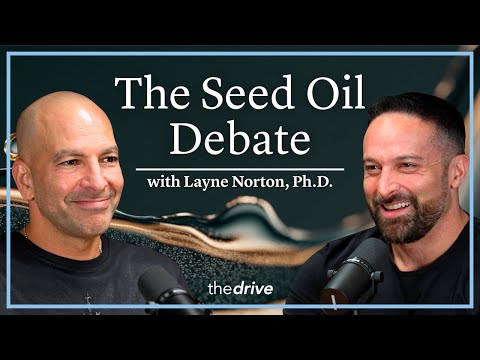
[@PeterAttiaMD] 380 ‒ The seed oil debate: are they uniquely harmful relative to other dietary fats?
![[@PeterAttiaMD] Summarizer](https://summaries.pages.dev/img/logo.webp)
Link: https://youtu.be/iB49uq-t1UM
Duration: 145 min
Short Summary
This episode presents a structured debate on seed oils between host Peter Aia and guest Lane, examining whether seed oils are harmful to cardiovascular health through analysis of major RCTs including the Minnesota Heart Study, Sydney Heart Study, and Finnish Hospital Study. Lane, who discloses funding from the National Dairy Council, National Cattleman's Beef Association, and Egg Board, argues that trans fat contamination in early trials confounded results, while meta-analyses show 21-31% cardiovascular benefit from polyunsaturated fats when trans fats are excluded. Converging evidence from mechanisms, cohort trials, and Mendelian randomization studies supports seed oils' cardiovascular neutrality or benefit when replacing saturated fat, with the host arguing that bigger health levers like caloric balance, physical fitness, and blood pressure matter far more than seed oil avoidance.
Key Quotes
- "the scientific method is perfect it is a perfect method but it is done by people who are not and that is why it is so important to look at the overall consensus of the evidence and looking at the different converging lines of evidence" (00:13:24)
- "41% reduction in the treatment group" (00:48:09)
- "Less than 1% of LDL is oxidized in the plasma" (01:30:47)
- "The purpose of biology is to pass on your genetic material" (01:36:19)
Detailed Summary
Episode Overview and Debate Format
This podcast episode presents a structured, courtroom-style debate on seed oils between host Peter Aia (serving as judge) and guest Lane (serving as advocate), with listeners acting as jury. The episode employs a discovery process requiring pre-submitted evidence and verifiable claims, moving beyond typical podcast debates that rely on spontaneous argumentation.
- Lane discloses that his research has been funded by the National Dairy Council, National Cattleman's Beef Association, and Egg Board
- These funding sources create potential bias toward animal-based foods, though Lane notes personal beliefs are equally powerful in driving people away from evidence
- The debate examines major randomized controlled trials including the Minnesota Coronary Experiment, Sydney Heart Study, Rose Corn Oil Trial, Finnish Hospital Study, and VA study
- The format requires each participant to pre-submit evidence before the debate begins
Minnesota Coronary Experiment (1966-1973)
The Minnesota Coronary Experiment represents the first major evidence point, conducted from 1966 to 1973 using institutionalized patients with complete dietary control. The study used isocaloric substitution of polyunsaturated fat (mostly linoleic acid from corn/safflower/sunflower oils) for saturated fat (butter/lard/meat) in the treatment group, while the control group maintained their baseline diet.
- A critical confounder was identified: margarine used in the study contained approximately 25-40% trans fats, which are atherosclerotic
- For every approximately 30 mg/dL decrease in total cholesterol, there was a 22% increase in mortality
- Results were withheld from publication for 13 years, raising questions about publication bias
- The isocaloric design meant participants did not reduce caloric intake, only changed macronutrient composition
Sydney Heart Study and Rose Corn Oil Trial
The Sydney Heart Study selected very high-risk subjects: under 500 men who had just suffered a myocardial infarction. Baseline saturated fat intake was 16% of total calories and polyunsaturated fatty acid intake was 6%, with the intervention group increasing PUFA to 15% and reducing saturated fat to 10% via safflower oil and safflower margarine.
- Safflower-based margarine contained 25-40% trans fats, confounding interpretation
- At 3 years, mortality was 32% in the control group versus 20% in the treatment group
- Total deaths were 37 in the treatment group and 28 in the control group
- The original published confidence interval was 1.03 to 2.8, and this study was the only individual study to reach statistical significance
- The Sydney Heart Study showed a 74% increase in risk with a confidence interval of 1.04 to 2.91
The Rose Corn Oil Trial enrolled 26 participants in the control group, 26 in the olive oil group, and 28 in the corn oil group, lasting 2 years in patients with significant cardiovascular disease.
- Total deaths were 3 in the control group, 5 in the olive oil group, and 8 in the corn oil group
- Cardiac deaths were 1 in the control group, 3 in the olive oil group, and 6 in the corn oil group
- The trial had the largest hazard ratio of any trial in this dataset at 4.64 (representing a 364% increase in risk with corn oil)
- The confidence interval was 0.58 to 37.15, which did not approach statistical significance due to the small sample size
Finnish Hospital Study: Strongest Evidence
The Finnish Hospital Study is identified as one of the strongest studies because it was not confounded by trans fats or omega-3s. This 12-year crossover study with 1,200 participants (effectively 2,400 person-observations) ran for 6 years on each diet.
- The control diet was 18% saturated fat and 4% polyunsaturated fat
- The treatment diet was 14% polyunsaturated fat and 9% saturated fat
- The study achieved a 41% reduction in cardiovascular disease risk in the treatment group with tight confidence intervals
- When omega-3 confounded studies were removed from analysis in Ramsden's work, polyunsaturated fat showed a negative effect
- Only when excluding both trans fats and omega-3s did the Finnish study and STARS remain, both supporting cardiovascular benefit from PUFA
Additional Studies: VA Study and Oslo Heart Health Study
The VA (Veterans Affairs) study enrolled approximately 850 participants, controlled food intake, and had an average follow-up of just under nine years.
- The study showed an 18% reduction in overall risk (CI: 0.56 to 1.21) but was not statistically significant
- The study included omega-3s, which may have confounded the results
- The Oslo Heart Health Study enrolled 400 participants and showed approximately a 47% risk reduction
- The Oslo study was also confounded by omega-3s, complicating interpretation
Meta-Analysis Findings
A 2017 meta-analysis examined studies of polyunsaturated fat substitution for saturated fat that were not confounded by trans fats, showing approximately 21-29% reduction in cardiovascular risk.
- The Cochrane analysis (which excluded trans fats but included omega-3s) showed approximately 29-31% cardiovascular benefit from polyunsaturated fats
- When including all human randomized control trials substituting polyunsaturated fats for saturated fat, the overall effect was null with no effect one way or the other
- Only when excluding both trans fats and omega-3s from analysis did the Finnish study and STARS remain as clean evidence
- Ramsden's analysis showed that when omega-3 confounded studies were removed, PUFA showed a negative effect, highlighting the importance of proper study design
Mendelian Randomization and LDL-Cardiovascular Causality
Mendelian randomization acts as a lifelong randomized control trial using naturally random genetic variants assigned at birth. Researchers have identified approximately a dozen genetic variants that affect LDL cholesterol levels, examining lifelong LDL cholesterol exposure and its relationship to cardiovascular mortality and disease risk.
- The 2012 landmark Mendelian randomization study demonstrated an R-value above 0.9 for the association between genetic LDL variation and cardiovascular outcomes
- Substituting polyunsaturated fats for saturated fat produces approximately a 15% change in LDL cholesterol
- Every 1 millimole (~38-39 mg/dL) reduction in LDL cholesterol via genetic variants corresponds to a 50-55% risk reduction in cardiovascular disease over a lifetime
- Statin trials consistently show approximately 22% cardiovascular risk reduction per ~38 mg/dL LDL reduction
- The gap between statin results (22%) and Mendelian randomization results (50-55%) is explained by cumulative LDL exposure time
- Statins prescribed later in life (around age 40) cannot undo decades of prior LDL penetration into the endothelium
Oxidized LDL Mechanics and Atherosclerosis
The lipid hypothesis states that any APOB-containing lipoprotein under 70nm in diameter can penetrate the endothelium into the intima in a concentration-dependent manner.
- Less than 1% of LDL is oxidized in plasma because LDL is mostly cleared quickly from plasma within hours
- Plasma antioxidants (vitamin E, vitamin C, beta-carotene) stabilize polyunsaturated fats in circulation
- Oxidation primarily occurs in the intima where antioxidants are less available
- Oxidized LDL is estimated to represent approximately 0.5% of LDL in the periphery normally but may rise to roughly 7.8% with high polyunsaturated fat intake
- Once inside the intima, an estimated 30-80% of LDL particles become oxidized
- Higher oxidized LDL measured in the periphery may be a downstream effect of initial LDL entry into the intima rather than oxidation occurring in the bloodstream
- Aggregation is identified as the more important endpoint than oxidation alone
- Saturated fat-enriched LDL is stiffer and more prone to sphingosine enzyme activity, which rapidly produces ceramides that cause particle clumping and aggregation
- Polyunsaturated fats increase membrane fluidity, improving LDL receptor recognition and clearance
- Polyunsaturated fats make APOB less prone to enzymatic modification inside the intima
- Polyunsaturated fats lower overall LDL concentration in the bloodstream, reducing the number of particles entering the intima
Seed Oil Processing: Hexane and Chemical Safety
Hexane, used to extract oils from seeds, has a boiling point of 69°C and is evaporated off at relatively low temperatures during processing, with typical residual levels between 0.05 and 0.5 parts per million (well under 1 ppm).
- Hexane toxicity occurs through inhalation rather than ingestion
- Rodent studies required 5,000 mg per kg of body weight to produce mild toxicity effects
- Calculations show one would need to consume 11,340 kg of oil at once to experience mild side effects
- Hexane does not bioaccumulate and is converted to innocuous compounds and cleared by the body
- The refining process actually decreases peroxide status (a measure of oxidation) by 5 to 10 fold
- Oil processing heating is done under vacuum, meaning virtually no oxygen and no chance for oxidation even when heated
- Trans fats form during processing at about 0.5% of the oil, described as below thresholds for negative effects
- Restaurant frying with thin layers (1 cm vs 5 cm) creates huge differences in oxidation rates
- Re-frying leads to significant oxidized products within 20-30 minutes
Linoleic Acid Consumption: Historical Context
Linoleic acid consumption has increased approximately 75x over roughly 150 years, from less than 3% of total food availability about 100 years ago to approximately 10-15% today.
- Human tissue levels of linoleic acid have increased by more than 100% compared to historical baselines
- The Hodza tribe, studied as a proxy for ancestral diet, has average LDL of 50-70 with almost non-existent cardiovascular disease
- The speaker cautions against the naturalistic fallacy—many synthetic things are good while many natural things are horrific toxins
- Soybean oil heated at 240°C for 3 hours shows approximately 1% oxidation
Cardiovascular Disease: Multifactorial Risks
Multiple risk factors beyond LDL drive cardiovascular disease: blood pressure, cardiovascular fitness, insulin sensitivity, and inflammation all matter.
- VO2 max, grip strength, and overall strength are described as enormous predictors of longevity with effects measured in hundreds of percentage points
- Class three and class four obesity (even with healthy blood markers) is associated with 80-200% increased mortality risk based on hazard ratios
- The speaker argues that caloric imbalance and activity levels contribute "a lot more" to declining health trends over the last 50 years than increasing seed oils
- Converging lines of evidence—including mechanisms, cohort trials, and Mendelian randomization studies—support the cardiovascular neutrality or benefit of seed oils when replacing saturated fat
- The host characterizes the seed oil debate as "majoring in the minor and minoring in the major"
Science Communication and Final Recommendations
The speaker estimates that 99 times out of 100, when a headline or social media hot take seems wrong, reading the actual study explains the finding.
- A PhD advisor reportedly stated that designing a study to show no effect or to show an effect is "the easiest thing in the world"
- Social media content about nutrition typically condenses complex topics into 30-second videos, leaving out context that takes hours to cover
- Food companies pivot marketing based on trends (tallow/lard vs seed oils) to sell products, not for health reasons
- The speakers disagree on whether plasma-oxidized LDL disproportionately drives cardiovascular disease
- Speaker 1 argues for comparing a high-saturated-fat diet (LDL ~200 mg/dL) versus high-seed-oil diet (LDL ~100 mg/dL) at equal particle counts to test oxidized LDL ratios
- If polyunsaturated fats are argued to be harmful, logical consistency would require arguing saturated fat is also harmful, since both would be subject to the same scrutiny
- Final recommendations include: controlling caloric intake, exercising regularly, limiting saturated fat, keeping LDL under control, getting APOB measured, and prioritizing monounsaturated fats (olive oil, avocado oil) when replacing saturated fats
Transcript: Download plain text