[@RenaissancePeriodization] Best Bodyweight Only At-Home Workout for Muscle Growth (Minimal Equipment)
· 5 min read
![[@RenaissancePeriodization] Summarizer](https://summaries.pages.dev/img/logo.webp)
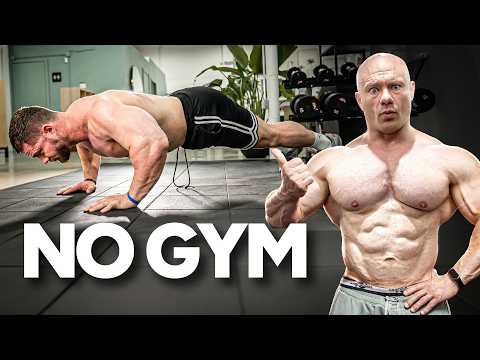
Link: https://youtu.be/HjWZ-kKJXgc
Duration: 23 min
Short Summary
Dr. Mike demonstrates a versatile upper body workout designed for home environments using minimal equipment. The routine strategically sequences exercises to fatigue the back and chest first while preserving the shoulders and arms for later movements. Professional athlete Jared Feather validates the effectiveness of this high-intensity approach for both vacations and daily training.
Key Quotes
- "We are going to show you a workout that is rapid fire that nukes your entire upper body and you can do with either just one power rack, one Smith machine, and you can even do it at home with basically no equipment except a few little trinkets." (00:00:04)
- "If the shoulders and arms get fatigued first, the back and chest kind of like aren't hit very well. But if the back and chest are fatigued first, you're still leave a lot of room in the tank to stimulate your shoulders and arm." (00:01:08)
- "Your chest is already cooked cuz remember we did a whole bunch of that before. And here we are trying to touch the chin or we are trying to go just underneath the chin to touch the need of the neck, keeping the elbows in." (00:08:40)
- "Ideally you want to shoot for 10 to 20 repetitions per set to get that really good mix of an awesome cardio workout and enough volume to make the muscles grow." (00:13:41)
- "This training split, this system basically trains your whole upper body roughly evenly. Lots of work for the chest, lots for the back, plenty for the shoulders, and a ton for the biceps and triceps." (00:16:27)
Detailed Summary
Episode Summary: Upper Body Home Workout
Workout Overview and Equipment
- The session features a versatile routine demonstrated with a power rack but adaptable for Smith machines or home setups using a broom handle and two chairs.
- Dr. Mike recommends an adjustable pull-up bar costing approximately 20 dollars that cinches to door frame sides over top-cinching models.
Exercise Sequencing and Mechanics
- The warm-up sequence for sternum pull-ups progresses from shrug ups to half pull-ups, concluding with full range pull-ups for 3 to 5 reps.
- Rest intervals between warm-up sets are optimized between 10 to 30 seconds to prepare the body for subsequent intensity.
- The workout structure intentionally fatigues the back and chest muscles first, ensuring shoulders and arms remain fresh for later exercises.
- After a 5-second break following wide grip push-ups, the routine transitions to chin height pull-ups aiming for mechanical failure.
- Underhand pull-ups are introduced as the easiest variant, focusing heavily on rear delts and biceps.
- Inverted rows are performed with the bar at waist height, targeting the midback and rear delts with a goal of at least 10 repetitions.
- For strong individuals, inverted skull crushers are executed with the bar lowered to knee height to target triceps and front delts.
Scaling and Progression Strategies
- Individuals unable to perform sternum pull-ups can scale by performing additional sets of chin-ups or utilizing an adjustable doorway bar to lower the bar height.
- Beginners can scale push-ups by using chairs, couches, or benches as implements to create a lever and avoid full ground contact.
- The recommended rep range per set is 10 to 20 repetitions to achieve a mix of cardio workout and muscle growth volume.
- If rep counts fall below five per set, rest time between sets should increase by an extra 30 seconds to allow for better wind recovery.
- Progression is achieved by tracking and adding repetitions over time, starting with an average of 10 reps per set and incrementally increasing to 11 or 12 reps.
- Participants can expand the workout from one set to two, three, or eventually four to five sets with rest periods ranging from 5 to 30 seconds.
Weekly Training Split
- One day a week includes two to three sets of wide grip push-ups, sternum pull-ups, regular push-ups, and chin-ups to focus on chest and back.
- Later in the week, the workout repeats with increased sets of two, three, or four for inverted rows, skull crushers, diamond push-ups, underhand pull-ups, and face pulls to emphasize arms and shoulders.
- Face pulls should feature one or two sets earlier in the week, increasing to three, four, or five sets later in the week for more shoulder work.
Technique and Outcomes
- Users should prioritize technique, eccentric control, big stretches, and full range of motion to minimize injury risk.
- The last sets are described as brutal, causing users to gasp for air due to high metabolite buildup.
- Short rest breaks of 5 seconds or 30 seconds condense workout time while increasing cardiovascular fitness, muscle growth, strength, and mobility.
- The training split trains the upper body evenly across chest, back, shoulders, biceps, and triceps, allowing bias towards specific muscle groups by adjusting set counts throughout the week.