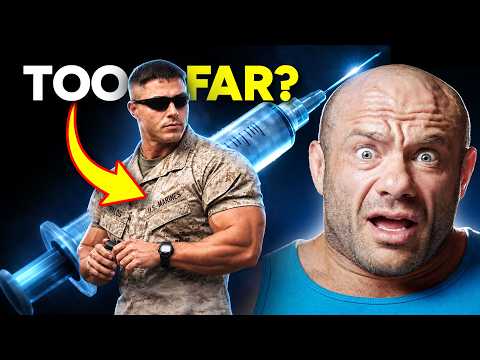
[@RenaissancePeriodization] The Military’s Steroid Soldier Plan: Smart or Insane?
![[@RenaissancePeriodization] Summarizer](https://summaries.pages.dev/img/logo.webp)
Link: https://youtu.be/_PGJPasgNCU
Duration: 21 min
Transcript: Download plain text
Short Summary
This RP Strength episode features Dr. Mike Israetel discussing a Department of War testosterone screening initiative announced by Secretary of War Pete Hegseth, with service members aged 30+ tested annually and younger members able to volunteer. The segment includes cited commentary from CBS News/KFF Health News medical correspondent Dr. Celine Gounder and NYU Langone endocrinologist Dr. Marcus Gunclavis, who push back on the program's claimed benefits, while Dr. Mike argues TRT for hypogonadal warfighters produces meaningful performance gains and has been unfairly dismissed by the medical establishment.
Key Quotes
- "I'm sorry, there are bullets flying at you. Do you want to be normal or do you want to be optimal? That's crazy. We need optimized soldiers because every life counts. Every decision counts. Every stray bullet counts. And every ability to be slightly more better at your job absolutely counts. Do you know why? Cuz it's important how our fighters fight. Better fighters mean more people come home alive." (00:00:00)
- "testosterone in the normal range is not a performance drug. For a man whose level is genuinely low, replacement can help libido and mood a little. It has not been shown to sharpen thinking, fix fatigue, or make a healthy 30-year-old a better soldier." (00:07:46)
- "regular fuel in a car is not performance fuel, but if you're low on fuel, what your car is able to do is substantially hampered." (00:08:50)
- "For most men over 30, we don't have evidence that finding and treating a low testosterone number makes them healthier, stronger, or more capable. We do have evidence that it carries risk. Launching a mass screening program anyway isn't following the science." (00:15:33)
- "Do you know why? Cuz it's important how our fighters fight for two reasons. One, we want to be winning wars instead of losing them or protracting them for longer. And two, better fighters mean more people come home alive." (00:20:38)
Detailed Summary
Episode Overview
This RP Strength segment, hosted by Dr. Mike Israetel, examines a new Department of War testosterone screening initiative announced by Secretary of War Pete Hegseth. The discussion weaves in pushback from two medical experts and a defense of TRT from Dr. Mike.
The Hegseth Announcement
- Secretary of War Pete Hegseth announced a screening program for testosterone deficiency in service members.
- Service members aged 30 and older will be tested annually as part of their periodic health assessment.
- Service members under 30 may voluntarily opt in to testing.
- If treatment is recommended, choosing testosterone replacement therapy remains entirely the service member's decision.
- Hegseth framed the initiative as restoring and optimizing natural capabilities, protecting longevity, and ensuring the biological foundation to sustain the fight — explicitly not artificial enhancement.
Expert Skeptics
- Dr. Celine Gounder, CBS News medical correspondent and editor-at-large for public health at KFF Health News, stated that testosterone in the normal range is not a performance drug and that TRT for genuinely low levels helps libido and mood only a little.
- Gounder argued: "For most men over 30, we don't have evidence that finding and treating a low testosterone number makes them healthier, stronger, or more capable. We do have evidence that it carries risk. Launching a mass screening program anyway isn't following the science."
- She noted that U.S. TRT prescriptions have more than tripled, with many cases involving men who were never properly diagnosed.
- Dr. Marcus Gunclavis, director of the Homan Division of Endocrinology, Diabetes, and Metabolism at NYU Langone Health, warned that TRT increases red blood cell production and, if levels rise too high, can cause elevated risk of blood clots, pulmonary embolisms, and kidney injuries.
- Gunclavis added that a man's position on the testosterone scale has no link to how masculine he is, feels, or looks.
Dr. Mike's Defense of TRT
- The host cited the normal testosterone range as roughly 300–900 ng/dL, with hypogonadism (true low testicular production) defined as below 300 ng/dL.
- He gave a concrete patient example of raising levels from 150 ng/dL into the 700s to improve recovery.
- Dr. Mike argued that bringing someone from an abnormally low level into the normal range is effectively a performance intervention, because low-range performance is on average substantially worse.
- He pushed back on Gounder's skepticism, contending that taking hypogonadal individuals into the high-normal range produces marginal improvements in focus, determination, physicality, aggression, and recovery under stress — benefits being ignored in mainstream coverage.
- He characterized the listed adverse effects (slightly elevated red blood cells, pulmonary embolisms, kidney injuries) as "unbelievably rare" but real, arguing benefits should still be weighed against them.
Logistical and Operational Concerns
- Dr. Mike raised practical issues for deploying combat units: TRT injections are typically needed at least once a week, more commonly twice a week.
- A 2-week resupply gap could cause a cold-turkey cycle-off, producing declines in decision-making, sleep, cognitive and physical performance, recovery, motivation, and morale.
- He endorsed letting all service members volunteer for testing, noting low testosterone can occur under 30 as well.
Historical Framing and Closing
- Dr. Mike cited a 1970s–80s analogy, claiming doctors then told athletes there was no evidence anabolic steroids improved muscularity or performance — a position that eroded public trust in medicine.
- He argued the human body did not evolve for integration into the U.S. military, contending that optimization could produce better warfighters and contrasting this with operational soldiers like DJ Shipley.
- Dr. Mike reframed dosing as a statistical question: beyond individual anecdotes, what matters is what happens "if you give a million people TRT," with blood work allowing dose adjustment.
- He signed off with "War fighters, thanks for keeping us free," framing the segment as a rebuttal to media narratives skeptical of widespread TRT use.