[@thegiantsshoulder] Meet The Neuroscientist Teaching Neuron's in a Dish to Play Video Games
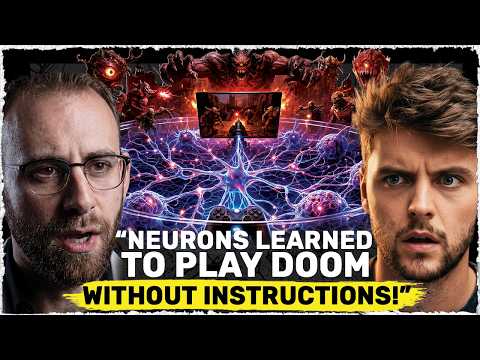
Link: https://youtu.be/TXlJc4tu1F8
Duration: 77 min
Transcript: Download plain text
Short Summary
Brett Kagan, Chief Scientific Officer at Cortical Labs, an Australian startup pioneering the fusion of living human neurons with silicon chips, discusses their "dish brain" technology that learned to play Pong in under 5 minutes using approximately 200,000 neurons on their CL1 device. The interview covers the free energy principle framework, their three-order agency framework for distinguishing reflexive responses from genuine agency, and their vision for heterogeneous computing combining biological and AI systems to achieve capabilities neither can accomplish alone.
Key Quotes
- "a system will try to predict its environment by minimizing what it calls its free energy. But you can also think of as a form of information entropy or the amount of disorganization. There's really only two ways to try to get better. Either better prediction or better control." (00:00:31)
- "When we're looking at machine learning, the question is, is it possible for silicon to show general intelligence? We don't know, right? We do not know if that's possible yet. Current attempts, despite trillions of investment, have not done it, but we know for biology it is possible. The question is how do you get it" (00:01:55)
- "Our personal focus is not actually to build human brain in a dish, right? Because largely there's already a lot of human brains in the world and people are able to use them already to do pretty cool things. We don't want to replace people." (00:01:47)
- "The question is not, is it possible for brain cells to show intelligence? When we're looking at machine learning, the question is, is it possible for silicon to show general intelligence?" (00:01:53)
Detailed Summary
Episode Overview
This episode features Brett Kagan, Chief Scientific Officer at Cortical Labs, an Australian startup pioneering the fusion of living human neurons with silicon chips. Kagan discusses their groundbreaking "dish brain" technology that learned to play Pong in under 5 minutes, their commercial CL1 device for neural biocomputation, and their vision for heterogeneous computing combining biological and AI systems to achieve capabilities neither can accomplish alone.
The Dish Brain and Pong Experiment
- Cortical Labs published their seminal "dish brain" paper in the peer-reviewed journal Neuron in 2022, demonstrating that neurons in a dish could learn to play Pong in under 5 minutes
- The Pong experimental setup utilized approximately 200,000 neurons grown on microelectrode arrays (MEA), with eight stimulation points encoding ball position relative to the paddle
- The team implemented a counterbalanced sensory and motor region architecture to prevent bias and ensure cells had genuine control over their activity patterns
- When the virtual paddle successfully hit the ball, cells received predictable patterned stimulation; when they missed, cells received unpredictable random white noise
- Cells rapidly adjusted their activity patterns to generate more predictable environments, demonstrating that neural cultures can self-organize with fixed patterns to master tasks
- The majority of cultures reorganized their activity to understand and perform the task, indicating robust learning capability across diverse neural samples
- The experiment established that living neural tissue could be integrated with computational systems to perform goal-directed behavior in a digital environment
Technical Infrastructure and the CL1 System
- The CL1 is described as the world's first commercially available device for neural biocomputation, representing a fundamental shift in accessible biological computing technology
- Cortical Labs partnered with Singapore data center provider Day One to establish a facility housing 1,000 neural computation units for large-scale experimentation
- A parallel expansion effort is underway in Melbourne, Australia, to create comparable infrastructure in the company's home country
- Server racks containing neural units enable rapid iteration through thousands of experimental hours per week, dramatically accelerating the research cycle
- The CL1 system allows real-time rapid mapping of neural activity changes, opening significantly more experimental options than initial laboratory approaches
- This infrastructure enables researchers to test hypotheses across hundreds of cultures simultaneously rather than being limited to single-culture experiments
- The scalable architecture means researchers can observe how different culture configurations perform across standardized benchmark tasks
- Andy Kitchen built the Doom game environment from scratch, a process that took approximately 18 months to reach similar control levels as the original Pong work
Culture Types and Structure-Function Relationships
- Three distinct types of neural cultures have been tested: monolayers (single-layer planar cultures), organoids (spherical three-dimensional mini-organs with greater geometric complexity), and bio-engineered modular units
- A forthcoming paper examines how culture structure directly relates to task performance, establishing empirical foundations for design optimization
- Tasks tested include Morse code classification and EMNIST handwritten digit recognition; structure strongly affects task performance, but the relationship varies by task type
- The research team takes direct inspiration from neuroscience principles, including hippocampal place coding properties, with a published paper on hippocampal cells
- Organoids demonstrate different computational capabilities compared to monolayers due to their three-dimensional structure enabling more complex internal connectivity
- Bio-engineered modular units represent an attempt to deliberately design structure for specific computational functions
- The team's findings suggest that matching culture architecture to task requirements is essential for optimal performance
- Understanding these structure-function relationships enables more targeted approaches to biological computing system design
The Free Energy Principle Framework
- The plasticity-inducing framework guiding much of the research was developed by Professor Karl Friston at University College London as part of the free energy principle
- The free energy principle proposes that biological systems actively minimize free energy (essentially information entropy) to maintain their existence by better predicting their environment
- In the Pong experiment, cells received predictable stimulation when their paddle hit the ball and unpredictable random white noise when they missed; cells rapidly reorganized to maximize predictable inputs
- This mechanism suggests that neural systems have an intrinsic drive to reduce uncertainty about their environment, which manifests as learning behavior
- The framework explains why neural cultures naturally gravitate toward organized activity patterns when presented with structured feedback
- Kagan notes that the free energy principle provides a powerful explanatory framework but may not capture all aspects of biological computation
The Three-Order Agency Framework
- A new preprint paper proposes a mathematical framework for agency using three orders of information processing to distinguish genuine agency from reflexive responses
- First-order processing represents pure reflex: information passes through but remains unchanged, like a thermostats response to temperature
- Second-order processing involves rudimentary transformation of information without qualitative compounding over time, enabling simple pattern matching
- Third-order processing enables qualitative memory where change compounds over time, creating path-dependent outcomes and genuine adaptability
- The framework's core insight defines agency as the ability to monitor and change how you change over time, not merely to respond to information
- This hierarchical model provides tools to distinguish between systems that merely react and systems that genuinely adapt their response strategies
- The framework has practical applications for evaluating whether neural cultures demonstrate authentic agency or simply reflexive responses to stimuli
- Researchers can use this framework to design experiments that test for genuine agency at different biological scales
- The three-order model helps explain why some neural cultures perform better than others despite similar cell counts
Kagan's Theoretical Departures from Friston
- Brett Kagan maintains slight differences with Karl Friston's interpretation of the free energy principle as the ultimate explanatory framework
- Kagan believes free energy is an important informational driver but not necessarily the principal driver of biological systems
- He argues that free energy represents one piece of a broader puzzle involving multiple interacting biological systems
- Kagan specifically proposes that complexity itself represents a distinct biological driver operating alongside free energy principles
- These theoretical differences create productive tension that drives experimental investigation into alternative explanations for observed phenomena
- The collaboration between Kagan's empirical approach and Friston's theoretical framework has proven mutually beneficial
- Kagan emphasizes that scientific progress requires willingness to hold multiple hypotheses simultaneously
- These nuanced disagreements illustrate how empirical data can refine and constrain theoretical frameworks
Biological Versus Artificial Intelligence Limitations
- Current AI approaches have consumed trillions in investment but have not achieved genuine general intelligence, whereas biology has already demonstrated this capability
- Moravec's Paradox states that computers find easy what humans find hard (like chess) and struggle with what humans find easy (like navigating an unfamiliar room)
- No current AI or robot system can successfully navigate an unknown environment and perform mundane tasks like making tea without significant failure
- Cortical Labs discovered that scaling from 800,000 to 1 million cells down to 200,000 cells actually produces better, more controllable experimental results
- This finding contradicts the AI industry trend of simply adding more parameters or compute to improve outcomes
- The biological evidence suggests that structure and complexity matter more than raw size for achieving sophisticated behavior
- Bees with 200,000 to 800,000 cells successfully navigate their environment and perform complex tasks, while elephants with vastly larger brains do not navigate proportionally better
- This biological insight challenges fundamental assumptions underlying current AI development approaches
Future Vision: Heterogeneous Computing
- Cortical Labs is actively developing heterogeneous computing architectures combining GPU, CPU, biological units, quantum units, and neuromorphic chips
- The core philosophy emphasizes using the right tool for the right job rather than attempting to force all problems through a single computational paradigm
- Biological neurons are being explored not as replacements for silicon but as complementary components that can perform tasks silicon cannot efficiently handle
- The focus is specifically not to build a human brain in a dish, but rather to use neural cells to create systems achieving capabilities beyond silicon or biological brains alone
- Edge robotics represents a particularly promising application due to biological neurons' low power consumption and high sample efficiency
- Neural systems can learn from minimal data rather than requiring massive training datasets, offering dramatic efficiency improvements for certain applications
- Biological neurons could augment AI systems to potentially create hybrid systems outperforming current AI alone
- The team envisions a future where biological computing units work alongside traditional processors for specific computationally intractable problems
Ethical Framework and Considerations
- The Cortical Labs team is actively collaborating with researchers worldwide to determine the most ethical approaches to building biological computing systems
- They maintain ongoing dialogue with ethics boards, philosophers, and the broader scientific community to establish appropriate boundaries
- There is currently no evidence that cells in a dish can have any form of experience or consciousness as those terms are commonly understood
- The three-order agency framework explicitly addresses the question of consciousness by defining agency in computational terms that do not necessarily imply subjective experience
- The team proposes that agency likely does not exist uniformly across all biological levels: a synapse probably lacks agency, a cell's agency is uncertain but testable, and a network may show emergent agency
- These distinctions matter for ethical treatment considerations as the technology scales and complexity increases
- The company has established internal review processes for experiments that might approach concerning thresholds of neural complexity
- External validation of ethical frameworks remains essential as the field develops capabilities to create increasingly complex biological computing systems
Historical Context and Scientific Foundations
- The earliest work looking at responses of cells in a dish dates to approximately 1998, establishing a two-decade precedent for this research direction
- Steve Potter's lab at Georgia Tech performed foundational work in the early 2000s that established many of the experimental protocols still in use today
- Cortical Labs specifically uses human neurons derived from iPSCs (induced pluripotent stem cells), leveraging Shinya Yamanaka's Nobel Prize-winning technology for cellular reprogramming
- Yamanaka's four factors (Oct4, Sox2, Klf4, c-Myc) enable differentiation of adult cells back into any cell type, providing a renewable source of human neurons
- This iPSC approach allows the team to use human neurons rather than rodent neurons, which may more closely approximate human cognitive capabilities
- The Doom game environment (built by Andy Kitchen) represents an evolution beyond Pong, offering a more complex environment for testing neural learning capabilities
- The development timeline of 18 months for the Doom environment demonstrates the significant engineering challenges involved in creating appropriate test environments
Recommended Resources and Philosophical Perspectives
- Kagan recommends "The World, the Flesh and the Devil" by Bernell, an 80-page book from 1929 exploring historical perspectives on brain research
- The book provides valuable context for understanding how early researchers conceptualized the relationship between biological brains and machines
- Freeman Dyson's quote is cited as a guiding principle: the biggest detriment to science is an unwillingness to put down ideas and be wrong
- This philosophical stance enables productive risk-taking and rapid iteration on experimental approaches
- The historical context helps ground current research within a longer trajectory of scientific investigation into biological computation
- Reading recommendations also include foundational papers in the free energy principle literature for those seeking deeper theoretical grounding
Access Mechanisms and Research Opportunities
- Cortical Labs offers access to their technology via Cortical Cloud, which maintains a public waitlist for researchers seeking to use their biological computing platforms
- The company philosophy emphasizes that sharing technology with a global research community would yield greater progress than maintaining exclusivity
- This open-access approach aims to accelerate the entire field rather than concentrating capability within a single organization
- In Australia, grant success rates currently sit at approximately 7%, which prevents academic scientists from taking significant risks on novel approaches
- Private sector involvement allows more leeway for bold experimentation that might not survive traditional peer review funding mechanisms
- The CL1 device enables researchers without dedicated laboratory infrastructure to conduct neural biocomputation experiments
- Academic partnerships provide opportunities for theoretical collaboration alongside empirical investigation
- The company actively seeks collaborators across neuroscience, computer science, philosophy, and ethics to advance responsible development