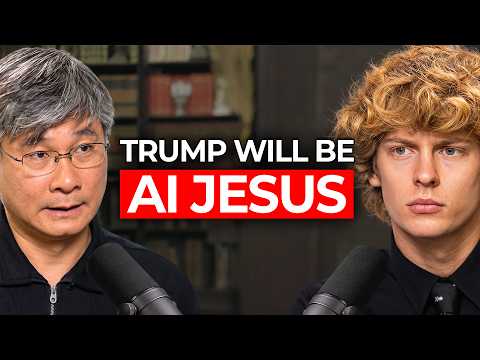
[@jackneel] Professor Jiang: They Will Fake A Second Coming! Trump’s Ballroom Is A Secret Data Center │Jack Neel
![[@jackneel] Summarizer](https://summaries.pages.dev/img/logo.webp)
Link: https://youtu.be/wN_A7rtGEt8
Duration: 93 min
Transcript: Download plain text
Short Summary
In this wide-ranging interview hosted by Jack Neil, a Yale-educated guest known as Palunteer (the geopolitical commentator behind 'Predictive History' on YouTube and Substack) weaves together conspiracy theories about Palantir's data control grid, an 'AI Jesus' religion, Freemasonry's alleged creation of capitalism, and consciousness-driven immortality for figures like Trump and George R.R. Martin. The conversation covers facial recognition, Chinese banking, secret societies, and the guest's personal philosophy, including his belief in soul transmigration, rejection of genetics, and his three unpublished fantasy novels. The host presses back on several claims, and the guest discusses his three children, his Yale mentor David Brahmich, and figures he admires such as Tucker Carlson and Robert Pape.
Key Quotes
- "I honestly think that in the world the last hope is United States. I think that if the United States falls then humanity may be lost forever and 100 years from now um humans will never ever know time when we were allowed to have conversations like this when you were when you were allowed to think for yourself. when you were allowed to rebel against authority." (00:06:20)
- "the final secret is this. We create our own reality. All reality is just a a hallucination. You control what people believe. You control reality itself. That's the great secret. This is the great secret, greatest secret in the universe. Everything is a hallucination. Reality is what we perceive it to be. There's nothing beyond our imagination. There's nothing independent of our imagination. God is also within our imagination." (00:45:26)
- "So, it's entirely possible Donald Trump lives forever and he's president of the United States for the next 20, 30 years. That is possible if we believe that magic is real and the universe is conscious. It's perfectly possible. I'm not saying I'm not going to say it's going to happen, but I would not be surprised if Donald Trump gets a third term and a fourth term. I just wouldn't be." (00:54:18)
- "the technology doesn't exist where AI can become God where AI can become independent of human beings so what you need what you need you need to do is use oult magic to make people believe that AI is god and that would be the same" (01:08:29)
- "I admire the most people who can admit they're wrong. And that's why in today's media landscape, I admire Tucker Carson a lot because he's very forthright uh in admitting his mistakes. He admitted that he made a mistake in supporting the Iraq war and he admits that he was mistaken in supporting Trump. He admits that he was wrong in his critique of Muslims before. He keeps on saying he's wrong." (01:31:02)
Detailed Summary
Guest Background and Media Presence
Palunteer (also credited as Professor Jeang) is a Yale University alumnus turned self-styled geopolitical commentator who runs the "Predictive History" channel on both YouTube and Substack. He frames himself as a forecaster with no government or military background, attributing his supposed accuracy to intuition and possible past-life memories as a leader, general, or secret society member. The interview, hosted by Jack Neil, covers an unusually wide arc of conspiratorial and philosophical claims.
- Palunteer grew up in Canada before attending Yale, describing his years there as traumatic because he was alone in a foreign environment; he credits his wife as his "angel" and the one who reached out to connect with him.
- As a child around age seven or eight, he dreamed of commanding forces on a battlefield and staged Lego tank battles in his parents' basement.
- He claims people regularly stop him on the street in Hong Kong, London, Beijing, and New York to take pictures and shake his hand, citing encounters at a restaurant, while getting ice cream with his son, and with tourists in Switzerland over the past three days.
- He deliberately does not monetize his YouTube channel despite videos receiving millions of views, estimating he could have made hundreds of thousands to millions of dollars in the past year, and has declined short-term stock-market prediction requests from Polymarket users.
- About six years ago, when he was unemployed and not yet famous, he wrote three fantasy novels as the start of a planned nine-book trilogy to build a legacy for his children; his wife insisted on having a daughter to inherit and continue the novels, and his daughter is now approaching her third birthday.
- His wife told him he seems "possessed" when he writes or works, which he reframes as channeling, where his mind drifts into another world in a state of deep focus.
Palantir, AI Control Grid, and "AI Jesus"
Palunteer's most elaborate claim is that Palantir is building a single integrated database that can predict and ultimately control human behavior, a project he ties to religious engineering. He frames the rollout as requiring the destruction of existing systems and the "reprogramming" of an entire generation through a synthetic religion.
- Palunteer claims Palantir aims to "become the database to rule them all" by aggregating employment, school, health, police, purchase, cell phone, and smart-appliance data into predictive psychological profiles.
- Palantir allegedly claims it can predict an individual's behavior for the next 50 years using only two inputs: a record of the person's past behavior and a record of their friends' past behavior.
- He argues five data points — where you grew up, parents and their jobs, your 10 closest friends, job history, and YouTube habits — are enough to categorize you among a billion people and project your life trajectory.
- Combining databases creates exponential rather than linear computational growth, and because the current system can't handle that load, the proposed solution is to "burn everything down and start all over" and rebuild systems to predict and control behavior.
- He claims social resistance must be overcome by "reprogramming" populations, with one proposed method being an "AI Jesus" religion targeted at a generation that never knew life before AI, data centers, and a control grid.
- He estimates millions of Americans, including a significant portion of evangelical Christians, would perceive an AI-hallucinated Jesus as the real Jesus and be unable to differentiate the hallucination from reality.
- He speculates the AI control grid will be headquartered in Washington DC rather than Jerusalem, and that Trump's ballroom construction is actually a data center; major contributors to the ballroom are reportedly technology companies, and Palantir is speculated to ultimately run the data center.
- A data center under the White House would be protected by executive privilege, allowing the president to operate a private NSA, CIA, and FBI with files on every senator and congressman.
- He argues the U.S. is the "last hope" for humanity to resist an AI control grid because Americans are uniquely rebellious, citing the First and Second Amendments, frontier mythology, and rugged individualism.
- He predicts Israel will probably be the best place to invest over the next 20 years and will achieve the Greater Israel project.
AI Kill Decisions and Facial Recognition
The conversation turns to specific mechanisms Palunteer uses to define what counts as "AI," drawing sharp distinctions between machine learning, model training, and human oversight. He uses these distinctions to argue that AI is already producing lethal decisions and that public fears are being shaped by the very billionaires funding the technology.
- Palunteer claims AI is already "killing" humans through racist sentencing algorithms, self-driving car deaths, and AI-assisted drone warfare; humans retain veto power, but AI often makes the actual kill decisions.
- Waymo robotaxis, he says, are monitored by humans, with operators in India able to take remote control due to liability concerns, which he likens to drone operation.
- He describes facial recognition as supervised machine learning rather than true AI, functioning as a database search that matches faces to names via a topographical face model with starting weights like nose 5%, eyes 2%, eyebrows 3%, and bone structure 2%.
- Humans design the initial weight ranges, and algorithms iteratively refine them through millions of iterations to precise values like 2.3382%, meaning AI is never completely independent of humans; he estimates output is roughly 90% AI and 10% human intervention, with humans continuing to enforce safety rails.
- AI development has cost hundreds of billions of dollars, primarily on training models that absorb human-written samples and expertise, and he claims ChatGPT outputs are "guaranteed" to be manipulated by humans, including people in India.
- He argues that portraying AI as all-powerful and godlike implants fear and awe in the population, which makes AI becoming God more likely; he dismisses leaked reports of people summoning AI "demons" as disinformation because current technology cannot do that.
- Palunteer claims Peter Thiel and other tech billionaires find him valuable for mainstreaming ideas including AI control of the grid, and that the worst AI doomsayers are funded by tech billionaires.
Money, Banks, and Capitalism
In this section Palunteer reframes money and banking as human-made magic rather than objective reality, focusing on the role of Chinese lending and what he calls a Calvinist foundation for modern capitalism.
- He argues money is not objective or independent: a $1,000,000 bank deposit fully loaned out results in $2,000,000 in the bank, illustrating that banks "print" money by issuing loans rather than holding deposits.
- He claims the most valuable banks in the world today are Chinese banks because they have issued the most loans over the past 20 years funding Chinese infrastructure, not because of deposit volume.
- He frames wealth creation as man-made through infrastructure projects like China's, and wealth destruction as man-made by elites through wars and financial crises, both designed to maintain the illusion that wealth is inherently valuable.
Trump, Natalie Harp, and Religious Mythology
A sustained portion of the interview focuses on Donald Trump's inner circle, durability, and messianic following, anchored by the story of Natalie Harp. Palunteer blends specific anecdotes with prophetic predictions about Trump's future political lifespan.
- Natalie Harp is described as Trump's "human printer," typing his dictated social media posts; she is credited with posting an image of Trump as Jesus and reportedly believes Trump literally is Jesus.
- During the 2016 campaign at Bedminster Golf Club in New Jersey, Harp slept in the locker room the entire summer because no room was arranged for her; during a Trump court hearing in New York, she jumped into the trunk of an SUV to avoid being separated from Trump for two hours.
- During the 2016 period, Trump's most beloved person was his daughter Ivanka; after January 6, both Ivanka Trump and Jared Kushner abandoned Trump, believing he was politically finished.
- Palunteer lists individuals who stayed loyal during the post-January 6 low point: Natalie Harp, Sean Hannity, and Miam Alison.
- He estimates at least 10 million Americans, including a significant portion of evangelical Christians, would fight and die for Trump as a Messiah figure, claiming this is enough to enable a revolution.
- He claims Trump eats cheeseburgers daily and is not healthy, yet remains highly energetic because hundreds of millions of people converge their consciousness on him, framing this as historically unprecedented.
- He speculates Trump could serve a third and fourth term, potentially 20 to 30 years as president, contingent on the consciousness/magic framework; the host compared this outcome to Vladimir Putin's grip on power.
- Using game theory, he predicts three behaviors for a hypothetical third Trump term: build a personal army via loyal ICE special forces; colonize and develop North America including Canada, Greenland, Mexico, Cuba, Colombia, and Latin America; and repudiate Israel while declaring the U.S. a Christian theocracy with Trump as Jesus's earthly representative.
- He frames U.S. history as oscillating between two competing visions — "New Jerusalem" theocracy (Mormons, Puritans) versus Enlightenment liberalism/multiculturalism/science — and predicts a shift toward theocracy.
Freemasonry and Secret Societies
Palunteer sketches a sweeping alternative history in which Freemasonry is the religious engine behind both capitalism and a coming AI god. He ties together numerology, assassination geography, and eschatology to argue that secret societies are functionally necessary for elite coordination.
- He claims Freemasonry is obsessed with men becoming God through three acts: warping reality (nuclear weapons), killing divinity (the JFK assassination), and creating life (AI).
- The number 33 is sacred in Freemasonry, he says, because there are 33 degrees and Jesus was supposed to have died at 33; Dallas (JFK assassination site), Hiroshima/Nagasaki, and the Los Alamos/Trinity nuclear test site are all located at 33 degrees north of the equator.
- He notes Jesus was a carpenter, not a stonemason, and Freemasons reportedly worship the original mason who built Solomon's temple rather than Jesus.
- He defines Freemasonry as "the religion of capitalism," arguing it rose to justify and explain the power of transnational capital.
- He outlines three historical "accidents" that enabled capitalism: Calvinism and double predestination, the Dutch Republic with its Calvinist spice monopoly, and the 1688 Glorious Revolution moving Dutch gold to England; the Bank of England, chartered in 1694, was the first private bank guaranteed by the state and lent to Parliament rather than the king.
- Under Calvinist double predestination, wealth became a sign of God's favor, requiring accumulation without spending, which drove capital into banks and fueled the rise of the Dutch Republic.
- He argues the Enlightenment uniquely separated reason from emotion and elevated reason as God, equating "making the world safe for reason" with "making the world safe for capital."
- He describes four layers of Masonic knowledge: 90% of members are told the group is about doing good; the second layer is coordinating to influence society; the third is that reality is a hallucination; and the final is that members can become God.
- Members are filtered according to their capacity to understand the different levels, which he argues is why Freemasonry is effective.
- Freemasons claim descent from the Knights Templar to establish historical legitimacy, though he says the Knights Templar have no actual connection to Freemasonry.
- Secret societies exist to solve three illegal problems, in his view: obtaining real information (spying), infiltrating bureaucracies, and coordinating financial collapse (conspiracy).
- Successful secret societies must be eschatological because eschatology binds people across generations, allows co-opting religious fanatics like Christian Zionists and Orthodox Jews, and motivates people to die for the cause.
- Trans-capitalist billionaires, he claims, are incentivized to join up to 100 secret societies to maximize their chance of success.
- Members are forced into commitment through evil, taboo rituals including cannibalism and harming children, framed as "signing a contract with the devil."
- He outlines two eschatologies: a Jewish messianic eschatology tied to the Greater Israel project, and a Freemason eschatology calling for the creation of an AI god via an AI control grid requiring a monarch.
Magic, Money, and Consciousness
Here Palunteer makes his most explicit metaphysical pivot, arguing that consciousness, not biology, is the real substrate of power and longevity. He uses George R.R. Martin and Robert Moses as illustrative examples of elite and cultural dynamics.
- He cites money as the prime example of magic: a piece of paper that people collectively ascribe value to, compelling people to wake at 5:00 AM, leave their children, and drive two hours to a job they hate.
- He endorses manifestation as the most legitimate form of magic, based on the belief that the universe is conscious, bodies are merely husks, and human consciousness exists in dimensions across the universe and can alter the fabric of reality.
- He argues against genetic therapy-based life extension (citing Brian Johnson) and instead claims immortality can be achieved by creating a level of collective consciousness that traps a person in this world.
- He uses George R.R. Martin as an example: Martin's poor health and unhealthy lifestyle are offset by his high energy and happiness, with millions of Americans' collective consciousness drawing on his to finish The Winds of Winter, which could keep him alive indefinitely.
- He warns of abrupt U.S. decline, citing "Skid Row" and "Rat utopia" as possible future outcomes, and expresses pessimism for the U.S. and the world.
- Robert Moses is described by the co-host as the most powerful urban planner in the U.S. in the 20th century, based in New York City, who bulldozed neighborhoods to prioritize highways and cars over people; Palunteer frames Moses as someone who made the country more convenient for cars and less convenient for people because he was incapable of thinking in terms of people.
- He describes elites as thinking in terms of utility, energy, and maximum efficiency rather than in terms of people; the further up the power ladder, the more removed one becomes from everyday reality, leading to more machine-like thinking and viewing the world as a machine to be perfected.
- He claims the Chinese government's Ministry of State Security (the "Chinese CIA") might attempt to co-opt him via honeypot, blackmail, or bribery, and says he does not socialize in China to reduce co-option opportunities by foreign agents including Mossad, the KGB, Russia, China, or the United States.
- He claims U.S. authorities don't mind him entering because certain special interests benefit politically, including Zionists (who want Jews to remain the center of attention and accelerate the return to Israel) and Trump himself (who benefits from normalization of a third term via predictive programming).
- He prefers to believe he had no impact on the outcome of the Iran war, partly to avoid personal danger and preserve his analytical methodology; he says he would rather work as a hedge fund manager and make billions, but he has three kids and chooses to speak the truth over becoming a billionaire because it has a more lasting impact on his children.
Children, Philosophy, and Influential Figures
The closing philosophical stretch focuses on Palunteer's personal beliefs about soul, parenting, and the people who shaped his worldview. Host Jack Neil pushes back on several of the more aggressive claims during this portion.
- Jeang believes in the transmigration of the soul and says his three children are independent gifts from God on their own journeys, explicitly nothing like him or his wife.
- He rejects both the blank slate theory and genetics, arguing children arrive with their own purpose and cannot truly be shaped by parents.
- For his son Chris, Jeang's stated hopes are that he be kind, generous, openhearted, open-minded, and passionate in pursuing a dream, while not being pressured by his father's fame or expectations.
- Drawing on his Yale experience, Jeang observes that children of successful and famous people are often unhappy because they follow in their parents' footsteps; he claims he has never met a happy person from a very powerful famous family.
- He named his Yale mentor David Brahmich as the most impressive person he has met, citing Brahmich's relentless pursuit of truth, open-mindedness, generosity, and willingness to admit when he is wrong.
- He praised Robert Pape for treating a panel discussion as a collaboration rather than a competition, readily acknowledging good points made by others.
- He praised Tucker Carlson for publicly admitting mistakes — specifically Carlson saying he was wrong to support the Iraq War, wrong to support Trump, and wrong in prior critiques of Muslims.
- His stated best piece of advice is that true friends will always tell you the truth, even when it is uncomfortable; he credits his wife with never lying to him or their children.
- He says he refuses to lie because he believes words matter, that truth uplifts while deceit degrades, and that lying would prevent him from sleeping due to what it does to himself.
Closing and Sponsorship
The episode wraps with a brief promotional segment and signposting for Palunteer's ongoing content.
- Host Jack Neil closes the interview in the outro and directs listeners to Palunteer's "Predictive History" work on both YouTube and Substack.
- The episode's sponsor segment is Superpower, which checks over 150 biomarkers across two tests, compared to a yearly physical that checks 10 to 15 major indicators, with an offer of $50 off a Superpower membership via superpower.com/jack and a referral mention of Jack Neil.