Link: https://youtu.be/N5AQFYtqx8Q
Duration: 128 min
Transcript: Download plain text
Short Summary
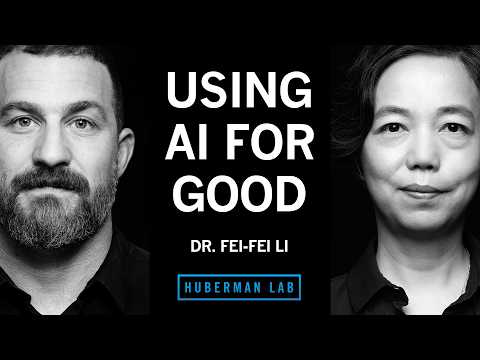
Dr. Fei-Fei Li, the Stanford computer scientist widely known as the "godmother of AI" and co-founder of World Labs, joins host Andrew Huberman for a wide-ranging interview on human-centered AI. The conversation covers the arc from vision-inspired neural networks through ImageNet and transformers to spatial intelligence and embodied robotics, alongside critiques of polarized AI discourse. Dr. Li advocates for collective guidance of the technology and for uplifting what she calls the "forgotten population" of teachers, parents, and students.</short><detailed>## Episode Overview
This Huberman Lab episode is an interview with Dr. Fei-Fei Li, the Stanford professor and AI researcher often called the "godmother of AI" and co-founder of World Labs. The wide-ranging conversation traces AI's intellectual arc, explores the philosophy of human-centered AI design, critiques current media discourse, and focuses heavily on the impact of AI on children and educators.
AI's Arc and the Rise of Generative Models
- Dr. Li recounts the trajectory from vision-inspired neural networks through ImageNet and the rise of transformers to today's generative video and world models, marking a fundamentally different phase of computing.
- She frames language models as just one chapter, with spatial and physical intelligence as the next frontier.
World Labs and Spatial Intelligence
- World Labs was co-founded at the beginning of 2024 by Dr. Li alongside multiple co-founders drawn from the Stanford community, and she describes it as her life's work.
- The company generates 3D and 4D worlds from text, pictures, or sketches, blending real-world capture with imagined environments for creators, robot training, architecture, healthcare, education, and industry.
- The team started heavily with PhDs and is now transitioning from model-focused work to building products in entertainment, design, and robotics.
- Dr. Li met with Ben Affleck to discuss AI tools for filmmaking, and World Labs is actively working with the VFX industry to empower rather than displace creators; short movies and nearly feature-length films have already been assembled using AI tools from both US and Asian companies.
Philosophy of Human-Centered AI
- Dr. Li argues humanity should collectively decide how the future of robotics is imagined, rather than letting companies or investors dictate a world of metal-style robots.
- She proposes positive use cases such as spongy, balloon-like healthcare robots with more contours and multitasking capability than rigid metal robots, including a child-guardian robot that can alert authorities or physically protect kids on the way to school.
- She also envisions an AI avatar that accompanies children online to spot predatory behavior beyond what parents can oversee.
- She credits Steve Jobs (whom she recalls walking shoeless around downtown Palo Alto with a hippie look) with humanizing computers through rounded edges, pocket-fit size, and cultural touches like Bob Dylan on the Apple landing page.
- Host Andrew Huberman argues technologists need a modern Steve Jobs-like collaborator to soften public perception of AI, and claims media framing of AI as "coming for us" is a financial-motive trick.
- Dr. Li criticizes current public discourse as unbalanced, split between extreme doomerism and extreme utopianism, and calls for middle-ground collective guidance of the technology.
- She worries AI rhetoric puts the public in a reactive position while multistakeholders are excluded from designing the future together.
- She notes traditional media operates on a 12 to 24-hour news cycle and does not care about the long arc of benevolent AI collaborations.
- Huberman points out that human-interest stories, such as AI helping cure a dog's cancer or diagnosing a child's mysterious symptoms, get far less attention than hype-driven narratives.
- Stanford has launched a Human-Centered AI Institute, and many entrepreneurs are building AI startups for drug discovery, healthcare, aging, and mental health.
AI, Children, and Education
- Dr. Li identifies as an educator and technologist and frames teachers, parents, and students as the most forgotten population by policymakers, technologists, and investors.
- She has children in the 7-to-20 age range and considers how kids feel about AI a critical issue, describing kids as curious, massively entertained by the technology, and already starting to use it.
- She argues Silicon Valley is not doing teachers and parents a service; they are being lectured at, berated, and looked down upon when they should be uplifted and resourced.
- K-12 and K-16 teachers are described as bearing the most important critical burden of society.
- When ChatGPT launched in November 2022, Dr. Li emailed the principal of her child's elementary school to offer a guest lecture for students and teachers, noting that no Silicon Valley investors or multi-billion/trillion-dollar companies thought first about neighborhood teachers and parents.
- Her recommendation is to show teachers what is actually happening with AI rather than just answering questions about cheating, because teachers are smart and eager to adapt.
- She frames moments of technological change as simultaneously moments of opportunity and loss, and characterizes creators as reskilling and upskilling to use AI tools.
Outlook
- Dr. Li identifies as an optimist in humanity, arguing that across the arc of human history, society has by and large advanced for the better despite atrocities and setbacks.
- Her stance is that technology should make jobs better and superpower creativity rather than take jobs away.
Host Notes
- Huberman promotes his first book, "Protocols: An Operating Manual for the Human Body," developed over more than five years and 30 years of research, available at protocolsbook.com.
- He also mentions the free monthly Huberman Lab neural network newsletter, which includes podcast summaries and 1-3 page protocol PDFs covering sleep, dopamine, deliberate cold exposure, cardiovascular training, and resistance training.</detailed><tags><item>ai</item><item>robotics</item><item>education</item><item>world labs</item><item>fei-fei li</item><item>spatial intelligence</item><item>human-centered ai</item><item>silicon valley</item><item>kids and ai</item><item>media discourse</item></tags><notable_section_indexes><item>0</item><item>1</item></notable_section_indexes>
![[@hubermanlab] Summarizer](https://summaries.pages.dev/img/logo.webp)